Atlas for the unknown
Jackson · August 19, 2026 · 9 min read
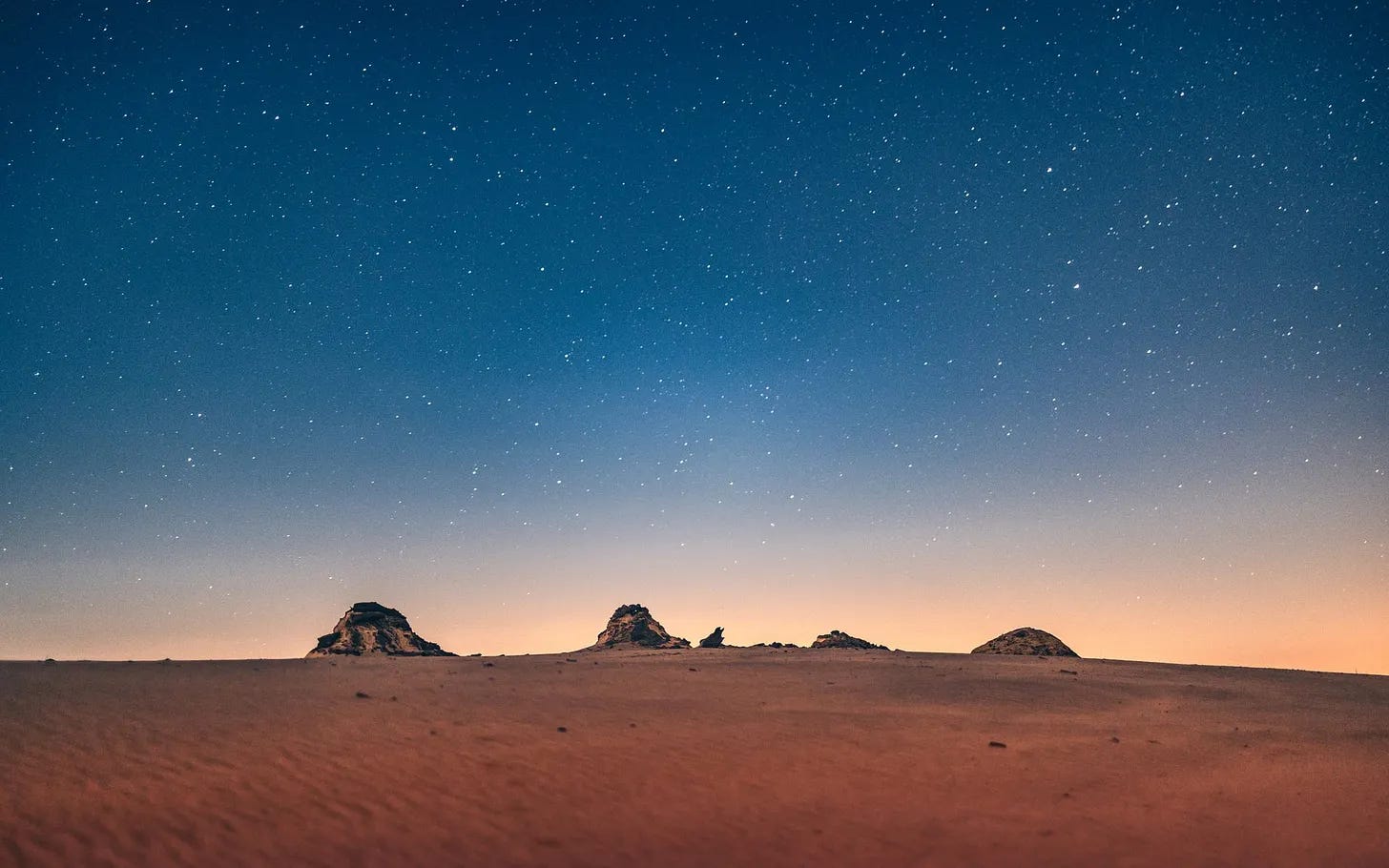
Every voyage encounters the same edge, the unknown.
For most of human history that edge was a physical place. It was the far side of the water, the country past the pass, the wild. Meeting that edge was part foolhardy, part heartful. A daily, full immersion. At its highest it was met with an attunement to self as an experiential, relational instrument, life itself the map.
Time and shared exploration grew that knowledge into artifacts and instruments that attempted an explanation of the lived map. The external got covered first — what river ran to what mountain or sea, and what lay on the other side of that. Gradually the shared experience painted in the edges, until a piece of paper could tell you how far away a land across the sea was and what it was like.
Those instruments and maps have come to the point of self-driving cars and satellites and so much more. Navigating physical space has never been easier or asked less of anyone. But while every square meter of the ocean floor has been contoured, the true relational exploration, the wild, is still irrevocably available. The map as it pertains to your unique experience of this amazing and precious Earth still has the edge, the unknown, the country across the sea, your own hand held up to your own stars in your own backyard.
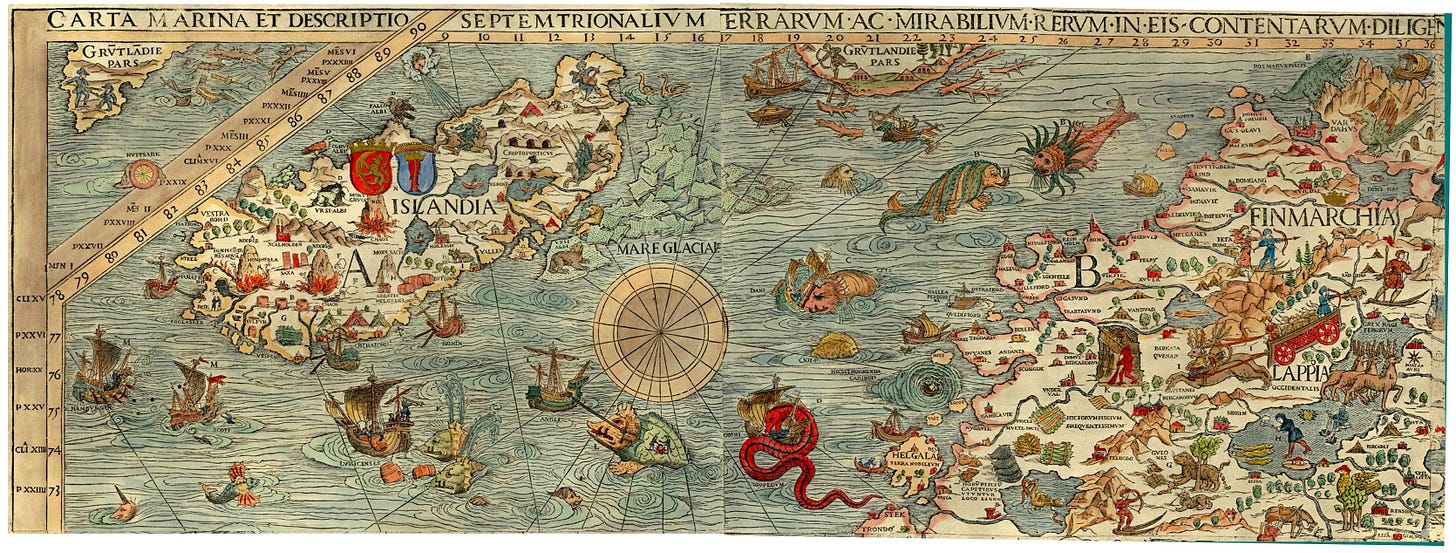
Olaus Magnus, Carta Marina, 1539. Where knowledge actually gave out, the honest ones left the space blank. Olaus Magnus, 1539 / Wikimedia Commons, public domain
Throughout the ages everyone has been on their own voyage, meeting their own wild, be it by crossing the mountain, moving to a new city, or meeting their own heart.
Everyone has their own unique experience. Ask someone where they should live and watch what happens. Ask why a city their closest friend adores makes them want to lie down on the floor of the airport. Ask why the same job was survivable in one town and not in another, or where they and their partner and their kid could all three actually thrive at once, there's nothing to hand them. No chart, no table, no sailing directions.
The key, I think, is relationality.
You are never not in relationship with the ground you're standing on. It acts on you, it asks specific things of you, it gives some people back to themselves and quietly takes something from others, and that relationship is as real as a current under a hull - and about as visible.
It's also not only about the ground. There are other people standing on it with you. Life is relational: to self, to place, to other people. Lose any one of those three and the triangle loses its integrity.
Like the wayfinders of old who navigated successfully by relating to the rhythms of how the earth and solar system relate to each other, we too as voyagers of the current age, with a technologically enriched toolkit at our disposal, must engage in a relational way with the world around us to navigate well.
The industrial era has disconnected us from our relationship to earth and self and replaced it with a relationship to productivity. The never-ending hunger for attention that productivity brings allowed that sense of the world being mapped to become sufficient reason to relax our relationship to place.
But productivity isn't the true nature of voyaging.
The personal atlas is about as unmapped now as the Atlantic was in 1400. And because there was never a map of it, we agreed that the pull one feels toward a place is a mood rather than reliable information. There is much to learn, much to explore, and it always resolves to personal experience.
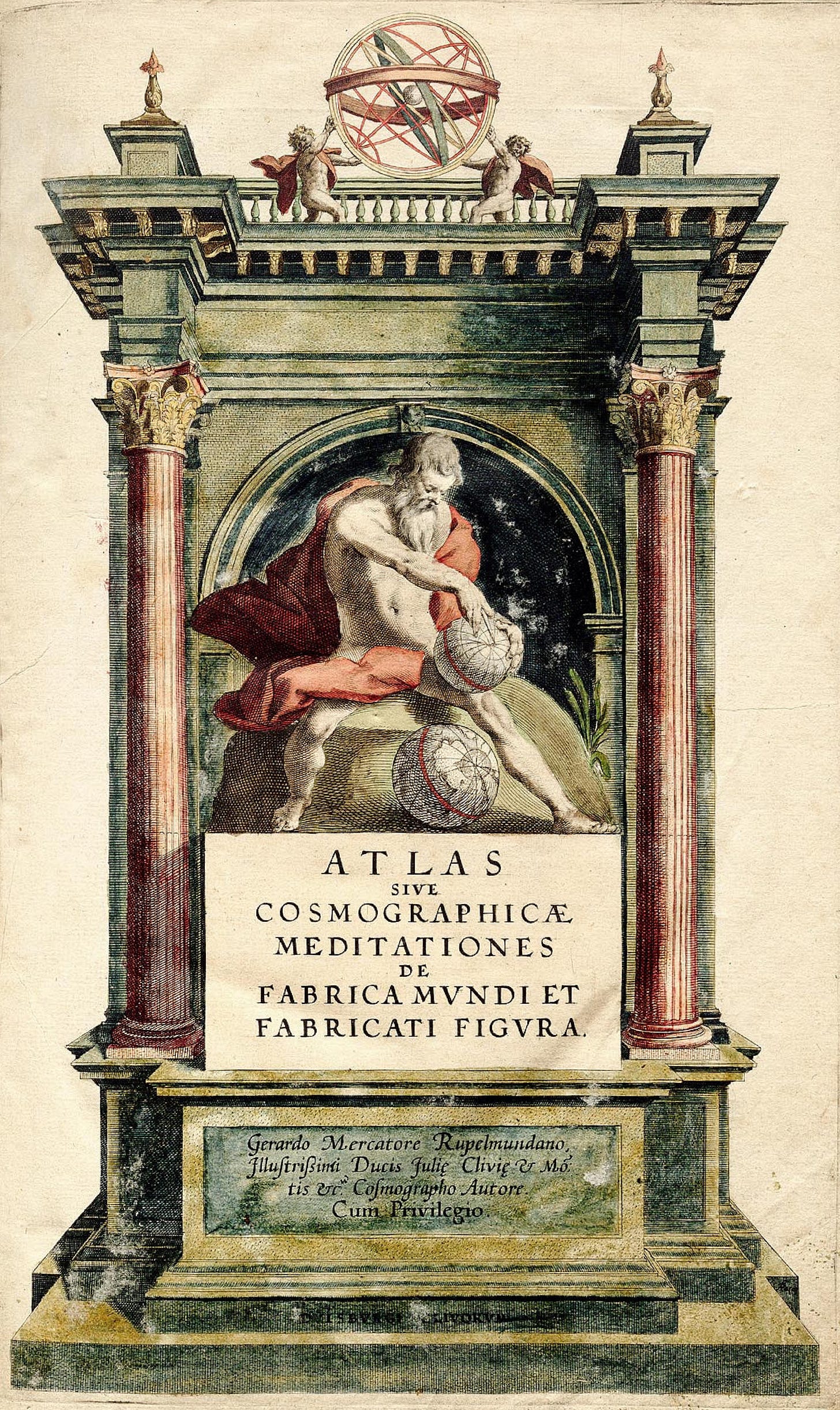
Atlas sive Cosmographicae Meditationes de Fabrica Mundi et Fabricati Figura — "Atlas, or Cosmographical Meditations upon the Fabric of the World." Mercator, 1595. Gerardus Mercator, 1595 / Wikimedia Commons, public domain
Atlas was a Titan, Iapetus's son, Prometheus's brother, who picked the losing side in the war between the Titans and the Olympians. When Zeus won, most of the defeated were thrown into Tartarus. Atlas got a worse deal: exile at the western edge of the world, condemned to hold up the sky. Not the earth. The sky.
The globe on his shoulders in every ancient carving is covered in constellations, because it was never the earth he was holding. He keeps the two apart so that there's a gap between them wide enough for everything else to stand in. The true space holder, the holder of the gap, the space that is filled with conscious experience.
Mercator, the man who bound the first book anyone ever called an atlas, said plainly in his preface that his 'atlas' did not refer to that Titan at all. He meant Atlas, King of Mauritania, who was a philosopher, a mathematician, an astronomer, the person the old accounts credit with making the first celestial globe. Which is a different kind of load-bearing entirely: he took the sky and made it into an object you could hold in two hands and turn.
And underneath both, the word itself seems to sit on a root meaning to bear, to carry, to endure a load. Which is why the Romans gave the same name, atlas, to the vertebra at the base of the neck where a burden rests, and why sixteenth-century anatomists moved the name up the spine to the ring of bone the skull balances on, having decided the real weight a person carries isn't on their back at all.
So an atlas was never a picture of the world. It's always been the system that bears the weight of not knowing, so a person can move through the world as themselves rather than as cargo.
Which brings me to the compass.
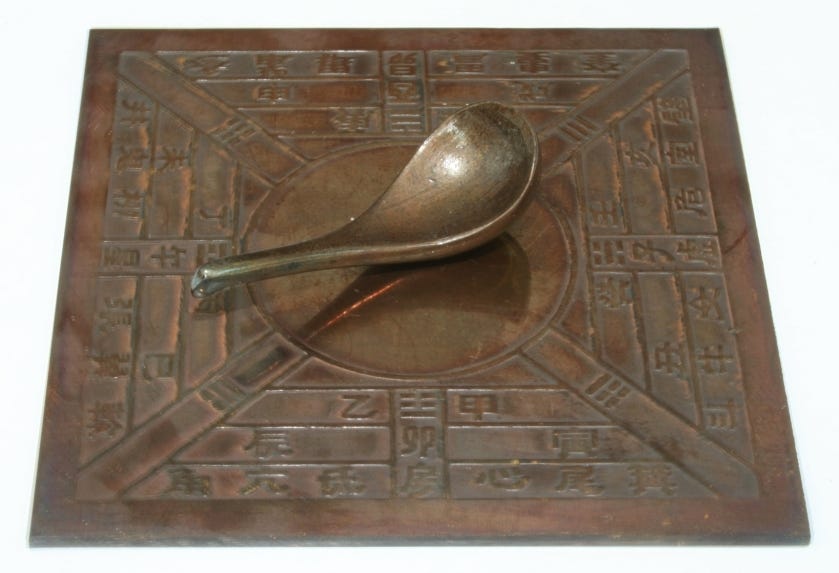
A si nan — lodestone spoon on a bronze plate. A modern reconstruction; no Han compass survives. Wikimedia Commons, CC BY-SA 3.0
The compass is the ancestor of every locational instrument we have ever built. The earliest we can trace it back to is China, where it wasn't a navigational tool at all. It was a lodestone spoon resting on a bronze plate, used for divination and geomancy, for siting buildings and graves. It was for reading the alignment between a person and a structure and a set of forces nobody could see directly, but everybody could feel the effects of.
Something like a thousand years went by before it occurred to anyone to take the instrument built for reading the invisible order of the world and put it on a boat to find true north.
(That lineage runs a lot further, through the I'Ching and Leibniz and the telescope and the first photograph of the whole earth, and it's the subject of the next piece in this series.)
The relational use came first. The applied locational use grew out of it.
Which is also, I think, where astrology and Human Design actually belong in this.
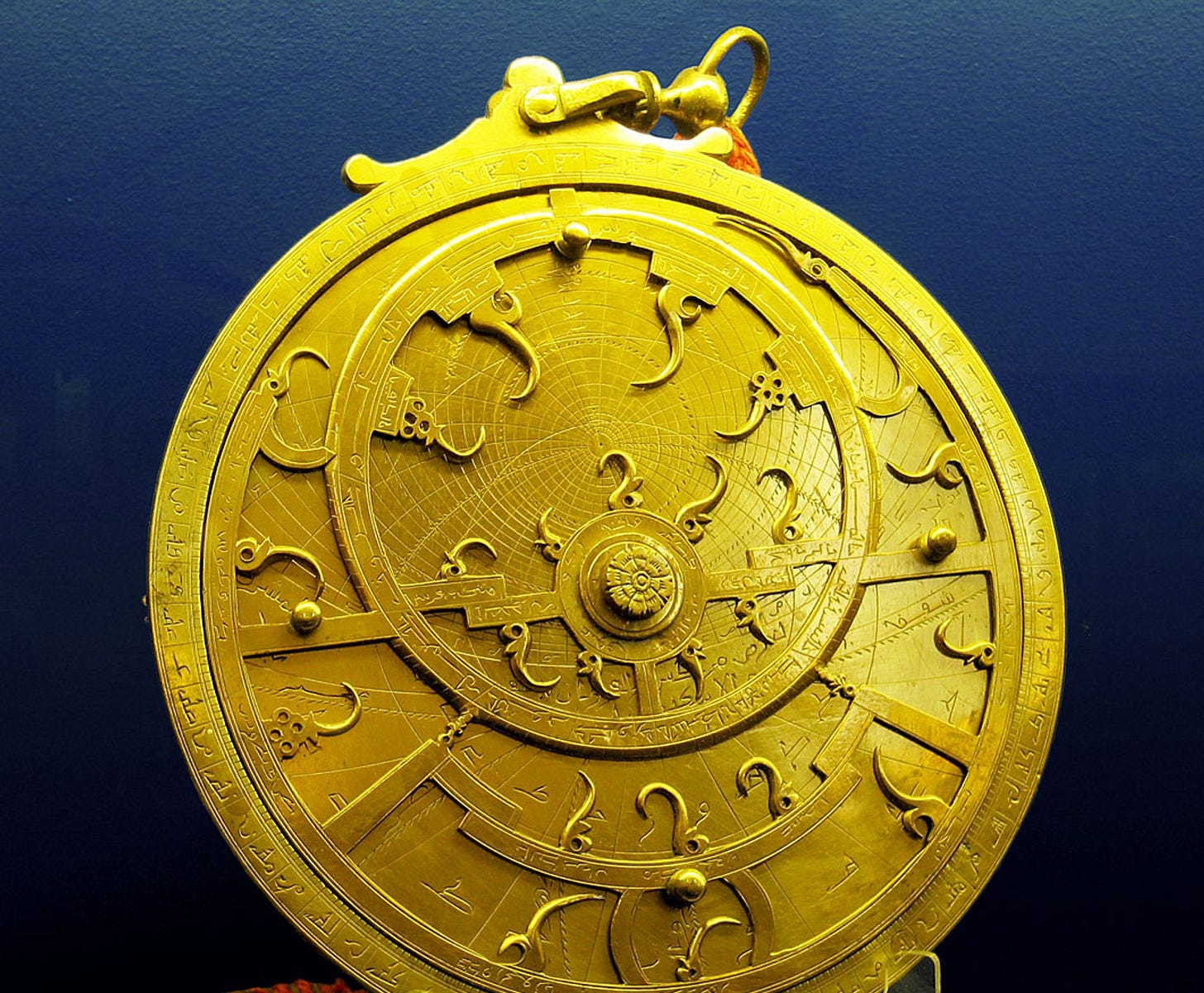
A Persian astrolabe. One brass object that finds your latitude, tells the hour, locates the stars, and casts a chart — all of it the same operation. Andrew Dunn / Wikimedia Commons, CC BY-SA 2.0
Two people can stand on the same corner of the same city in the same weather. One comes alive and the other goes flat. The variable isn't the ground. It's the person who is standing on it.
Astrology and the syncretic system of Human Design are, at their roots, among the oldest and most developed attempts we have at describing that variable. They are structured ways of saying that people are not interchangeable, and that the differences between us have shape rather than being random noise. They blend centuries of observation, correlation, myth, subjective experience into language and lens to proof one's experience against. They are cast intrinsically, as our very body is, from nature and the experiential gap that is life on Earth.
Astrology and Human Design are spatial. A natal chart is a map of the sky as seen from one specific point on the earth at one specific moment — it has a location baked into it and always has. Human Design enriches that same concept with added details. These are cartographies.
Geography maps the terrain, and these systems map the traveler themself.
An atlas brings those together as an enriched toolkit for action, exploration and contemplation.
So that is what ELA is.
ELA stands for Energy Location Atlas. ELA is an atlas for the relational territory, a personal atlas for the modern voyager.
It maps the personal and planetary influences at a location with a comprehensive toolkit — a true modern atlas that can tell you what the energetic influences of a place are for you and your relationships, across multiple doctrines, alongside the weather.
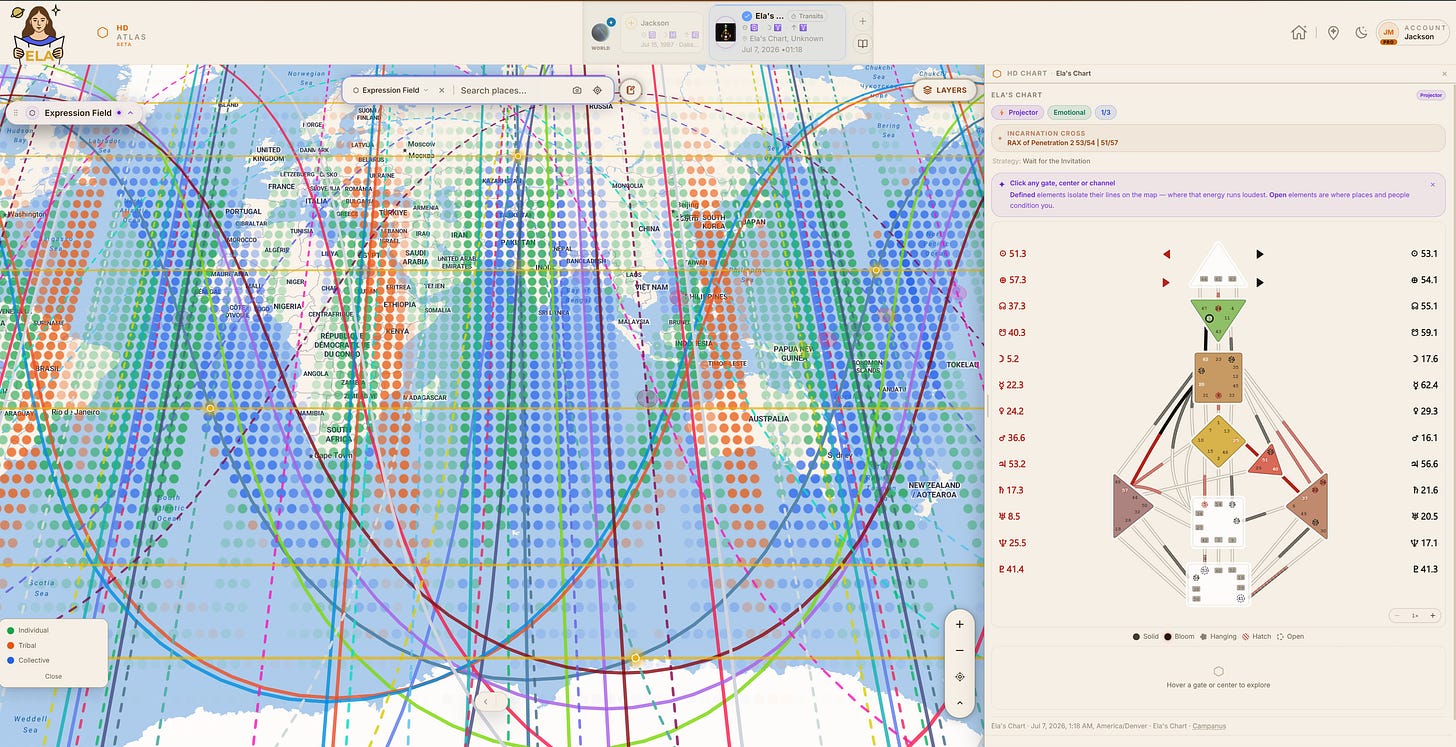
It isn't just an astrocartography app, an astrology app, or a Human Design app.
It's a full navigational toolkit, built to stand beside any serious software in either field, organized to geographic space rather than the chart. We look to ground astrology, Human Design and cartography in an atlas that works with the complete relational trifecta of self, other and place in harmony.
All the chart work is here, the whole toolkit. But rather than a map bolted on, the map is the thread, the grounding, the physical space we relate to, the one third of the triangle of relationality with self, other and place. It holds where you are now in space, the weather, moon phase, local geography, and the energetic influences unique to you in a single connected interface that hopes to lift up — and make a little more space - for your freedom and capability to explore.
Incidentally, yours is already drawn. It takes birth info and about a minute.
An important note.
A map is not predictive. It cannot tell you what your experience of a place will be — even in this new frontier of personal mapping. That is your own relationship to the experience. An atlas at its best, I think, strives to inform, so that awareness can make a relationship deeper. It can point out currents and weather patterns so that one can align properly. But it cannot predict your experience of that weather or those currents.
Grounding, not predicting.
Informing, not confining to an expectation.
If we think of the physical geographic map as the skeleton and skin, the seasons as the life process, the compass as the intuitive heart-mind, then we can think of the angular planetary energies — the astrocartograpic focal points of energy that trace lines over form — as the fascia of the system.
And Human Design can be seen as the wiring underneath - which parts of you carry current and which don't. All together we have a potent interface for a sovereign relationship between self and place.
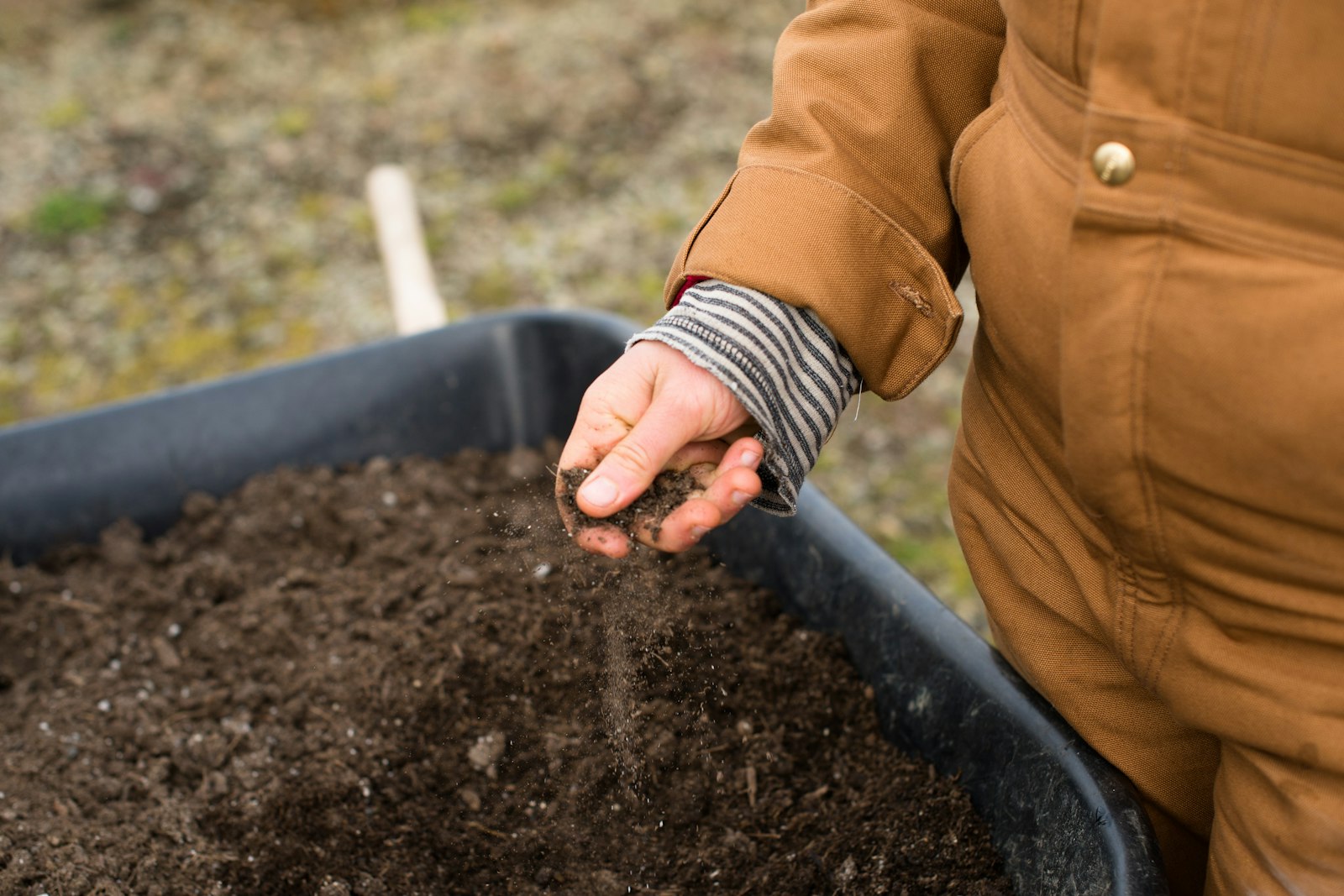
Groundedness and movement were never opposites. Photo by Zoe Richardson on Unsplash
What a thing like ELA is for, in the end, is alignment — and most of what people actually want follows from that rather than from any external answer, after all.
Some thoughts from using and exploring the concepts underlying the toolkit ELA provides.
This is not a case for the horizon-chaser, perpetually sailing toward the next thing, convinced the completing place is out there somewhere and always a little further on.
This isn't a place for fear or a carrot on a stick — there is a better place to be. That isn't sovereignty. That's restlessness with better scenery, and the field of astrocartography in particular is full of it.
The captain, done right, is also a gardener. Cultivation and relationship are in harmony. Gardening is its own navigation: reading what's actually in front of you, working with what this particular soil and this particular season will really give rather than what you wish they would. The garden is your own conscious experience, wherever you happen to be. Cultivating that garden is learning to read the waters of experience yourself, to track the stars based on the shape of your hand. Finding, keeping and discarding language that helps you navigate truer, with more ease and spaciousness.
The instrument doesn't exist to get you to leave. It exists to offer a little lift of the sky, a lodestone for your pocket, an atlas to relate, explore and wonder with confidence.
Every atlas ever assembled was an answer to the same quiet request. Give me something I can have with me that helps me find my way through what I can't see yet.
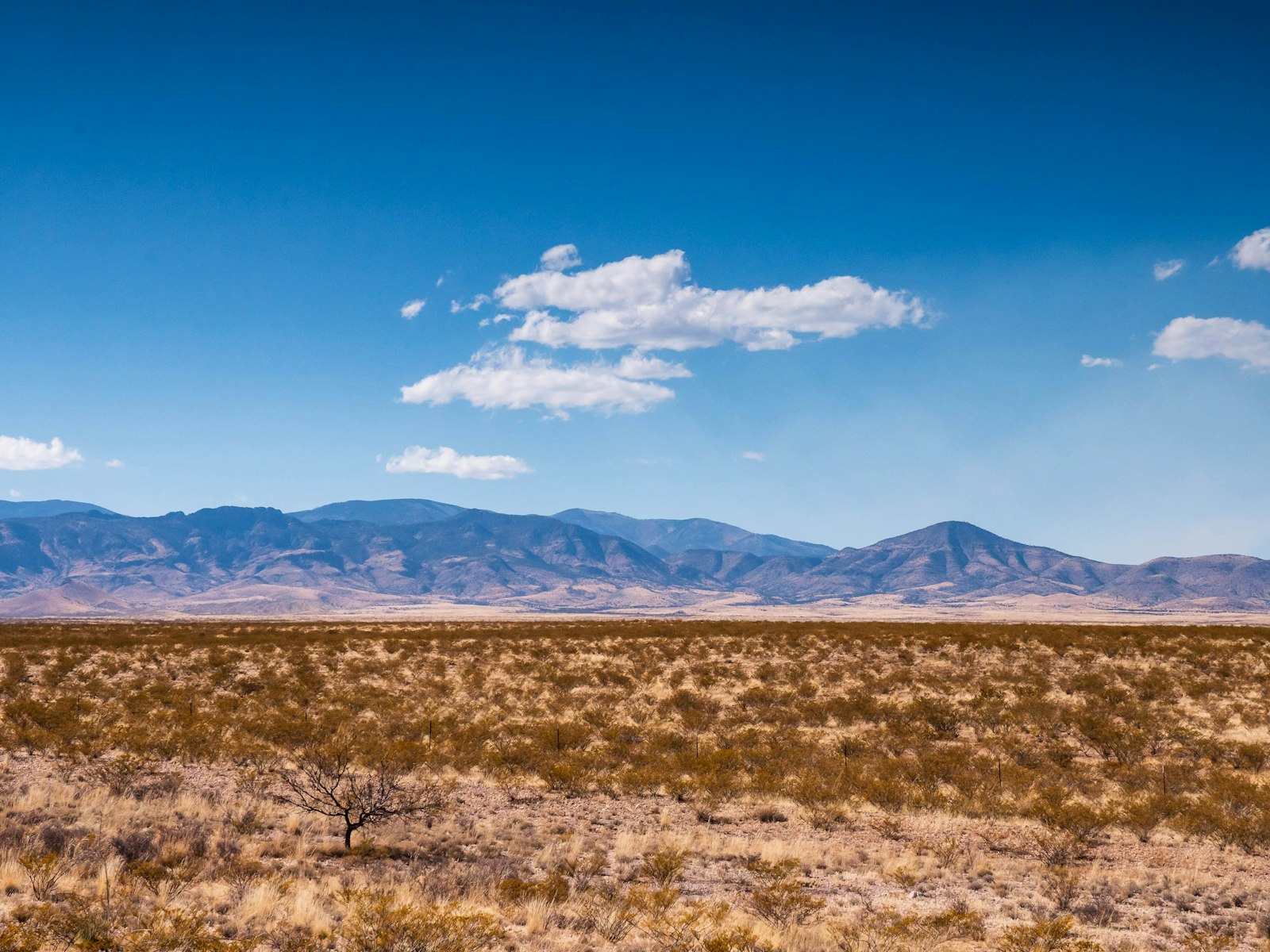
The map paints the interface. The weather is yours. Photo by Raychel Sanner on Unsplash
In reverence of the incredible planet we call home.
The map is open at elamap.com.
Place is personal.
— Jackson
Santa Fe, New Mexico
Originally posted on Place is Personal, my Substack. elamap.com is now the canonical home for future posts.