Is Astrocartography Real? An Honest Answer
Is astrocartography real, and how accurate is it? An honest answer that separates the astronomy, which is checkable, from the interpretation, which is a symbolic tradition rather than a scientific finding.
Photo: Evgeni Tcherkasski / Unsplash
There are two questions hiding inside "is astrocartography real," and almost every answer you will find online quietly swaps one for the other.
The first question is whether the astronomy is real. That one has a clean answer: yes, and you can check it.
The second is whether the lines mean what astrologers say they mean. That one has an honest answer too, and the honest answer is not yes.
Astrocartography is built on real, checkable astronomy: planetary positions and the angles of the horizon and meridian at your birth moment, computed to arc-second precision. Whether those lines carry the meanings astrologers assign them is a symbolic tradition, not a scientific finding. Honest tools keep those two claims separate.
Most of this field will not tell you that second part. I would rather say it on the first screen than have you find out later and wonder what else we blurred.
The part that is straightforwardly real
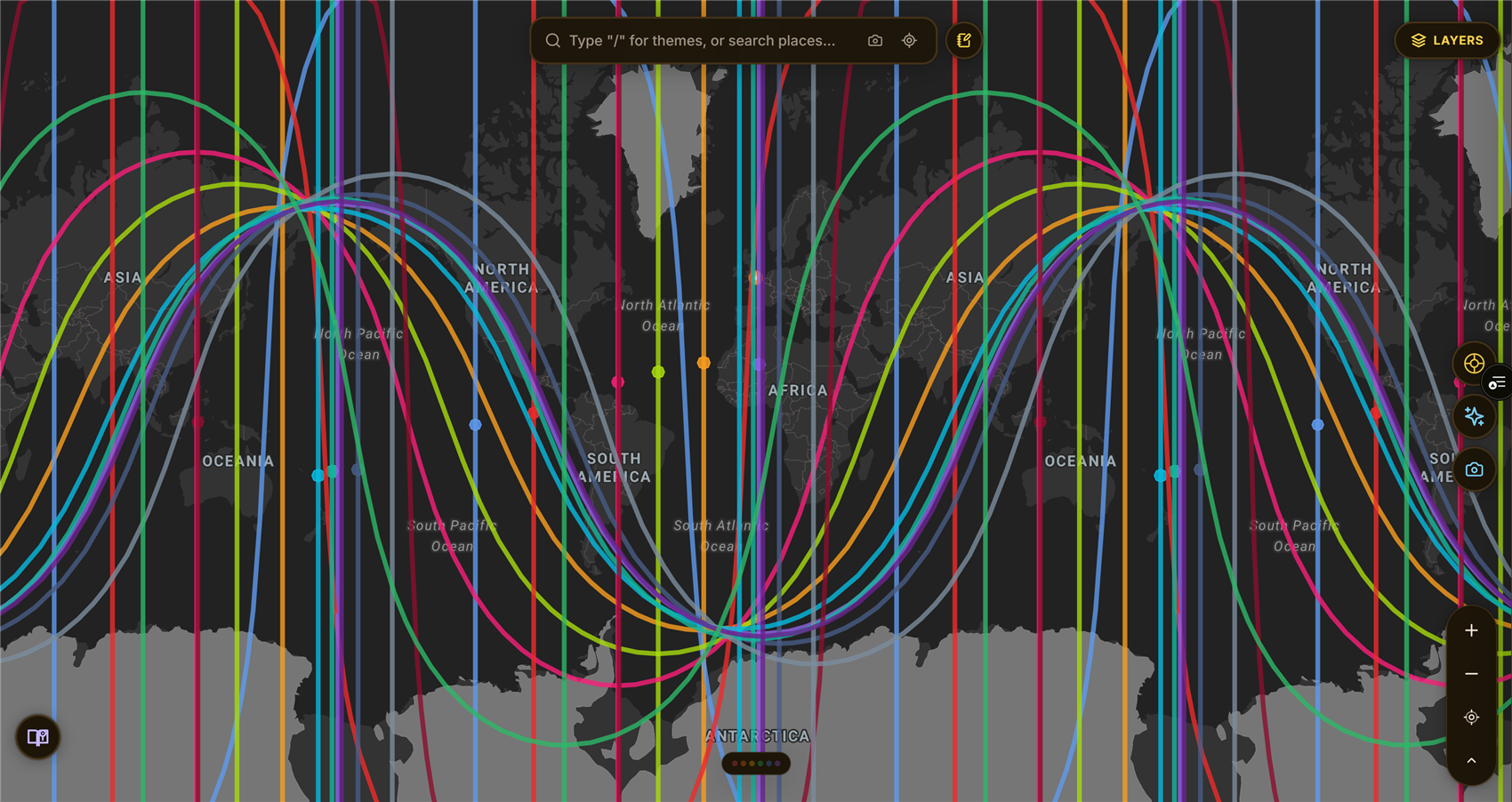
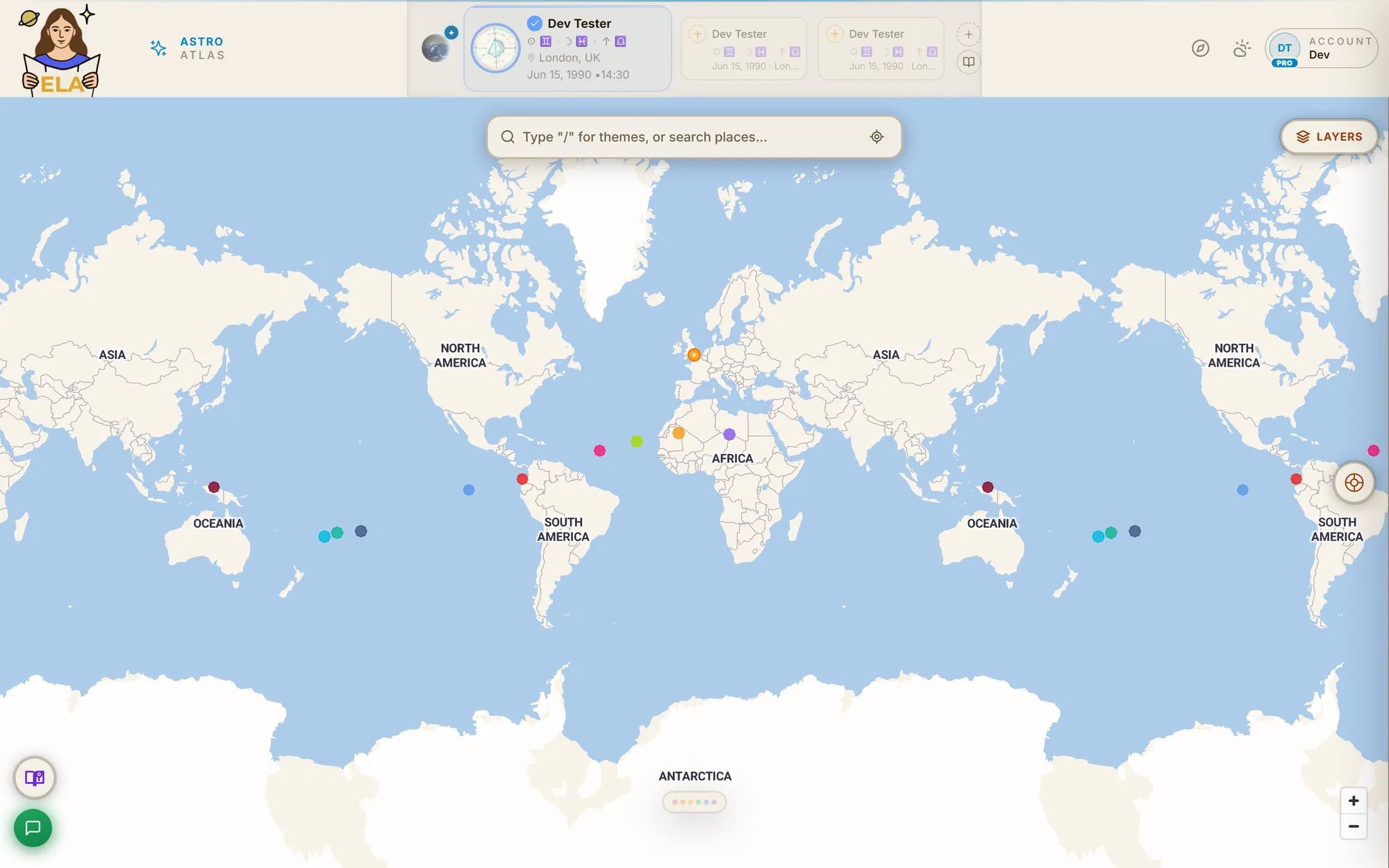
An astrocartography map is a projection of a real sky.
At the moment you were born, every planet was in a specific place relative to the Earth's surface. From some longitudes it was rising. From others it was setting, or directly overhead, or directly underfoot. Those positions are not a matter of interpretation. They come out of the same planetary data used to navigate spacecraft, and two competent tools should agree on them very closely.
That is a real computation with a right answer, and it is the part of this field you are entitled to hold to a standard. When ELA Map draws your Venus line, the claim being made is narrow and testable: Venus was on that angle along that curve at your birth moment. You can check it against an independent source, and we would rather you did.
If you want the specifics of what runs underneath, that is the data and engine behind ELA Map.
The part that is a tradition, not a finding
Now the harder half.
There is no controlled study showing that living on your Jupiter line makes you luckier. Astrocartography has not been validated the way a medical claim or a physical law is validated. Neither has Human Design. Anyone telling you otherwise is either confused or selling something, and if we ever tell you otherwise, hold us to this page.
What can be said accurately is narrower and, I think, more interesting. Astrology is a very old, heavily documented symbolic system for describing human variation. It is internally consistent, it has named rules you can learn and argue with, and it has been refined by people paying close attention for a very long time. Whether that constitutes knowledge about the world or a sophisticated language for reflection is a question people have argued about for centuries and will not settle because you read a guide.
Our position is that a symbolic system does not have to be scientifically proven to be useful, but it does have to be honest about which of those two things it is.
What accuracy actually means here
Because the astronomy is checkable and the symbolism is not, "how accurate is this tool" is a question about the first layer only. That makes it answerable, and it is where you should push.
Three things move a line on the ground.
The ephemeris. The underlying planetary data. Good ones agree to a fraction of an arc-second. Older or homegrown ones drift.
The projection. How a spherical sky gets drawn onto a flat or globe map. Errors here bend lines in ways that look plausible and are not.
Your birth time and its time zone. The angles move about one degree every four minutes. A birth time off by a quarter of an hour moves a line a real distance. Worse, historical time zone rules changed constantly, and a tool that silently applies today's rule to a 1974 birth in a region that observed different daylight saving that year will be confidently wrong, with no warning to you.
That third one causes most of the disagreements between tools, and it is the least visible to the person using them. If two maps disagree about where your Saturn line falls, check the time zone handling before you assume one of them is broken.
The tell to look for
Here is the practical test I would apply to any tool in this field, including ours.
Ask it why.
A tool that gives you a confident sentence about a place and cannot show you where the sentence came from is asking for trust it has not earned. A tool that can name the doctrine, show the inputs, and let you disagree with the reasoning is doing something different, even if you end up rejecting the tradition entirely.
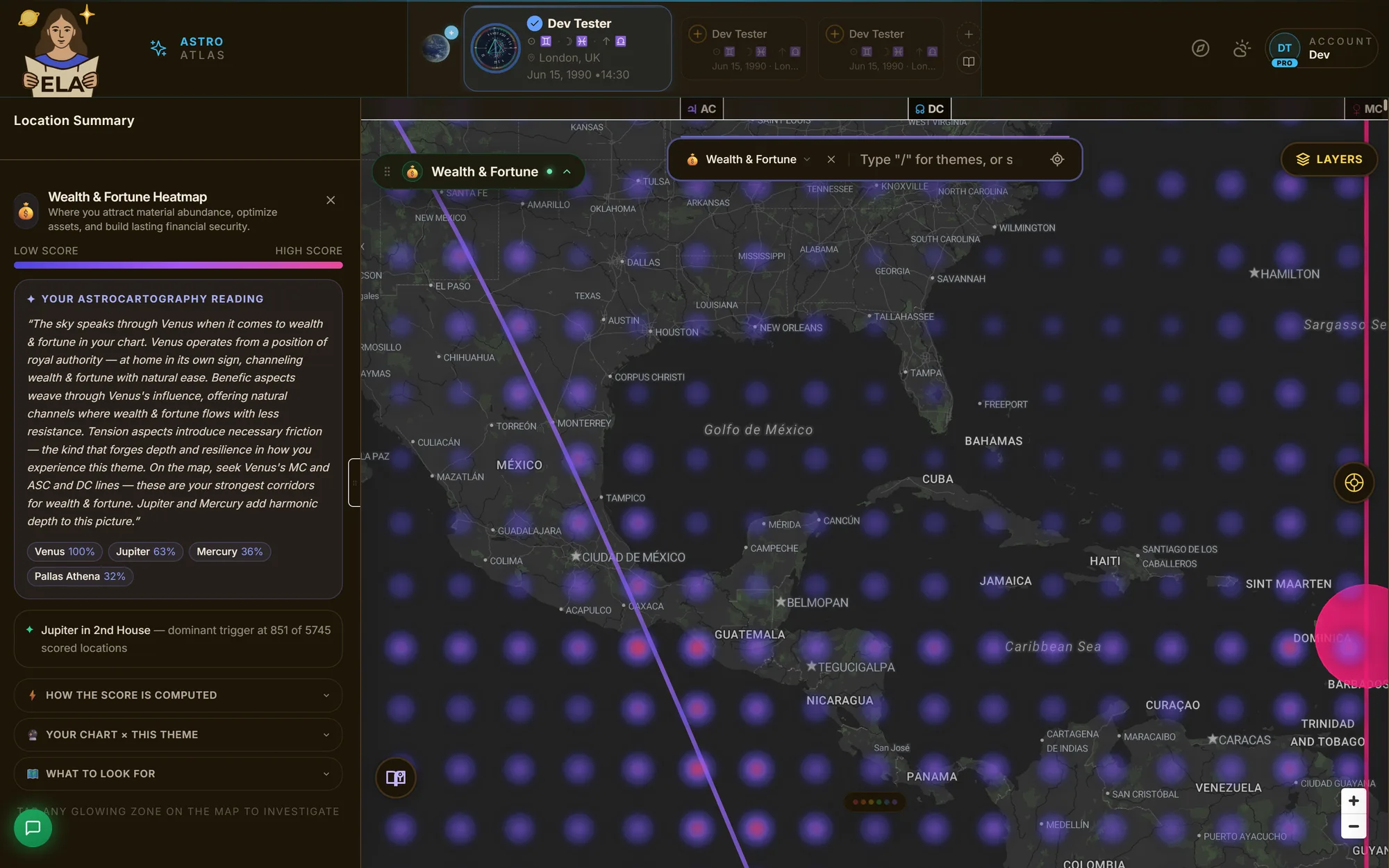
A real reading from ELA Map, chosen deliberately because it is unimpressive. The score is a 3. The label says "Quiet here." The panel names exactly which factor produced that number and tells you no lines fall within three degrees. A tool that can only produce exciting answers is not reading anything.
This is also why every interpretation in ELA Map comes from named, written doctrine rather than a language model improvising. Ask the same question twice and you get the same answer, because the answer is derived rather than invented on the spot. Generative AI can sound profound without being accurate. Named doctrine can be disagreed with, but it can always show its work.
That is not a claim that the doctrine is true. It is a claim that you can see it, which is a different and more checkable promise.
Generic, and then yours
There is a second thing worth asking a tool, and it is the one that turns this from a reference table into something you actually want to sit with.
A line has a meaning of its own. Venus overhead means something before it means anything about you. That much any book can give you, and most tools stop there, which is why so much of this writing reads like a horoscope column: true of everyone, so not quite true of anyone.
But your Venus is somewhere specific. It sits in a sign, in a house, carrying its own condition in your chart, and it was doing all of that at the moment you were born. ELA Map weaves that in. The read you get for a place leads with what the line does at that angle, then anchors it in the placement that is actually yours, so the sentence in front of you could not have been written for anyone else with the same line.
It is a small structural difference and it changes the texture completely. The generic version tells you a place is good for relationships. The woven version can tell you which flavour of relating your Venus reaches for, and what that specifically tends to do when a place puts it on the horizon.
The part I did not expect, building this, is how often the specific version is the one that stings a little. Generic readings are comfortable because they are vague. A reading built from your own placements can land somewhere you were not braced for, and that is usually the moment it becomes interesting rather than decorative.
None of that makes the symbolism true. It makes it precise, which is the only honest kind of rich. And because every sentence is derived from named doctrine rather than improvised, you can always turn it over and ask which rule produced it. Curiosity is welcome here. So is disagreement.
What the skeptics get right
The strongest criticism of this field is not that the astronomy is wrong. It is that the interpretations are unfalsifiable and flattering, and that people make expensive life decisions on them.
I think that criticism largely lands, and it lands hardest on exactly the style of astrocartography writing that sorts lines into good and bad and frames every case study as a move away from somewhere that does not favor you. That approach turns a map into a departure board and a chart into a permission slip. It is also the most popular way the subject gets written about.
The version worth defending is smaller. A line describes what a place tends to amplify and ask of you. Whether that reads as pressure or as structure depends on what you are actually doing with your life, which is information the map does not have and cannot get. Some of the most useful ground I know of reads as demanding.
What it is for, then
A map informs. It does not predict.
It can point out currents and weather patterns so that you can align with them. It cannot tell you what your experience of that weather will be, because that is your own relationship with it. Grounding, not predicting. Informing, not confining to an expectation.
If you want a tool that tells you where to move, this field is full of them and I would encourage you to be suspicious of every one. If you want a way to think about place that is precise about its astronomy and honest about its symbolism, that is what we are trying to build.
Where to go next
- How to tell if an astrocartography app is actually accurate for the tool-level version of this question, in detail.
- The data and engine behind ELA Map for what the calculations run on.
- Astrocartography: the complete beginner's guide if you want the technique itself from the start.
- Glossary for any term here you want defined plainly.
Your own map is free to look at. Check it against whatever else you trust.
Place is personal.