How to Tell If an Astrocartography App Is Actually Accurate
How to tell if an astrocartography app is accurate. The two calculations that matter, what goes wrong, and how to spot a rigorous tool instead of a confident one.

Photo: Olena Bohovyk / Unsplash
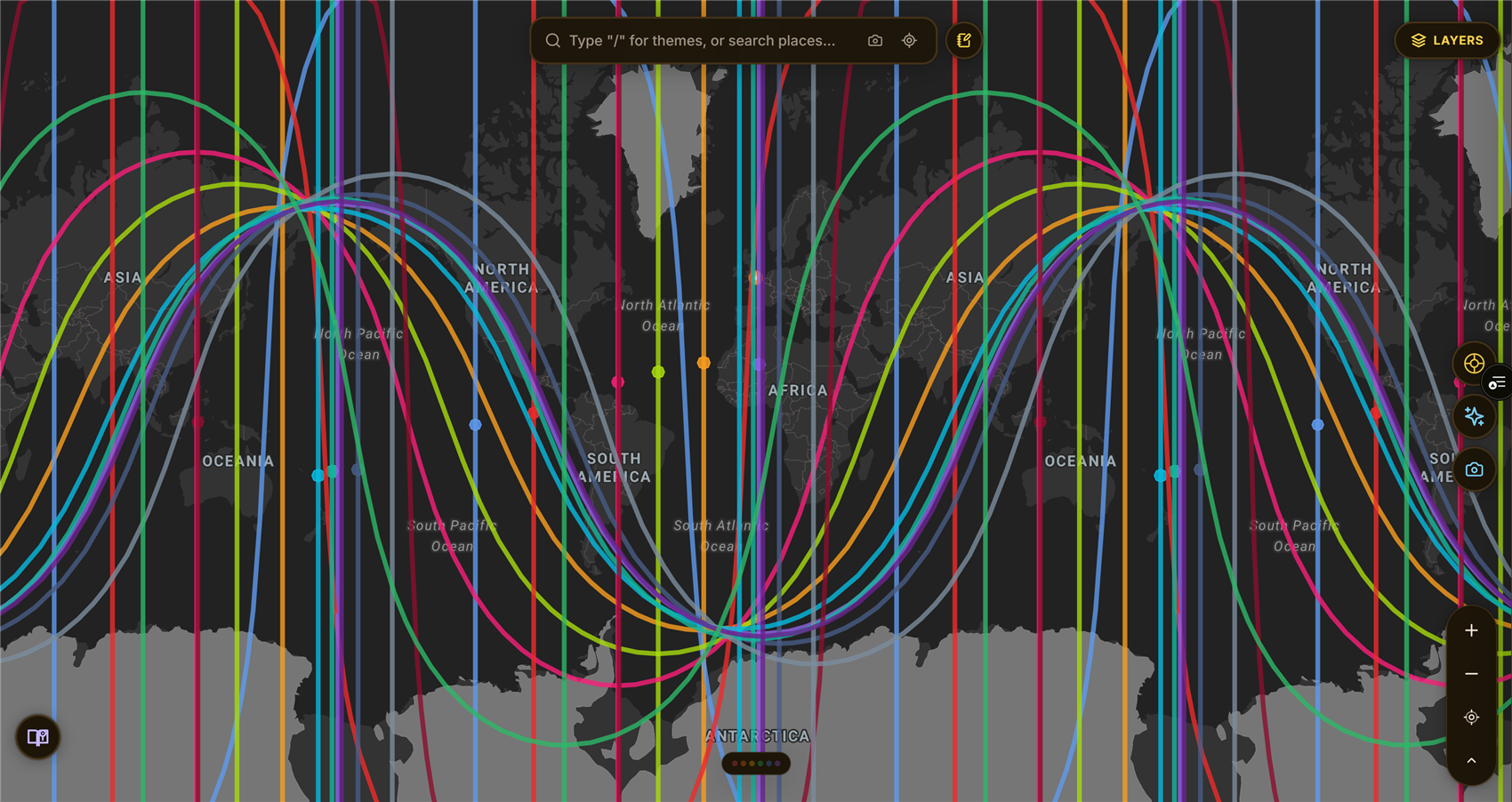
Locational astrology asks more of a computer than almost any other kind of astrology. It's not enough to know where a planet was in the sky when you were born. You need to know exactly where, on every longitude on Earth, that same planet was rising, setting, overhead, or underfoot at that exact moment. That's a second calculation, done independently, at every point on the globe. That complexity creates real room for error. A tool that gets it wrong while sounding completely certain isn't showing you confidence. It's showing you the opposite.
The part everybody skips
I've spent years building an ephemeris and line-plotting engine, and the thing that worries me most about this moment in astrology isn't bad code. It's good copywriting.
Check the work yourself
Free, no card. Run your own chart and see the receipts on every point.
Get startedMost of the conversation about "AI astrology" collapses into one question: is the AI making things up? That's a fair question, and worth asking. But it skips a harder, less visible problem underneath it. Locational astrology has to get two completely different calculations right, not one. The second one is almost never discussed.
First, you need the planet's actual position: where it sat in the sky at the exact moment and place you were born. That's an ephemeris problem. It's the one everyone talks about, because it's the one with a name people recognize (Swiss Ephemeris, NASA/JPL data, and so on). This part of the pipeline is genuinely mature. Observatories and space agencies have worked on it for decades. Any tool built on a real dataset is starting from solid ground.
Second, you need to find the exact spot on Earth where that planet crosses the horizon, sits on the meridian, or reaches its zenith, for every planet, at every longitude, around the entire globe. That's not a lookup. A planet's position doesn't map onto a location on Earth directly. You have to solve for where a specific angular relationship (rising, setting, culminating, anti-culminating) becomes true. That means an iterative numerical search: guess a longitude, check how close the angle is to exact, adjust, repeat, until the error is small enough to trust. Use too coarse a step size, or let small rounding errors compound across the thousands of iterations a full set of lines requires, and you get a line that's subtly, confidently wrong. Not "off by a continent" wrong, closer to "off by a few dozen miles." That's exactly the range that can put the line through the wrong city, or place it near a real one when it should be a country away. Near the poles the same math gets even less forgiving, because small errors in a planet's declination turn into large swings in where a line actually falls.
A tool can have flawless planetary data and still draw a bad line. The line-plotting step is a separate piece of engineering, built independently by whoever runs the tool, sitting on top of the ephemeris rather than inside it. That gap, between "the positions are right" and "the lines drawn from those positions are right," is the one most locational astrology content never mentions. It's less interesting to write about than "is this AI," even though it's the more common way these tools actually go wrong.
The ephemeris question, done honestly
Here's a claim I could make that would be easy, dramatic, and wrong: that Swiss Ephemeris, the software most of the astrology world has built on for decades, is somehow stuck on old data. It isn't. Swiss Ephemeris launched in 1997 on JPL's DE405/406 dataset. It moved to DE431 in 2014, and was rebuilt this year on DE441, JPL's most recent planetary dataset. It is, right now, running on very recent data. Anyone telling you otherwise hasn't checked, or is hoping you won't.
ELA Map's ephemeris partner runs on a different JPL dataset, DE440. The honest way to talk about the difference between DE440 and DE441 isn't old versus new. It's what each one was built to do. DE441 covers roughly 13,000 years. That's an extraordinary achievement, but reaching that far back and forward required fitting the lunar orbit without a core-mantle damping term, which costs it a sliver of precision in the present era. DE440 covers a much shorter window, a little over a thousand years centered on now, fit specifically for maximum precision in that window. That window happens to be the one every real birth chart lives in. Neither dataset is wrong. They're built for different jobs. DE440 is built for the job a birth chart actually needs done.
That's still only half the claim, and the less interesting half. The part almost nobody in this space demonstrates is the line-plotting step described above: the iterative search for where a planet's angle actually becomes exact at a given longitude. Getting that right isn't a property of the ephemeris at all. It's a property of whoever wrote the root-finding code on top of it. The way you catch drift or coarse-sampling errors before a user ever sees them is boring and unglamorous: an automated script independently recomputes positions against NASA/JPL's own published values every hour and flags any divergence. It does not trust the line-plotting engine to police itself. That's a checkable, ongoing process, not a one-time claim on a spec sheet. "Arc-second accuracy" only means anything if someone is actually re-verifying it hourly, indefinitely, instead of asserting it once and moving on.
Data accuracy is half the story
Getting the math right doesn't finish the job. The other half is interpretation. That's where a lot of what's marketed as "AI astrology" actually happens: someone takes a line name out of a chart and pastes it into a general-purpose chatbot. That's not the same thing as interpreting a placement in the full context of a natal chart, and it shows. A language model with no chart in front of it, no doctrine, and no constraints will produce something that reads fluently and means very little.
It's worth being precise about what "no AI" actually means when a tool claims it, because the honest answer is rarely a clean 100%. In ELA Map's case, the interpretation corpus is hand-vetted and matched to your specific chart by rule. Nothing is invented. Two things go a step further: the readings on your Today page and your Location Reports are compiled from our interpretation library, refined by AI, from your actual placements, lines and the day's transits. They aren't generating new astrological claims. They're stitching real ones together, for you, and a Today reading that names anything not in your chart is thrown out. That's a narrower and more honest use of the technology than pasting a line name into a general chatbot. It's also a more honest answer than just claiming "no AI, anywhere" and hoping nobody checks. Any tool making a purity claim about AI is worth asking the same question of.
If you want the fuller picture of how a chart's astrological weight gets scored across an entire map instead of read line by line, that's a related but separate problem: see the Heatmap Engine for how ELA Map handles it.
How to tell if a locational astrology app is actually accurate
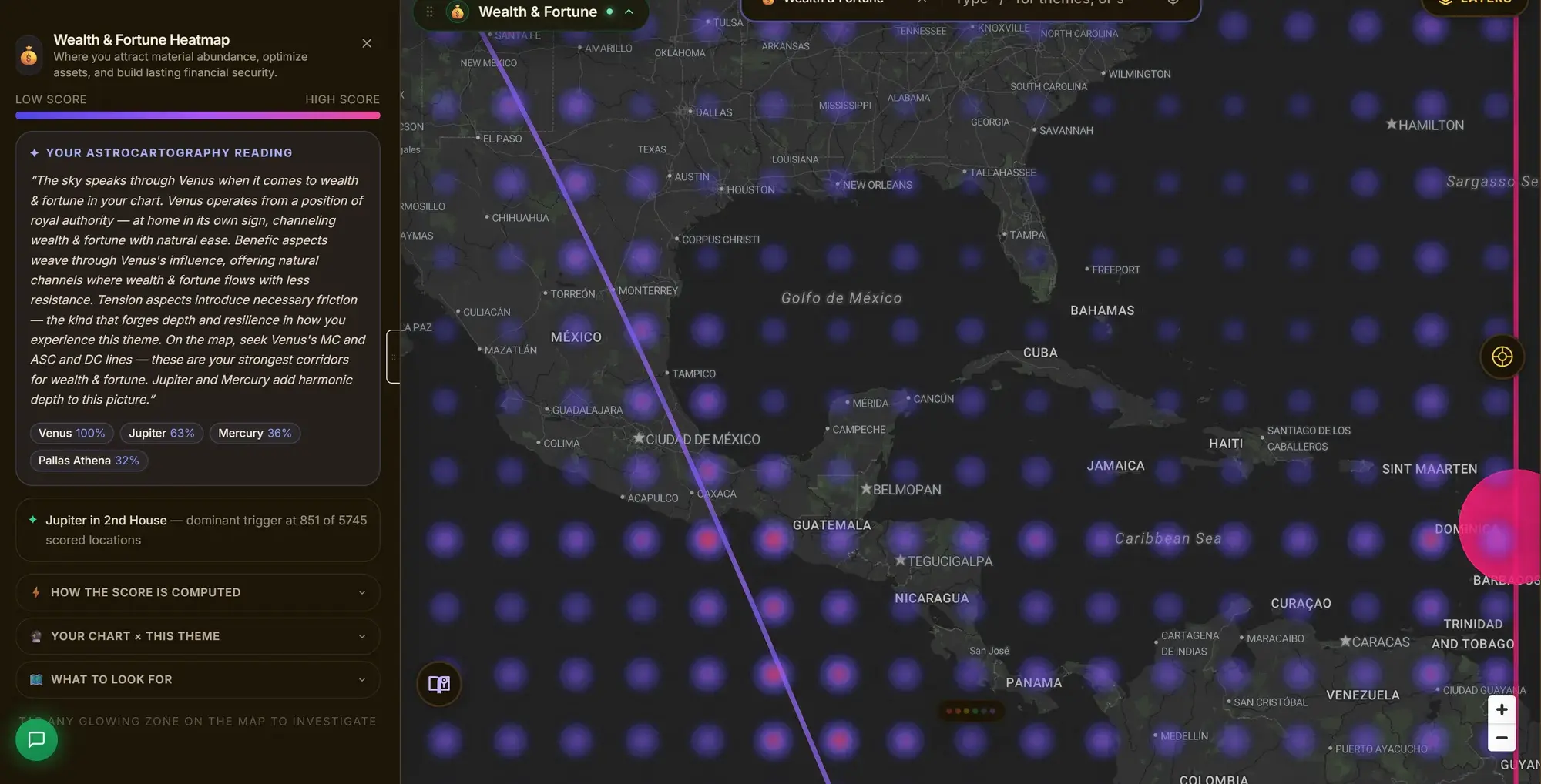
What honest computation looks like: ELA Map names the exact planets driving a location and cites the receipt ("dominant trigger at 851 of 5745 scored locations"). The number came from geometry you can check. It did not come from a language model deciding what sounds right.
You don't have to take anyone's word for this, including ours. A few concrete things to check before you trust a tool with a decision this personal:
- Does it name a real, checkable data source? "Powered by advanced AI" or "cosmic-grade precision" is marketing language, not a data source. A tool that's actually built on something real will name it: Swiss Ephemeris, NASA/JPL data, a specific dataset. If you can't find what it's built on, that's worth noticing.
- Can it explain how a line was actually calculated? Not in ten pages of documentation, just in one or two sentences you can follow. If a tool can't tell you, in plain language, what a line-crossing calculation is doing, be skeptical that it's doing one at all.
- Is the interpretation specific to your chart, or would it read the same for anyone? Generic, AI-feeling copy that never mentions your actual placements, houses, or aspects is a sign the interpretation layer isn't really looking at your chart. Real, chart-specific interpretation reads differently for a Leo Midheaven than a Capricorn one, because it should.
- Is the tone confident or is it honest? Dramatic, fear-based language, "never go here," "this line will ruin your career," dressed up in absolute certainty, is a tell about the content, not information about the place. Confidence is cheap. Accuracy is the thing that's actually hard to fake. That's exactly why so much content skips demonstrating it and goes straight to the drama instead.
- Does it show its work at the level of an individual point? If you can click a specific location and see which planet, which house, and which rule actually produced the reading in front of you, that's a tool built to be checked. If the only thing you can do is read the output and trust it, that's a tool asking you to take it on faith.
None of this is about any specific app. It's a checklist you can run against anything, including us.
A birth chart is an input to a decision you're still making yourself. It's not a verdict handed down by a tool. Anything, an app, a reading, a line, that tries to make that decision feel smaller or scarier than it is has gotten the relationship backwards. Sovereignty over your own chart means being able to check the work behind it, not just being asked to trust the tone it's delivered in.
Related reading
- The Heatmap Engine: how ELA Map scores every point on Earth against your chart, not just the points a line happens to pass through.
- Astrocartography Fundamentals: the four-angle mechanics every line in this piece is describing.
- The Data and Engine Behind ELA Map: more on the ephemeris and line-plotting pipeline referenced above.
- Glossary: plain-language definitions for ephemeris, orb, paran, and the rest of the vocabulary this piece uses.
Test it against your own chart
Free. No card. Check the precision on your own placements in about two minutes.
Get started