Personalized geographic intelligence: Relocation Astrology visualized
How ELA Map's astrocartography heatmap scores every place on Earth for love, career, wealth, and healing.

Photo: David Becker / Unsplash
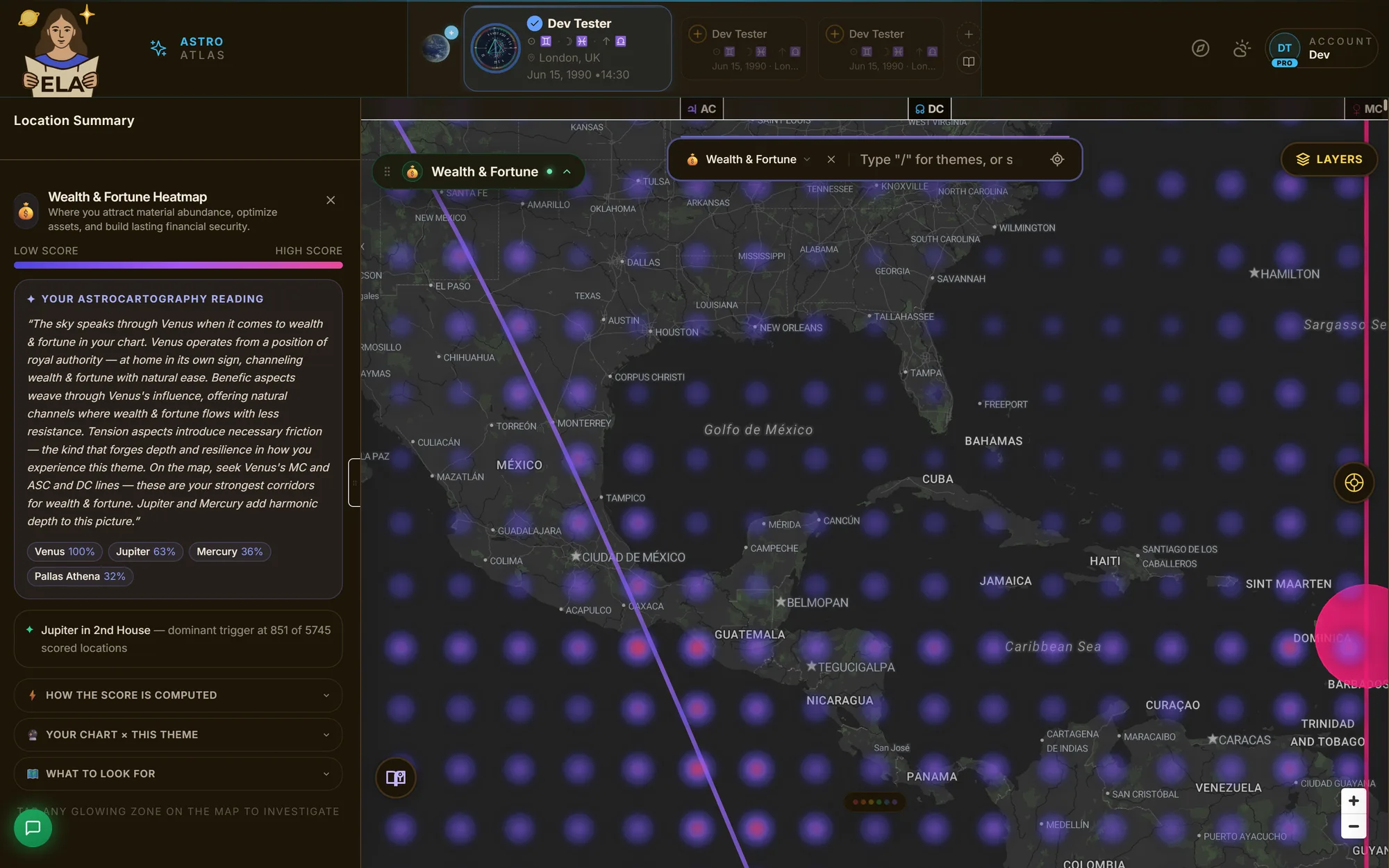
"Good vibes here" is not a scoring system. Most astrocartography heatmaps do one thing: they draw a radius of influence around a line and shade it in. The color fades the farther you get from the line. That's not a relocation engine. It's a blur filter. ELA Map's heatmap is a true relocation engine. Every point on the globe is evaluated on its own astrological merits, across seven independent scoring channels, weighted by named doctrine (sect, dignity, orb, rulership), for every life theme you can pick, including the ones built for Human Design. You don't have to take our word for the accuracy. You can see the receipt on every point on the map.
The problem with "where should I live" astrology
Type "best places to live astrology" into a search bar and you'll get a hundred maps that all do the same thing: draw a line, tell you what the line means, and stop. Venus line, love. Jupiter line, luck. Midheaven line, career. It's not wrong, exactly. It's just the first sentence of a much longer explanation that nobody bothers finishing.
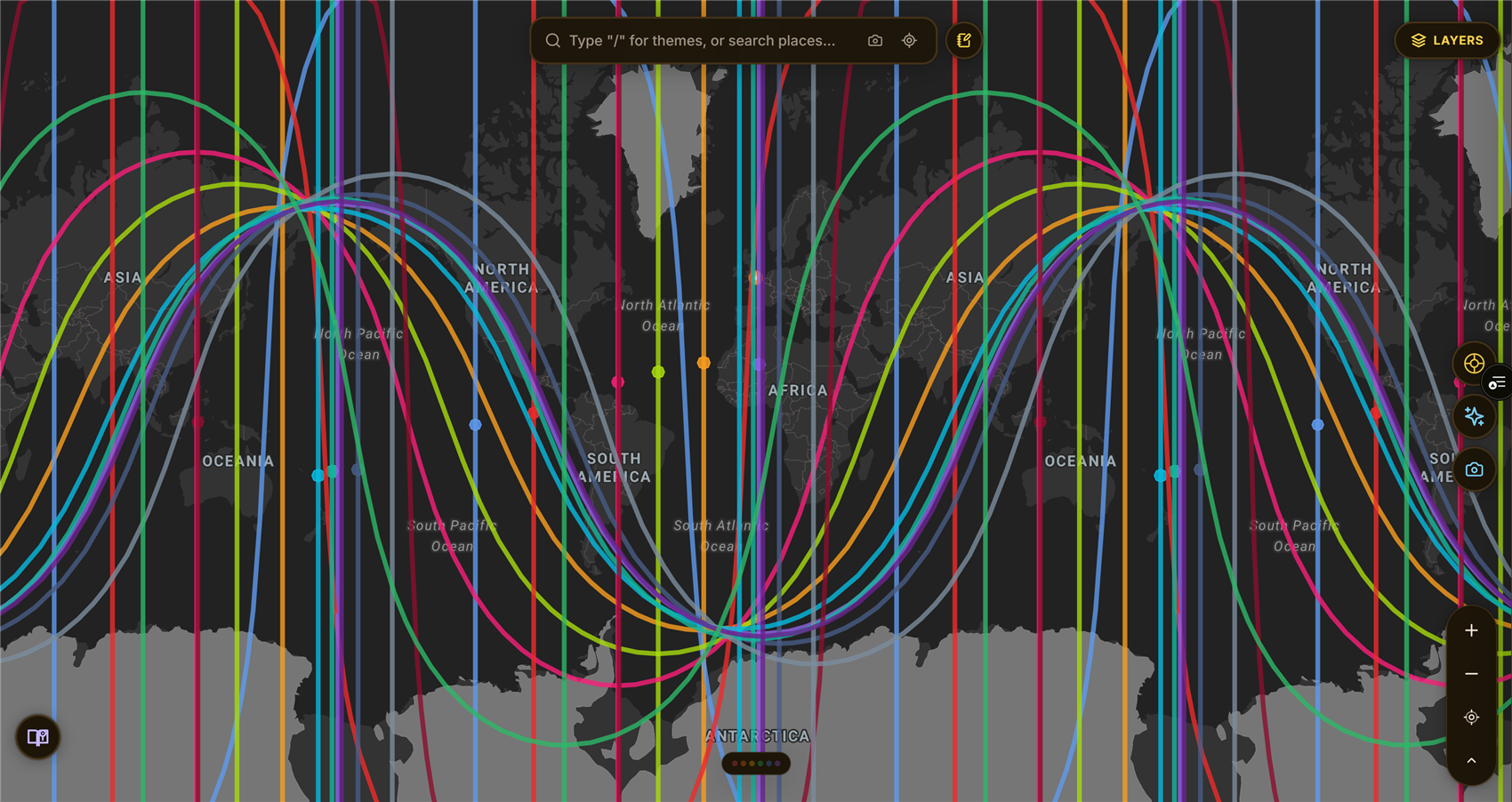
A line on an astrocartography map only tells you that a planet is angular at that longitude. It doesn't tell you whether that planet is dignified there or debilitated. It doesn't tell you whether the chart is diurnal or nocturnal, or what that does to a benefic or malefic's behavior. It doesn't tell you whether the planet forms a supportive aspect to the angle, or none at all. It doesn't tell you whether five other lines are stacking on top of it to reinforce or cancel each other out. And when these tools try to turn that line into a "heatmap," what they usually build is a soft-edged glow that radiates outward from the line and fades with distance. That's a visual effect, not a calculation. It tells you how close you are to a line. It doesn't tell you what's actually happening at the place you're standing.
What the heatmap actually is
ELA Map's heatmap is not a blur around a line. It's a full recomputation of your chart's astrological standing, at every point on the map. Every grid point on the planet is evaluated against your chart across seven scoring channels. Each channel has its own point budget:
| Channel | What it's measuring |
|---|---|
| Angular Strength | How close your planets sit to the four angles: Ascendant, Midheaven, Descendant, Imum Coeli, at that location |
| Essential Dignity | Whether each contributing planet is strengthened or weakened in its natal sign, and by how much |
| House Rulers | How strong the rulers of the theme's houses are once your chart is relocated there: their condition, and how close they sit to an angle |
| Aspect Support | Trine and sextile support reaching the angles from elsewhere in the chart |
| Crossings | Two-planet co-angularity at the same latitude (the classical paran), one of the oldest and most overlooked techniques in the craft |
| Zenith Power | Whether a planet's declination puts it directly overhead at that latitude |
| Midpoint Resonance | Planetary midpoints landing on an angle |
Each channel is capped, so no single mechanism can run away with the score. The channels are summed. A penalty is subtracted for genuinely afflicted contacts. The result is compressed through a final curve, so extreme highs don't blow out the map. What comes out the other end is a single 0 to 100 score per location, per theme. Every one of those scores can be traced back, channel by channel and contact by contact, to the astrological rule that produced it. Nothing in that pipeline is a language model's opinion. It's arithmetic on a real chart, run independently at every point, not smeared outward from a line.
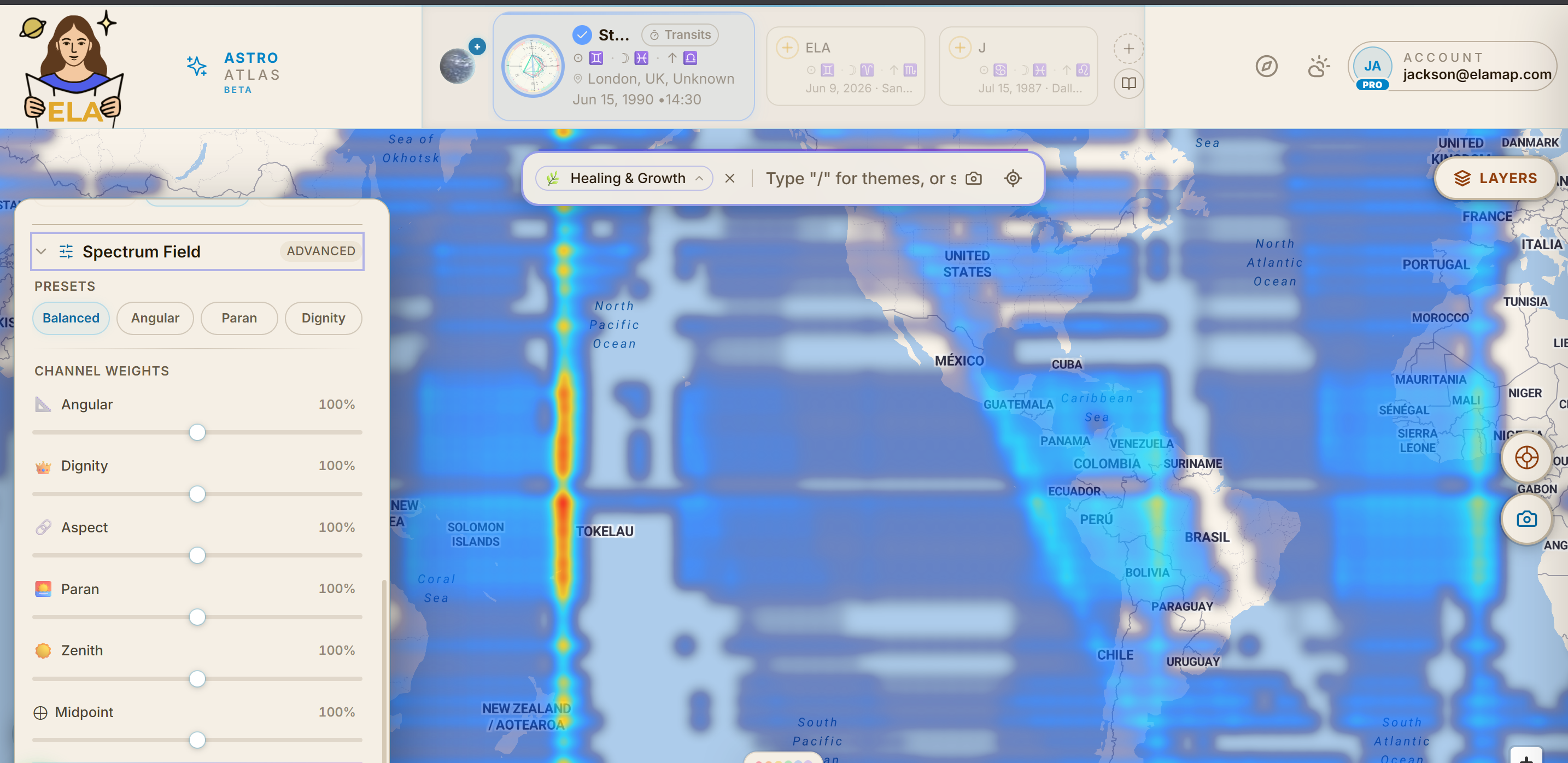
Six of the seven channels in the table above are real, adjustable dials in the app, not marketing copy. House Rulers is scored on every map and shows in each location's score breakdown.
The doctrine doing the work
Here's the part this space mostly skips. The engine doesn't treat every planet the same, regardless of context. It applies the same distinctions a serious traditional astrologer would make by hand, at every one of sixteen thousand grid points, every time.
- Sect. Jupiter behaves differently in a day chart than a night chart. So do Venus, Saturn, and Mars. The engine knows whether your chart is diurnal or nocturnal, and it scores accordingly. A diurnal Saturn reads as disciplined mastery. A nocturnal one reads as frustration. This follows the same doctrine Valens and Lilly wrote down centuries ago.
- Essential dignity. A planet in its own sign gives more and costs less. A planet in its fall gives less. If it's a malefic, it costs more. The engine doesn't soften a debilitated Mars. It amplifies the penalty, because that's what the tradition says happens.
- Retrograde motion. A retrograde benefic and a retrograde malefic don't get the same treatment. Neither gets a flat penalty. Benefit and harm are scored on separate tracks, and they can move in opposite directions at once.
- Parans and zenith contacts. Most relocation content stops at the four angle lines per planet. Almost none of it touches parans: the latitudinal alignments where two planets reach an angle together (in the app, you'll see these as crossing lines). Almost none of it touches zenith crossings either, where a planet's declination puts it directly overhead. Both are first-class scoring channels here, not an afterthought.
You can disagree with any individual rule. People have argued about dignity and sect for three thousand years and will keep arguing. But you can always see which rule produced the number in front of you. That is the whole point.
Watch your world light up
Free, no card. The whole globe scored to your chart in about two minutes.
Get started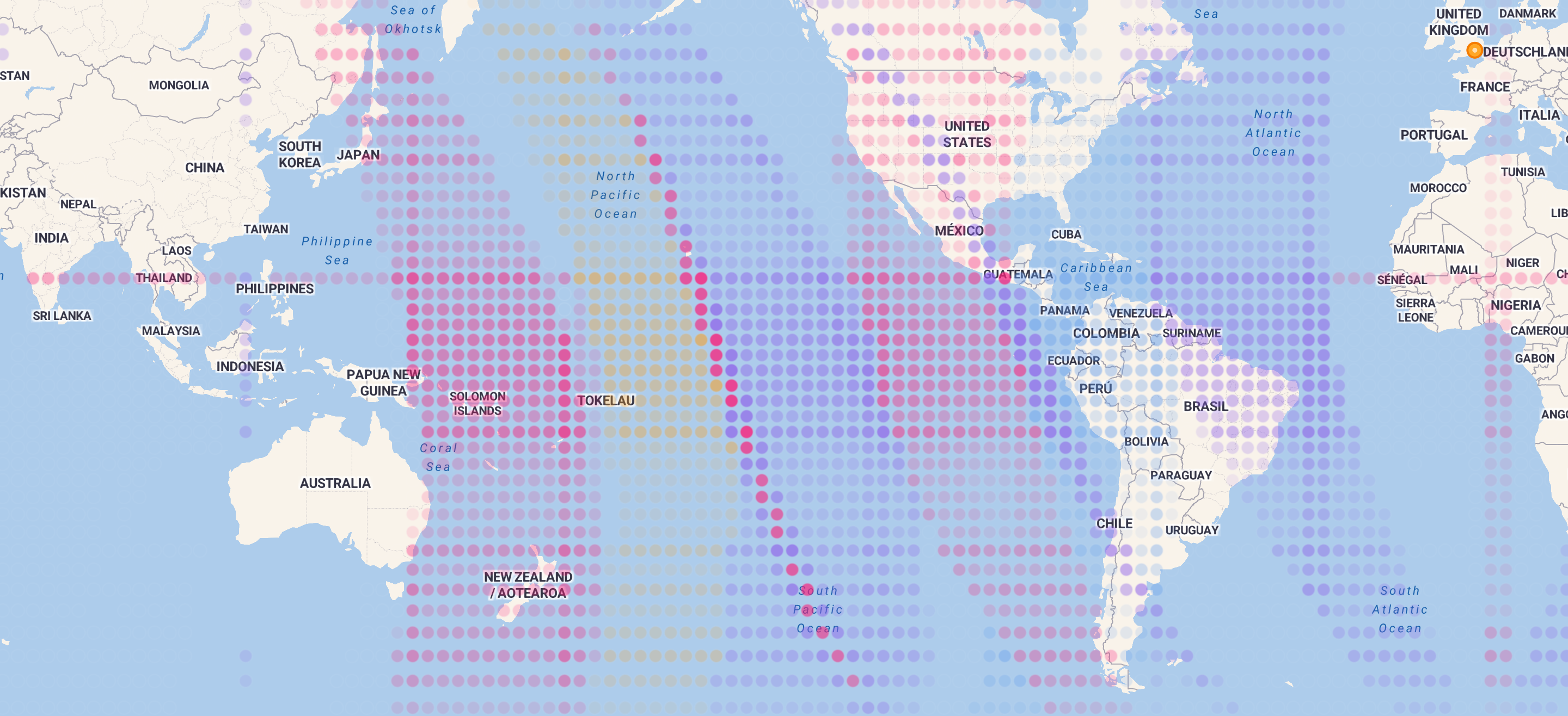
Full Spectrum view: every point is scored on its own, colored by the planet actually driving the number there.
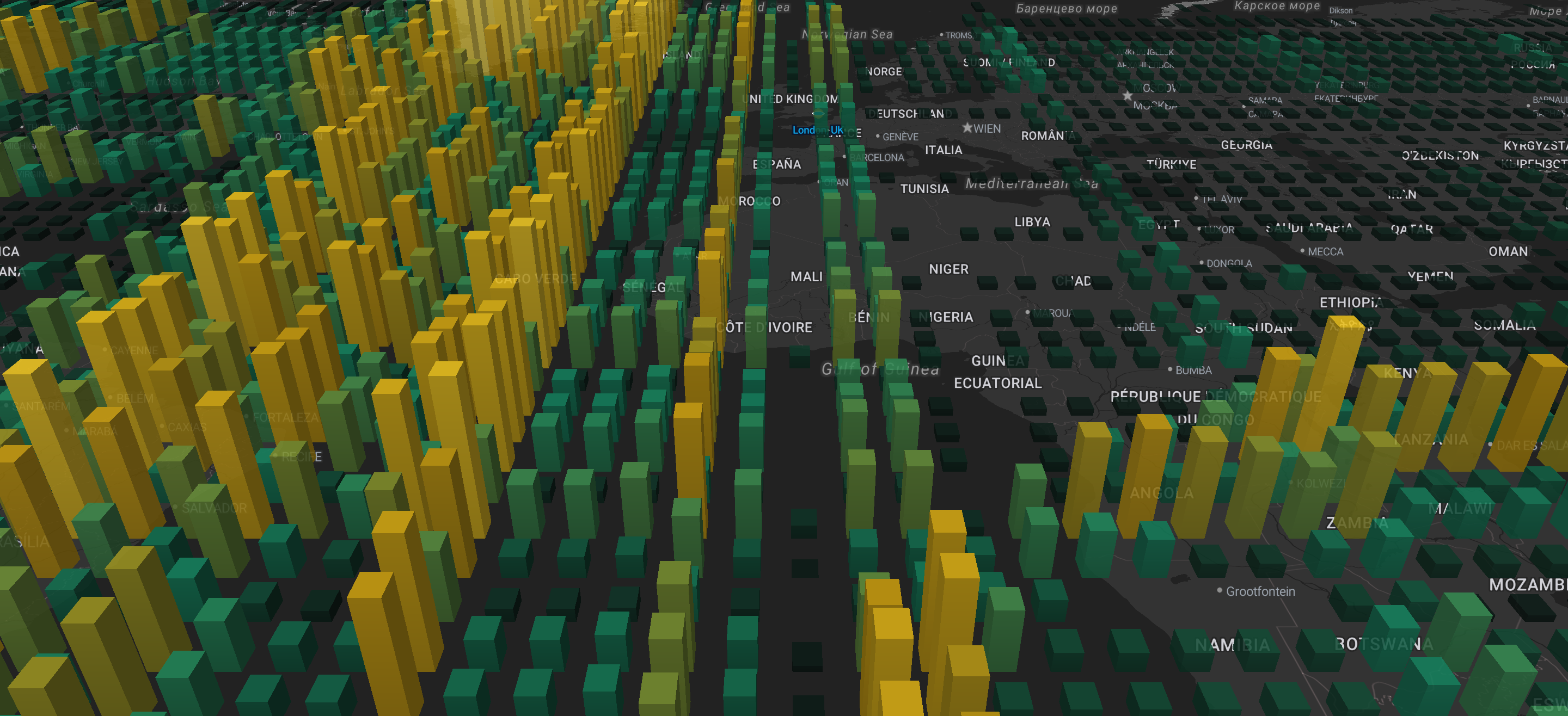
Score as elevation. Height is intensity, not just color, once you're in 3D mode.
What it's for, and what it isn't
The heatmap is a decision tool, not a fortune. It won't tell you that you'll fall in love in Lisbon or land a promotion in Singapore. Any tool that promises that is selling certainty a birth chart can't give. What it will do is show you where your chart's real astrological weight concentrates for the question you're actually asking, across an entire region or the whole globe at once. Instead of reading forty individual lines and holding the pattern in your head, you get the pattern as color. You can go find out what's driving it whenever you want the detail. It's built to shortcut the hardest part of reading a locational chart: not understanding any one line, but holding all of them in your head at once long enough to feel where they add up.
That's also why it exists at all. The heatmap only became possible because ELA Map already had to build an ephemeris engine that could recompute a full chart's geometry against sixteen thousand points on Earth for a single map (see the data and engine behind ELA Map). Once that capability existed, scoring instead of just drawing was the natural next step. Take the same NASA/JPL-grade positions, run them through the same doctrine you'd apply to any single relocation chart, and do it everywhere at once.
The themes, in Astro and Human Design
In Astro mode you pick from five themes. Each one has its own rule set, drawn from a different house structure and its own named authorities:
- Love & Relationships: the 7th house and Descendant, secondary weight on the 5th (Bonatti, Lilly, Dorotheus)
- Career & Purpose: the 10th house and Midheaven, secondary weight on the 1st (Ptolemy, Valens, Lilly)
- Wealth & Fortune: the 2nd, 8th, and 11th houses (Ptolemy, Valens, Dorotheus)
- Healing & Growth: the 12th, 4th, and 6th houses, keyed to the Moon and Chiron (Lilly, Bonatti, Reinhart)
- Full Spectrum: a theme-agnostic voltage map. Every planet contributes, regardless of benefic or malefic quality. Useful for finding places of raw activation rather than a specific life domain.
In Human Design mode there are two kinds of field you will rarely find anywhere else. The Expression Field shows where your defined design is amplified most. Five focus lenses (Bonds, Enterprise, Mastery, Creation and Renewal) each score one group of channels across the globe.
That Human Design side is a genuine gap in this space. Locational astrology tools exist. Human Design tools exist. A geographic scoring engine that speaks both languages at once, gate by gate, is hard to find (see Human Design astrocartography for what that overlay looks like on its own).
Reading it in ELA Map
The heatmap lives in the map's Field panel, switchable by theme without recomputing your chart:
- Reading the Map: the shared grammar of lines, angles, and orbs the heatmap draws on.
- Relocation Analysis: the single-chart, single-location version of the same question, for when you want to go deep on one place instead of scanning the world.
- Astrocartography Fundamentals: the four-angle mechanics behind every channel in the engine.
- The Data and Engine Behind ELA Map: the ephemeris work that made scoring the whole planet at once possible in the first place.
- Best Places to Live: how to hold a heatmap score honestly when you're actually weighing a move.
- Glossary: plain-language definitions for orb, paran, zenith, dignity, and every other term the engine uses.
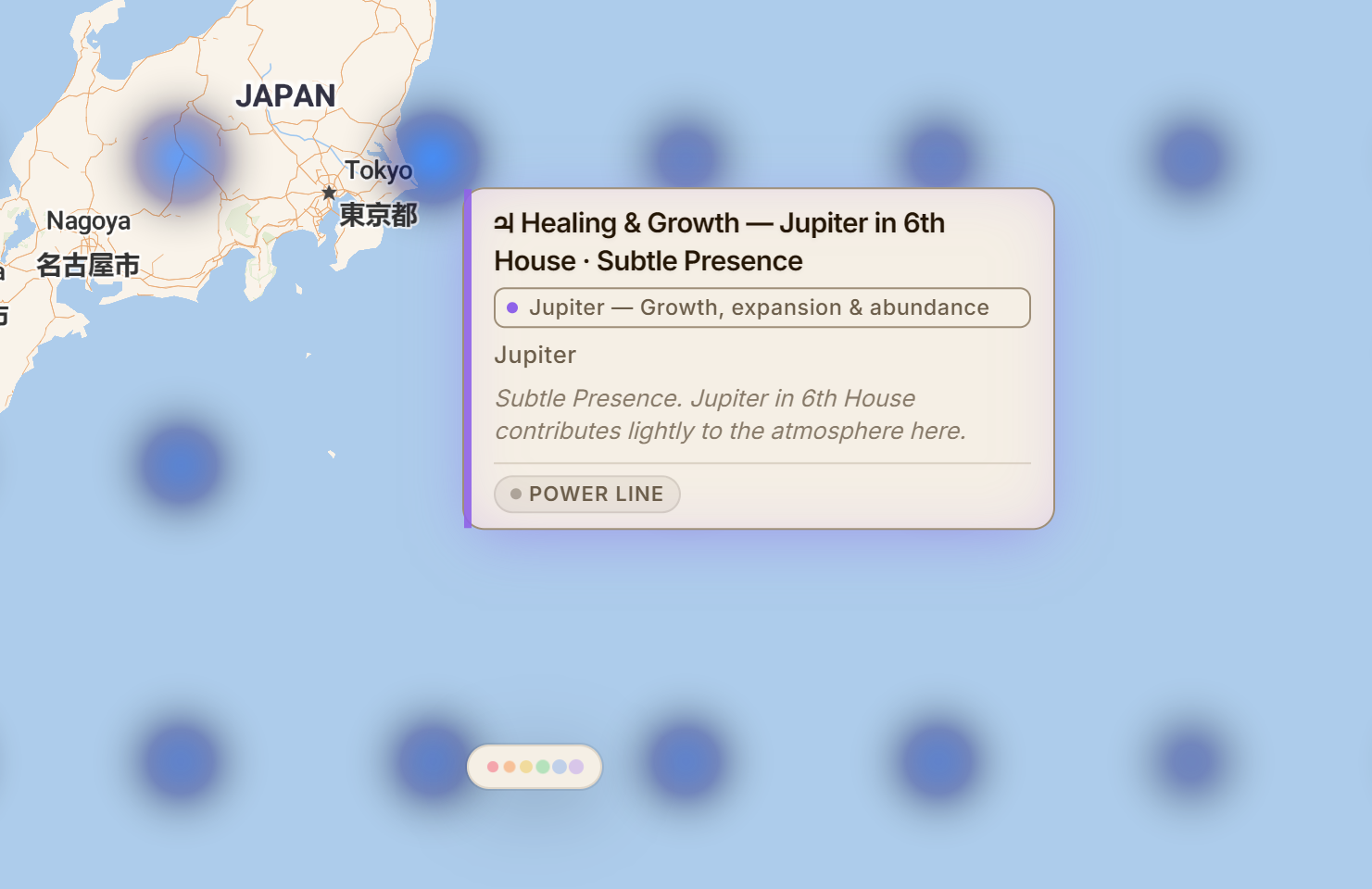
Click any point and the receipt is right there: the planet, the house, and what it's actually contributing to the score.
See your own heatmap
Free. No card. Your world scored to your chart, not someone else's, in about two minutes.
Get started