Human Design Astrocartography: The Complete Guide
Human Design astrocartography, or Human Design cartography, is a Human Design map of the world that shows where your defined gates and channels amplify. See how your chart interacts with the globe: locational Human Design.
Photo: Astroby krishna / Unsplash
Human Design astrocartography maps where on Earth your defined gates and channels get amplified, and where your open centers quiet down enough to hear your own Strategy and Authority. Your Human Design chart doesn't change when you relocate. Type, Strategy, Authority, and Profile are fixed at birth, for life. What changes is volume: which parts of your design get loud in a given place, and which go quiet. Human Design astrocartography maps that volume dial. It's drawn from the same planetary geometry as standard astrocartography, read through Human Design's own gate-and-channel language.
Human Design usually lives in one place: a static bodygraph, cast once and read forever. Astrocartography usually lives in another: a world map streaked with lines, built for people asking "where should I live," not "who am I." Human Design astrocartography is the small, specific territory where those two systems actually overlap. It's not a metaphor and not a mashup. It's the same birth-moment planetary positions read twice: once through Human Design's vocabulary, once through geography's. Almost nobody builds this. Casting one relocated Human Design chart is easy. Casting the full-globe version (every gate, every angle, everywhere on Earth) is a different order of computation entirely. That gap is what this page, and the tool underneath it, exists to close.
Does Human Design change by location?
No. This is the single most important sentence on this page. Your Type, Strategy, Authority, and Profile are calculated once, from your exact birth data. They do not move. A Manifesting Generator does not become a Projector by crossing a border. An emotional Authority does not become a sacral one on a layover. Nothing about relocation edits the chart itself.
What does change is expression: how loudly the design you already have gets played. Human Design astrocartography draws the specific lines on Earth where a defined gate or channel in your chart becomes angular (rising, setting, overhead, or underfoot). Those lines mark where that part of your design runs hottest. Cross into a place where none of your defined lines are active, and the same design runs quieter. It's not absent, just less insistent. That's the entire claim. Nothing in Human Design astrocartography defines a center, activates a gate, or completes a channel by virtue of place alone. A place can only amplify, foreground, or quiet what your birth chart already carries.
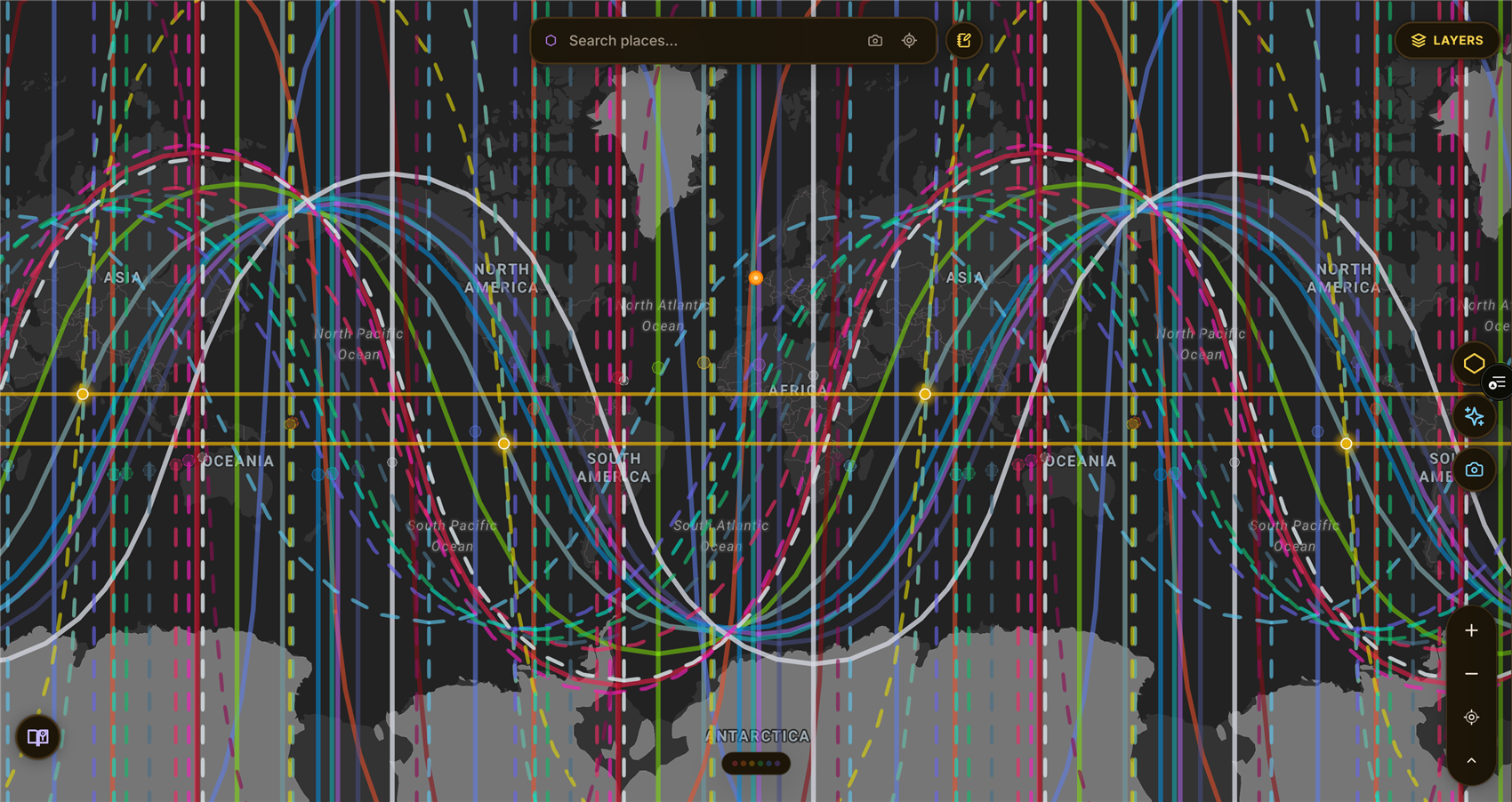
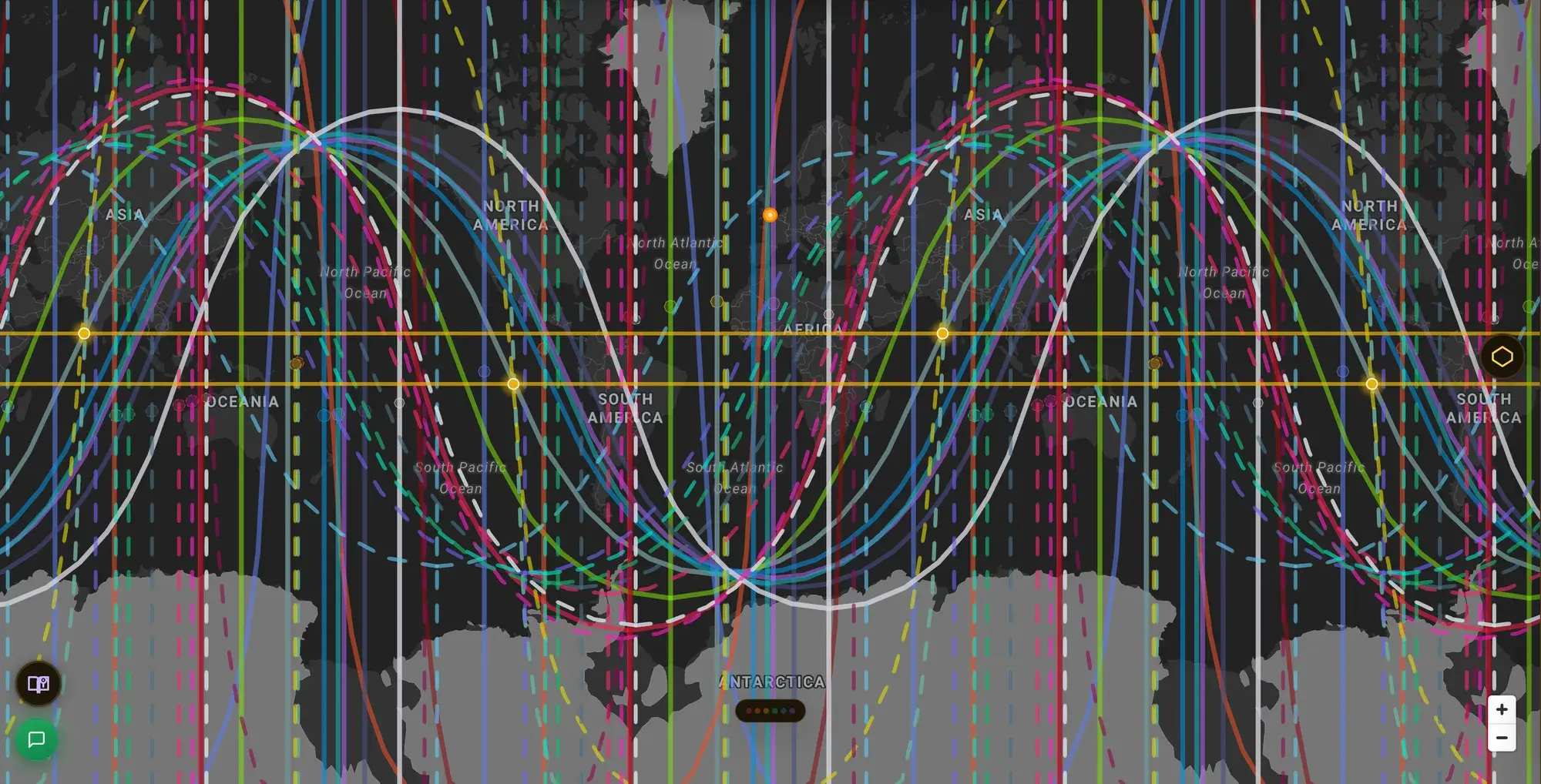
HD Cartography mode in ELA Map: every defined gate and channel in one bodygraph, drawn as its own line across the entire Earth at once. This is the full-globe view a single relocated chart can't give you.
The four angles: a map of resonance
Every line on the map belongs to one of four angles. They aren't four flavors of the same thing. Each one changes the register an activation plays in:
- Rising: it leads. It's the first thing a place pulls out of you, before you've decided anything.
- Setting: it arrives through other people. The activation shows up in who you meet and what they ask of you.
- Overhead: it goes public. Vocation, reputation, the version of you the world files under your name.
- Underfoot: it works in private. Home, roots, the inner life nobody photographs.
A channel that barely registers in your bodygraph can move to the front of the room in a city where its activating planet runs overhead, then recede in one where the same planet sits underfoot. Same design, different volume, set by geography. That movement is a map of resonance, not a map of change. It's the entire reason locational Human Design exists.
A gate is not a sign: the mechanics in sixty seconds
Human Design and astrology share raw material: the same planetary positions along the ecliptic. But they slice it differently. Conflating the two slicings is the fastest way to get Human Design wrong.
Astrology divides the ecliptic into twelve 30° signs. Human Design divides the same 360° circle into 64 gates, each keyed to one of the 64 hexagrams of the I Ching, each occupying exactly 5°37'30" of arc. Several gates fit inside a single sign. So "the Sun is in Leo" and "the Sun activates Gate 1" can both be true of the same birth moment. But they're answering different questions: one about a 30° zodiac division, one about a 5°37'30" I Ching division. A chart reading that treats them as interchangeable has already lost the plot.
Every gate a planet activates in your chart is fixed by that planet's ecliptic longitude alone: a single, unchanging number set at your birth moment. Relocating never moves a planet into a different gate. There is no version of "moving to Lisbon activates Gate 25" that is true. What relocation changes is which gate's slice of the ecliptic sits on your local horizon or meridian right now, from where you're standing. That's the same geometry astrocartography already draws, read through Human Design's hexagram grid instead of astrology's zodiac.
The highlighted wedge: one 30° zodiac sign (outer ring) spans roughly five Human Design gates (inner ring), each exactly 5°37'30" of arc.
Design and Personality are two separate activation sets
Every gate in your chart got activated twice, by two different planetary snapshots. Human Design astrocartography keeps both.
Personality activations are calculated from the planets at the moment you were born. This is the conscious layer, the design you'd recognize as you if you read the chart out loud. Design activations are calculated from the planets roughly 88 days earlier, at the moment the sun crossed 88° of arc before your birth. This is the unconscious, somatic layer, the design other people clock in you before you've said a word.
A relocation line only ever belongs to one of the two. When a Design-side gate goes angular in a place, the amplification tends to be felt in the body before it's named: instinct, physical charge, a register you notice in your gut. When a Personality-side gate goes angular, it tends to surface as opinion, something you find yourself arguing for, thinking about, consciously identifying with. Reading a Human Design astrocartography map without keeping the two apart collapses a real, felt distinction into noise.
The two fields: expression and conditioning
Human Design astrocartography works because it respects a boundary that's easy to blur and important to keep clear: place acts on what your chart defines, and it never invents what your chart leaves open. ELA Map renders that boundary as three distinct visual registers on the bodygraph: solid, bloom, and hatch. The difference between "yours," "amplified," and "conditioned" is visible at a glance, never blended:
| Expression field | Conditioning field | |
|---|---|---|
| Lives in | Your defined gates, channels, centers | Your open, undefined centers |
| What moves it | Place: which of your defined lines is angular here | People's auras and transits: who you're near, what the current sky is doing |
| What it does | Amplifies design that's already yours | Pressures you with what isn't yours (the not-self) |
| Honest verbs | amplifies, foregrounds, runs hot, resonates | conditions, presses, runs loud/quiet, absorbs |
| Never | defines, activates, completes, unlocks | defines, activates, completes, unlocks |
Your defined centers are the parts of your chart that are consistently, reliably you, everywhere on Earth. Human Design astrocartography's expression field draws where that fixed material gets turned up. Your open centers are where you're naturally porous to other people and to the sky's current transits. That's real Human Design, and real Human Design astrocartography honors it. But that porosity is a property of the fixed bodygraph, not something a place can install. An open center doesn't get "activated" by moving there. At most, the place is where the pressure on that opening happens to be loud right now, via transits or the people you're standing next to. The map is honest about which of those two things it's showing you.
What a place can never do to your chart
Worth stating plainly in one place, because it's the boundary every serious Human Design reading depends on:
- A place cannot define a center that your birth chart leaves open.
- A place cannot activate a gate you weren't born with.
- A place cannot complete a channel. Channels complete two ways in Human Design: electromagnetically, through another person's chart (synastry), or temporarily, through a transiting planet currently occupying the missing half. Geography is neither of those. The honest home for "I'm one gate away from a full channel" is a person, not a place.
- A place cannot change your Type, Strategy, Authority, or Profile.
What a place can do is turn up the volume on a gate or channel you were already born with. That's still a real and useful thing to know. It's just a smaller, more precise claim than "this city will complete me." Human Design astrocartography is built to make exactly that smaller claim, correctly, instead of the bigger one that sells better and isn't true.
Human Design astrocartography vs. the alternatives
| A standard Human Design chart | Standard astrocartography | Human Design astrocartography | |
|---|---|---|---|
| What it plots | Gates, channels, centers, once, for one moment | Planetary lines (rising, setting, overhead, underfoot) across the whole Earth | Human Design's gate/channel activations, drawn as lines across the whole Earth |
| Answers | "What is my design?" | "Where on Earth is a given planet angular?" | "Where on Earth does my specific gate or channel go loud?" |
| Location-aware? | No: one chart, no map | Yes, but speaks astrology's language (planets, signs, houses) | Yes, and speaks Human Design's language (gates, channels, centers) |
| Where it falls short alone | Tells you what you are, never where | Tells you where a planet is angular, but not what that means for your bodygraph | Nothing it leaves to the others |
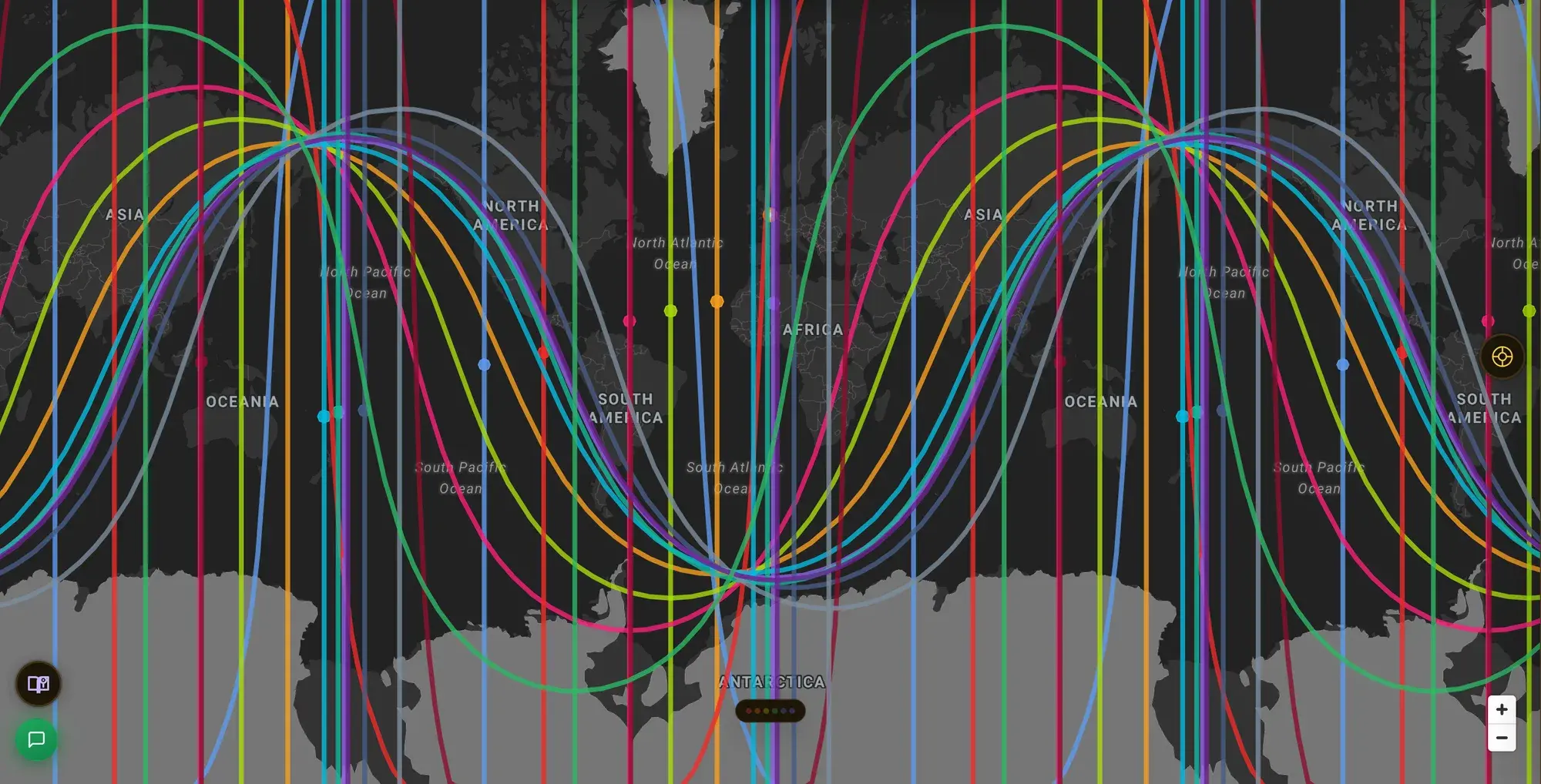
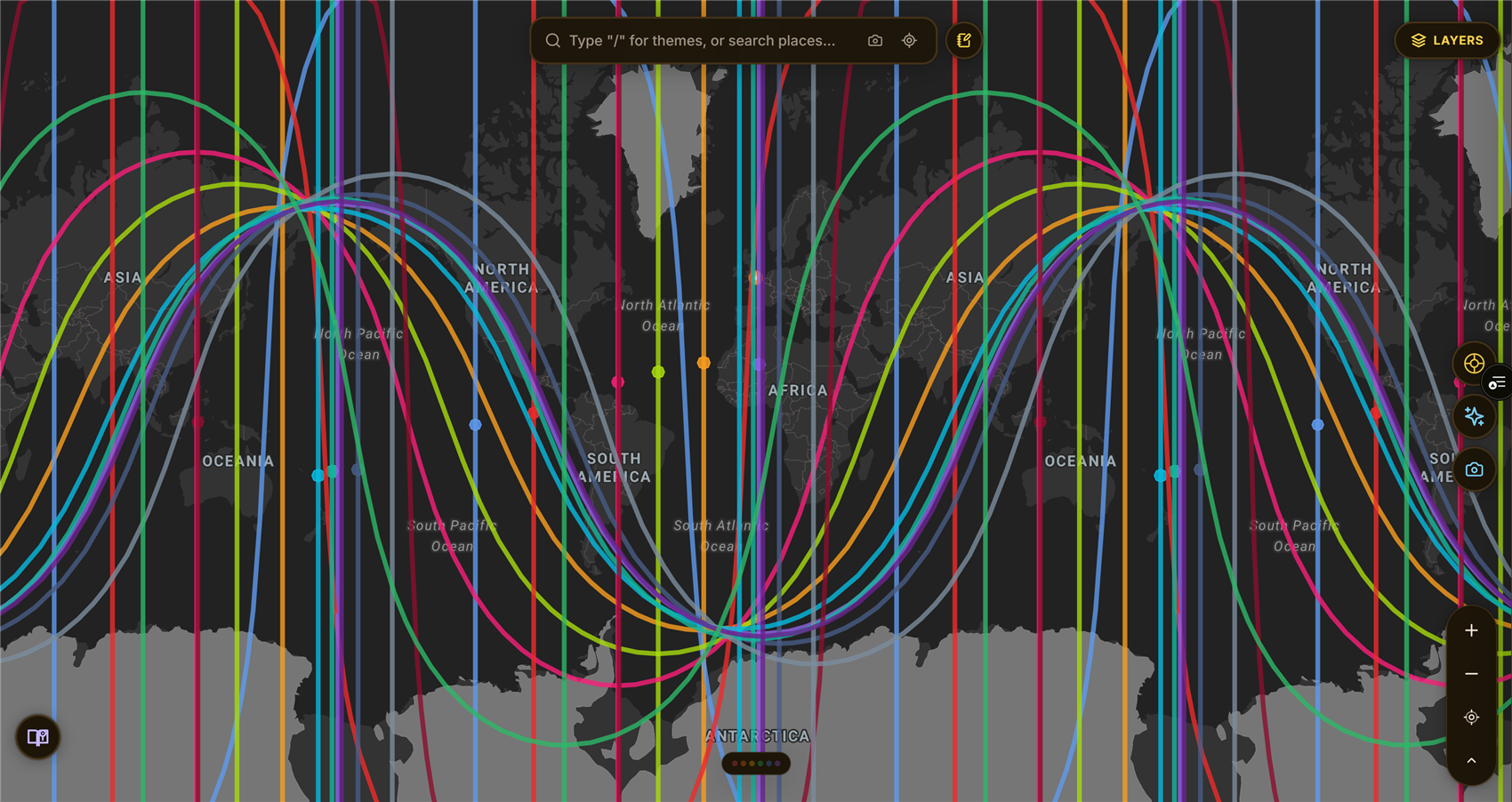
The same birth chart, read through geography's vocabulary: standard astrocartography draws each planet's lines across the Earth. HD Cartography (shown earlier) redraws the exact same geometry in Human Design's gates and channels instead. One birth moment, two readings.
Reading your own map: a walkthrough
- Start from your defined gates, not the whole chart. Undefined centers don't have relocation lines to read. They're informed by transits and people, covered separately in ELA Map's conditioning layer, not by geography's amplification lines.
- Pick one defined gate or channel you already recognize in yourself, something you'd call unmistakably you.
- Find where its line goes angular. ELA Map draws it on the four angles (rising, setting, overhead, underfoot), the same four registers astrocartography uses for any planetary line.
- Read the angle, not just the location. Rising means it leads: it's the first thing that place pulls out of you. Overhead means it goes public: vocation, reputation. Underfoot means it works in private. Setting means it arrives through other people.
- Check whether it's Design or Personality. A Design-side line runs somatic, felt before it's named. A Personality-side line runs mental, and you'll have opinions about it.
- Look for crossings. Where two of your lines meet at a single point, two parts of your design get forced into the same room at once. This is often the single most specific thing the map tells you about a city.
- Hold it against Strategy and Authority. The map is information about where your design gets loud. Deciding what to do with a loud (or quiet) place is still, correctly, a Strategy-and-Authority decision. The map doesn't make that decision for you.
The data underneath it
Casting one Human Design chart is a solved problem. Plenty of tools do it well. Casting the entire design, every gate, every channel, against every point on the surface of the Earth, accurately enough that a line lands on the correct side of a mountain range, is a different problem. It's one almost nobody has actually built. Off-the-shelf astrology libraries compute one chart at a time. They were never built to recompute a whole sky's geometry against a planet's worth of coordinates, for both the Personality and Design activation sets, simultaneously.
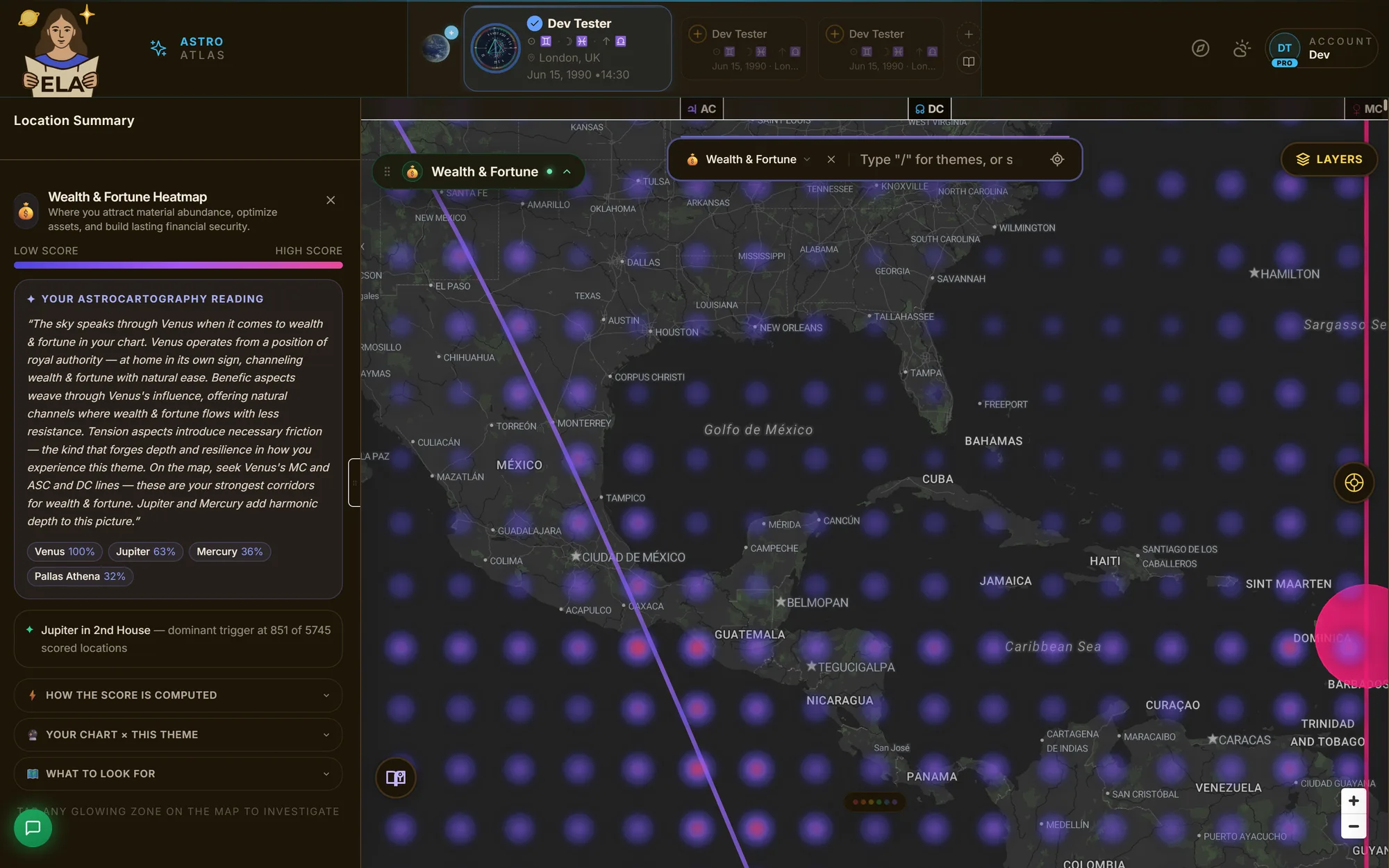
So ELA Map built its own ephemeris engine from the raw planetary data, the same NASA/JPL datasets used to navigate actual spacecraft, instead of wrapping someone else's shortcut. That's the foundation underneath full-globe Human Design activation maps, five-chart overlays, and crossings computed on the fly. None of that is something a single-chart tool can offer.
It's also the answer to the obvious suspicion anyone should bring to a page like this one. Every line here is geometry, not vibes. Every interpretation on the map is sourced from transparent, named Human Design and astrological doctrine, not generative AI, so it reads the same way every time you ask it. (Today readings and Location Reports are compiled from that same interpretation library, refined by AI.) Human Design itself was originated by Ra Uru Hu. ELA Map draws on that system's published mechanics (gates, channels, centers, Type, Strategy, Authority) without claiming certification or affiliation with any Human Design school. You can always see exactly which doctrine produced the sentence in front of you, and you're free to disagree with it. People have argued about both astrology and Human Design for as long as either has existed.
Reading it in ELA Map
Human Design astrocartography lives in the map's Human Design Cartography mode (HD Cartography for short). Good places to go next:
- Astrocartography Fundamentals: the four-angle mechanics (rising, setting, overhead, underfoot) this page builds on. Start here if locational astrology itself is new to you.
- Reading the Map: the shared grammar of lines, angles, and orbs across every layer ELA Map draws.
- Using Human Design Mode on the Map: how to switch into HD mode in the product, and what each overlay actually shows.
- The Heatmap Engine: how to score a whole region at once by Human Design activation density, instead of reading one line at a time.
- Best Places to Live: how to weigh a place through both the Human Design and astrocartography lenses, plus the somatic check that decides.
- Glossary: plain-language definitions for gate, channel, center, Personality, Design, and every other term on this page.
See your bodygraph mapped
Free. No card. Your defined gates and channels drawn across the Earth in about two minutes.
Get started