ELA Map Glossary: Astrocartography & Human Design Terms
Plain-language definitions for astrocartography, relocation astrology, and Human Design cartography terms: lines, parans, gates, channels, and the ephemeris.
A reference for the terms you'll encounter across astrocartography, relocation astrology, and Human Design cartography. Terms link to deeper guides where they exist.
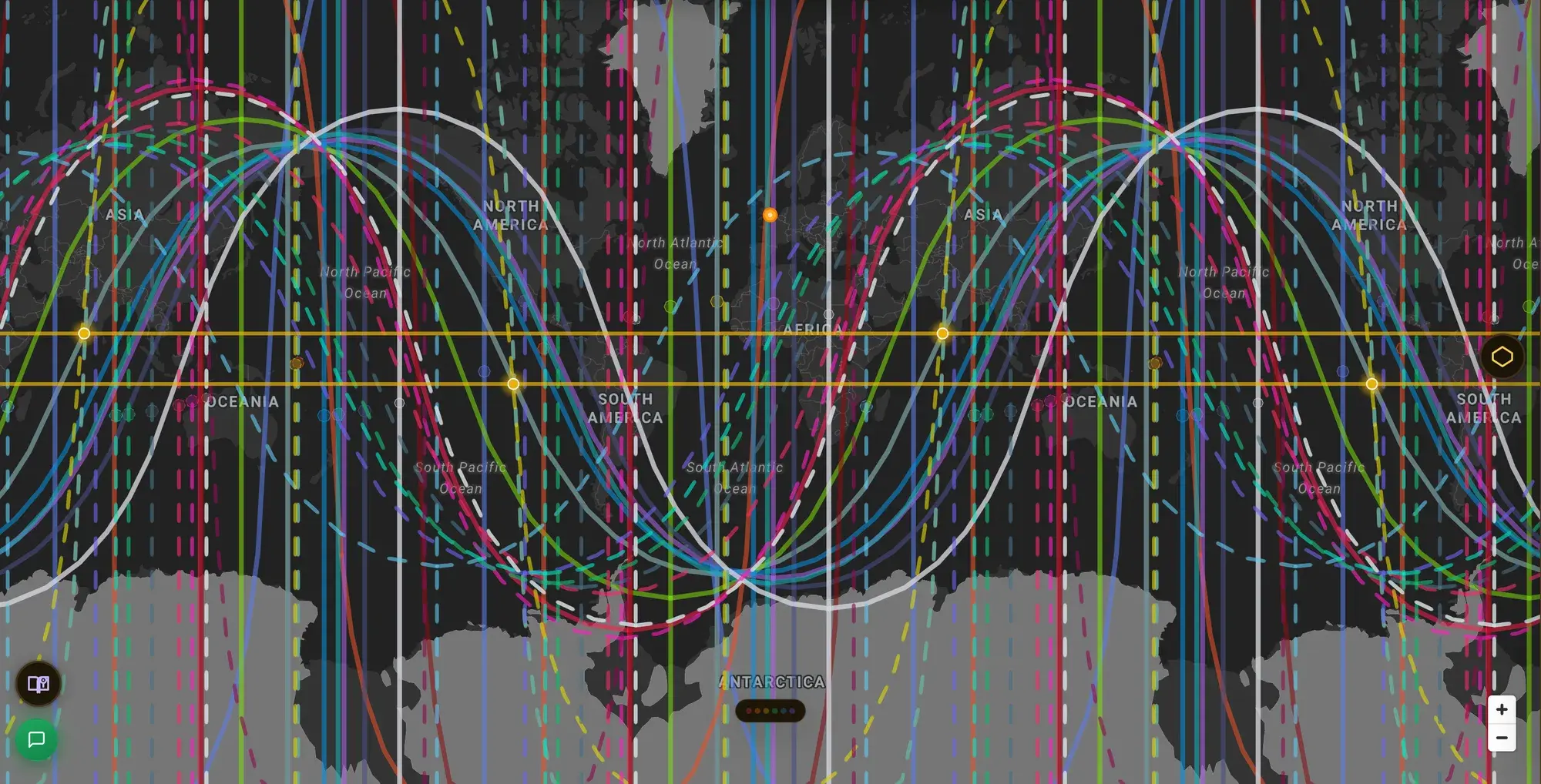
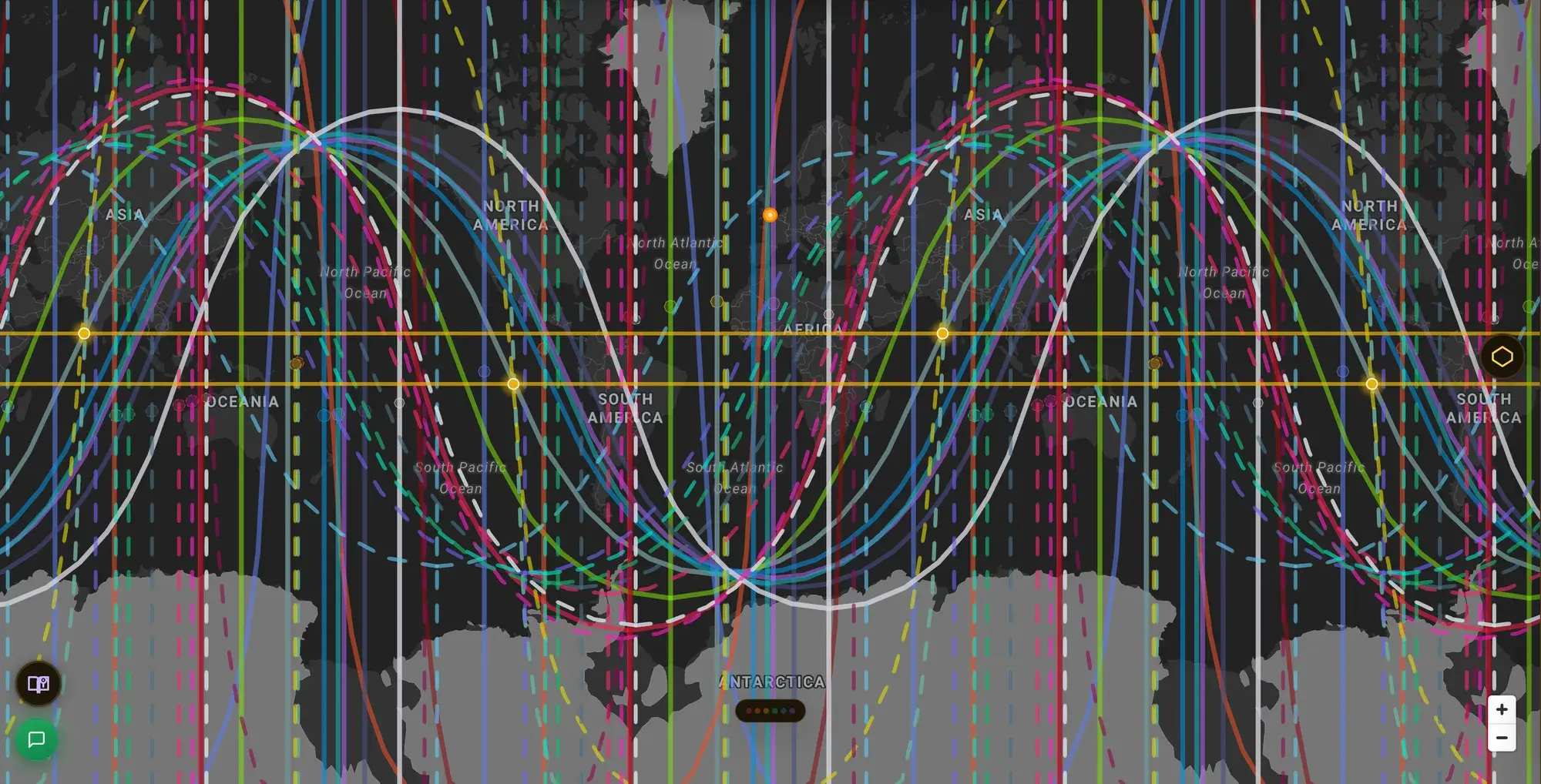
Most of the vocabulary below is visible in one view: lines, angles, gates, and channels, drawn across the Earth in ELA Map's Human Design mode.
Astrocartography
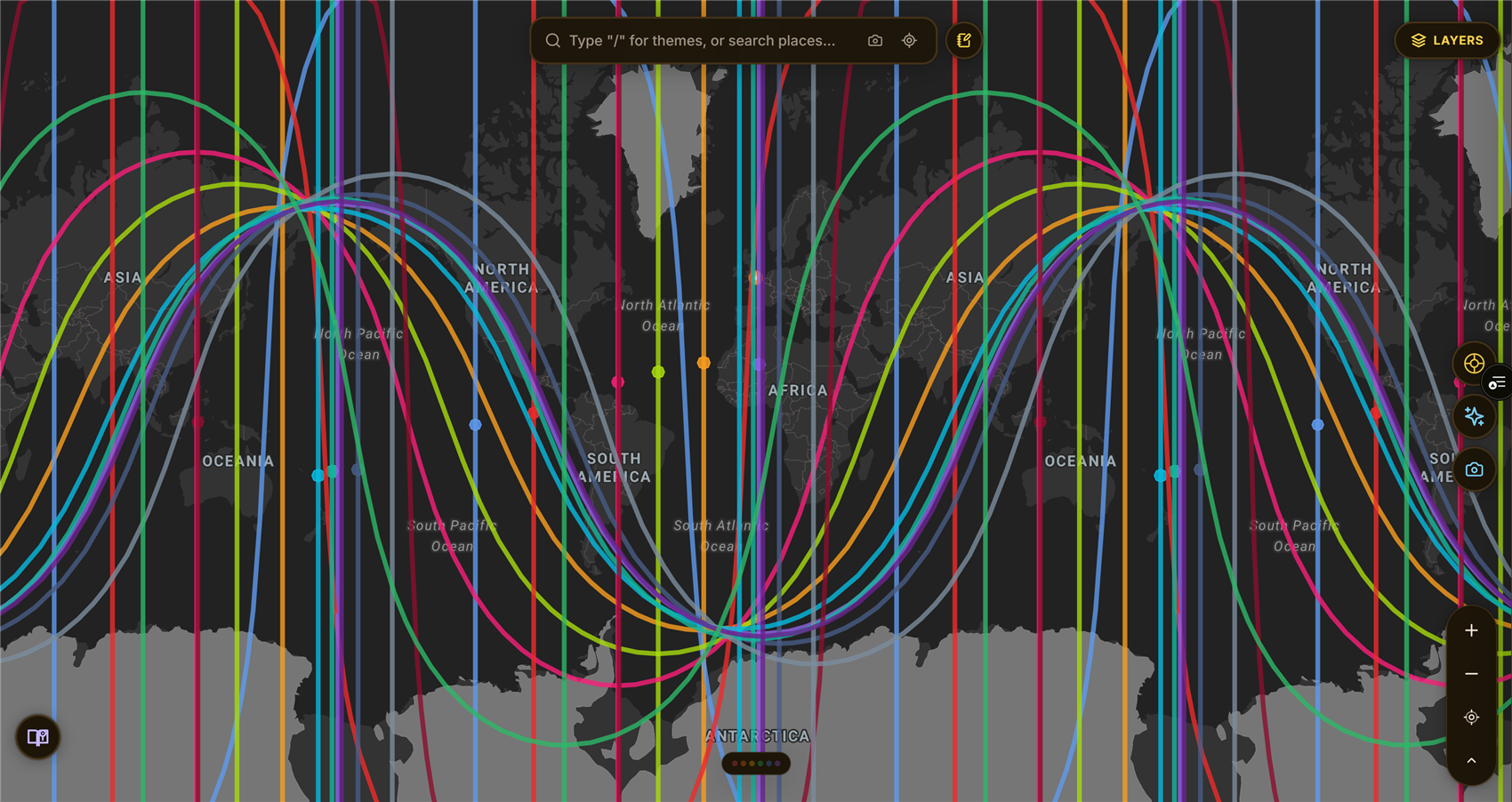
A technique that projects your natal chart onto the surface of the Earth. For each planet in your chart, astrocartography draws four lines around the globe: one where that planet was rising, one where it was setting, one where it was overhead, and one where it was directly underfoot. All four are set at the exact moment you were born. The result is a personal map of how the sky at your birth reaches down to geography.
For a full introduction, see Astrocartography Fundamentals.
Relocation Astrology
The broader practice of understanding how a place reshapes the expression of your natal chart. Astrocartography is its most visual branch: lines on a globe. Relocation astrology also includes comparing relocated charts, studying parans by latitude, and scoring regions with tools like a heatmap. The question behind all of it is simple: what does here call out of you that there doesn't?
See also: Family Relocation Astrology.
Locational Astrology
The umbrella term for any astrology that turns on place, not just time. Astrocartography is the best-known form. Locational astrology also covers relocated charts, local space, and parans. The same place-based lens applied to a Human Design chart is locational Human Design, the foundation of Human Design astrocartography.
Human Design Cartography
The mapping of a Human Design chart onto the Earth: locational Human Design, or the astrocartography of the bodygraph. A standard astrocartography line stops at the planet. Human Design cartography carries the planet's gate, channel, and center with it, so each line is specific to your design. See Human Design Astrocartography for the full guide.
The Four Angles
The four angles are the cardinal points of any astrological chart, and the four types of ACG lines that run across the globe. Each angle changes the register a planetary energy plays in.
Rising Line (Ascendant)
A line marking every place on Earth where a given planet was exactly on the eastern horizon at the moment of your birth. The rising angle is tied to presence and first impression. On a rising line, that planet leads. It's often the first thing a place seems to pull out of you.
Setting Line (Descendant)
A line marking every place where a planet was on the western horizon at birth. The setting angle governs relationship and encounter. On a setting line, that planet tends to arrive through other people: expressed by partners, drawn out by close contact rather than willed from within.
Overhead Line (MC / Zenith)
A line marking every place where a planet was at its highest point in the sky at birth: the midheaven (MC). The overhead angle is tied to public life, reputation, and vocation. On an MC line, that planet tends to go public. It becomes visible, career-shaping, the version of you the world files under your name.
Underfoot Line (IC / Nadir)
A line marking every place where a planet was directly beneath the Earth at birth: the imum coeli (IC). The IC is the most private angle: home, roots, the inner life nobody photographs. On an IC line, a planet works quietly, shaping foundation and belonging rather than projection.
ACG Power Line
Any of the four angle lines (rising, setting, overhead, underfoot) drawn for a given planet across the globe. "ACG" stands for astrocartography. Each power line is a curved meridian or circle on the Earth's surface. A complete astrocartography map contains dozens of them: one set of four per planetary body. The lines are computed from research-grade NASA/JPL ephemeris data, so they land on the correct side of a mountain range rather than approximating a region.
Paran
A relationship formed when two planets occupy the same angle at the same latitude at the same time. For example, one planet rises exactly as another sets, both at the same parallel on Earth. A paran doesn't mark a meridian. It marks a latitudinal band: the horizontal belt around the Earth where that two-planet relationship was active at the moment of birth. Parans predate the line-based system, and they name a different kind of planetary connection than a single-body power line does.
Crossing
The latitude band where two of your lines are angular together. It starts where two ACG lines intersect: at that point both planets reach an angle at the same time, and because that pairing depends on latitude, it holds along the whole latitude, not only at the point. ELA Map draws it as a line and labels it with both lines, for example Jupiter DC × Pluto AC. The classical name is a paran. Crossings are a second layer, weaker than the lines themselves, but they can tell you something specific about a city: two energies, in the same room, at once.
Zenith Point
The single place on Earth where a specific planet was directly overhead, at the exact zenith, at the moment of your birth. Every planet has one zenith point. The Sun's zenith is the latitude of your birth (the Sun was directly overhead at noon local solar time on your birth date, at that latitude). People often experience zenith points as places of acute personal resonance, where that planet's themes feel unusually direct and close to the self.
Local Space
A system of mapping that projects the planets outward from your birth location along compass directions rather than global meridians. Astrocartography asks, "where on Earth was Mars rising?" Local space asks, "in what compass direction was Mars from where I was born?" The result is a set of straight lines radiating outward from your birthplace. It's less a global map of where to live, and more a directional map of how planetary energies run from any given home base.
Cyclocartography
Jim Lewis's companion technique to astrocartography, published in 1982. Your natal lines stay fixed, but the planets keep moving. Cyclocartography draws the lines of those moving planets over your natal map, so you can see where the sky is activating your chart on a given day. The classic set uses the transiting outer planets, Jupiter through Pluto, and the progressed inner planets, Sun through Mars. You may also see these called transit lines or moving lines.
See Transit lines and cyclocartography for how they are cast and how they move.
Heatmap
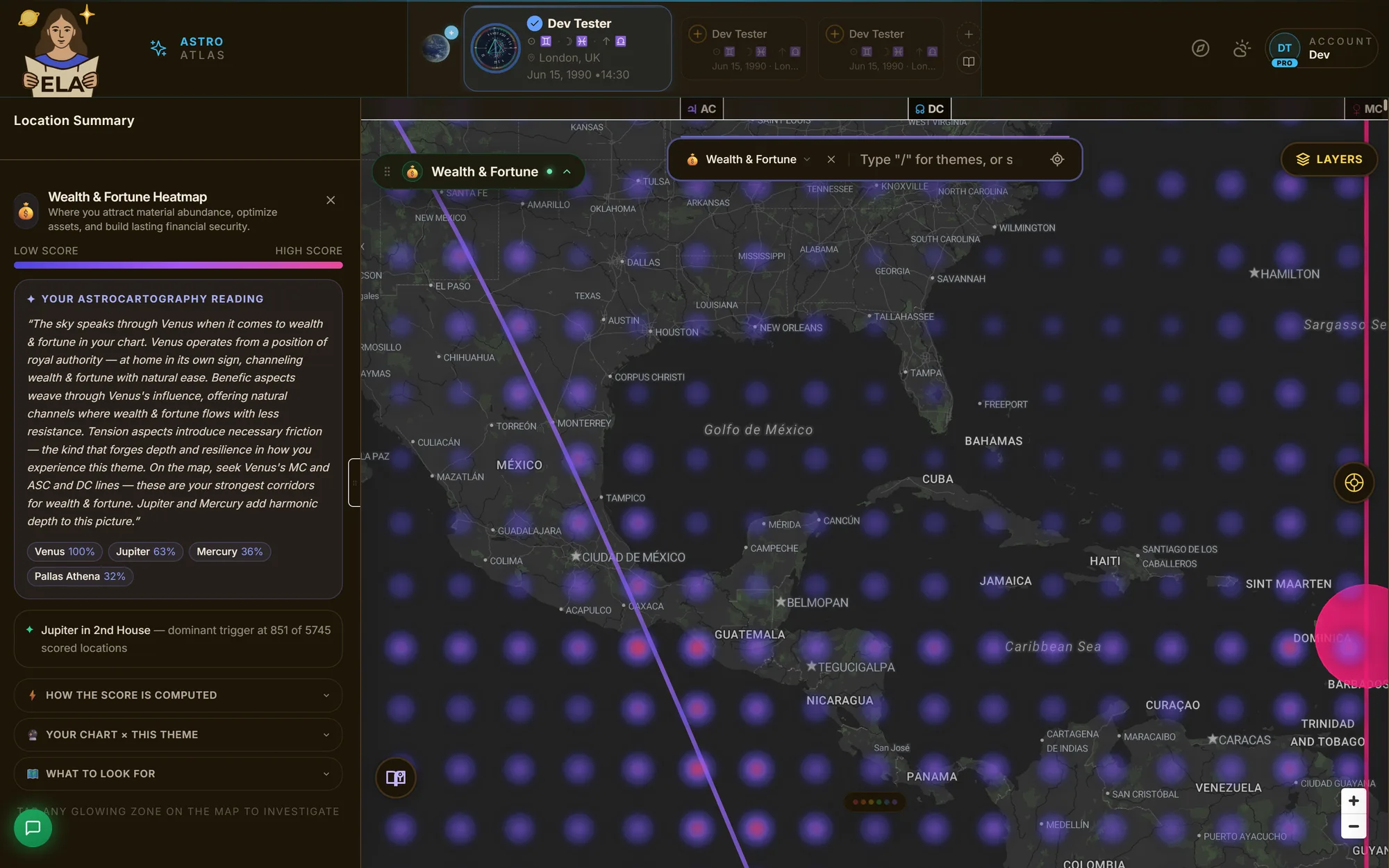
A color-coded overlay that scores every region on Earth against a chosen theme: love, career, wealth, healing, intensity, and others. Instead of reading one line at a time, the heatmap combines the influence of all relevant planetary lines, their orbs, and their interactions across a high-resolution grid. It then renders the result as a gradient across the globe. Warmer zones reflect stronger calculated influence for that theme; cooler zones reflect less. It's the difference between reading individual words and reading the paragraph.
See The Heatmap Engine for full methodology.
Composite Chart
A technique for studying a relationship between two people by creating a single chart to represent the pair. The most common method takes the midpoint of each matching pair of planets: the midpoint between your Sun and their Sun, your Moon and their Moon, and so on. Those midpoints become a new chart. That chart describes the relationship itself as a third entity with its own qualities, distinct from either individual.
Davison Composite
An alternative composite method that creates a relationship chart from a concrete event rather than mathematical midpoints. The Davison takes the exact midpoint in time between two birth dates and the exact midpoint in space between two birth locations. It then casts a real chart for that moment at that place. The result is sometimes called a "time-space midpoint" chart. It can be read on an astrocartography map in its own right.
Synastry
The practice of comparing two natal charts by overlaying them and examining the angular relationships, called aspects, formed between one person's planets and the other's. A composite chart produces a single new chart for the relationship. Synastry instead keeps both charts distinct and studies how they interact: which of your planets land close to theirs, and what those contacts tend to activate in each person. ELA Map supports multi-chart synastry overlays for up to five charts at once.
Human Design Gate
One of 64 archetypes drawn from the I Ching hexagrams, arranged around the ecliptic so that each gate occupies about 5°37'30" of the zodiac. The Sun transits a new gate every five or six days. When a planet occupies a gate at the moment of your birth (or 88 days before it), that gate becomes activated in your Human Design chart. Gates have fixed positions on the ecliptic, so they also have fixed positions on the Earth. That's what makes Human Design astrocartography possible.
See Human Design Astrocartography for how gates translate to lines on the map.
Human Design Channel
A connection between two of the nine centers in the Human Design bodygraph. Each channel has a gate on each end. When both gates are activated, by any planet, in either the Personality or Design calculation, the channel becomes defined, and both centers it connects become defined too. Defined channels create consistent, reliable energy in their domain. On the map, each activated gate generates its own set of geographic lines.
Human Design Center
One of the nine energy hubs in the Human Design bodygraph: Head, Ajna, Throat, G (Identity), Heart (Ego), Sacral, Root, Spleen, and Solar Plexus. Each center governs a domain of experience: cognition, identity, communication, willpower, life force, and so on. A center is defined when at least one connected channel is fully activated. It's open (or undefined) when it's not. Open centers aren't weaknesses. They're places where a person is sensitive and adaptive, often taking in and amplifying the energy of others nearby.
Personality (Human Design)
The conscious layer of a Human Design chart, calculated from the planetary positions at the exact moment of birth. Personality is the design you recognize as yourself: the traits you'd describe if someone asked who you are. On the Human Design map, Personality lines tend to read as what a place seems to be asking of you, the face a location puts on you.
Design (Human Design)
The unconscious layer of a Human Design chart, calculated from the planetary positions about 88 days before birth: the moment when, in Human Design theory, the soul enters the developing body. Design is the layer that shapes behavior and the body in ways other people often notice before you do. On the map, Design lines tend to read as what a location draws out of you, whether or not you intended to offer it.
Incarnation Cross
The overarching life theme in Human Design, formed by four specific gate activations: the gates of the Sun and Earth in both the Personality calculation (birth) and the Design calculation (88 days before birth). These four gates sit at the cardinal points of your Human Design chart. The cross they form describes the broad purpose or direction woven through a person's life. It's less a personality trait and more the territory the life keeps returning to.
Ephemeris
A dataset recording the precise positions of celestial bodies at regular intervals over time. Practitioners and software use ephemeris data to determine where every planet was at any birth moment. ELA Map computes all positions from the JPL DE440 ephemeris, NASA/JPL's own development dataset, used in spacecraft navigation. Planetary positions are accurate to within a tenth of an arc-second. Every line on the map traces back to that foundation.
For more on why this matters, see The Data Engine.
Ecliptic
The apparent annual path of the Sun across the celestial sphere as seen from Earth: the great circle the Sun traces over the course of a year. It's the reference plane shared by the zodiac signs, the Human Design gates, and the measurement of planetary longitude. All astrological positions are measured along or relative to the ecliptic. The same circle that defines Aries 0° also defines Human Design Gate 25. The two systems use the same coordinate, read differently.
See your birth chart drawn as a living map
Free. No card. Your chart, drawn across the Earth in about two minutes.
Get started