ELA Map FAQ: Astrocartography, Human Design & Relocation
Answers to the most common questions about ELA Map: what it is, how the data works, whether you need your exact birth time, and how to get access.
These are the questions most people ask before they see their first map. The answers here are short. Each one links to a deeper guide if you want the full picture.
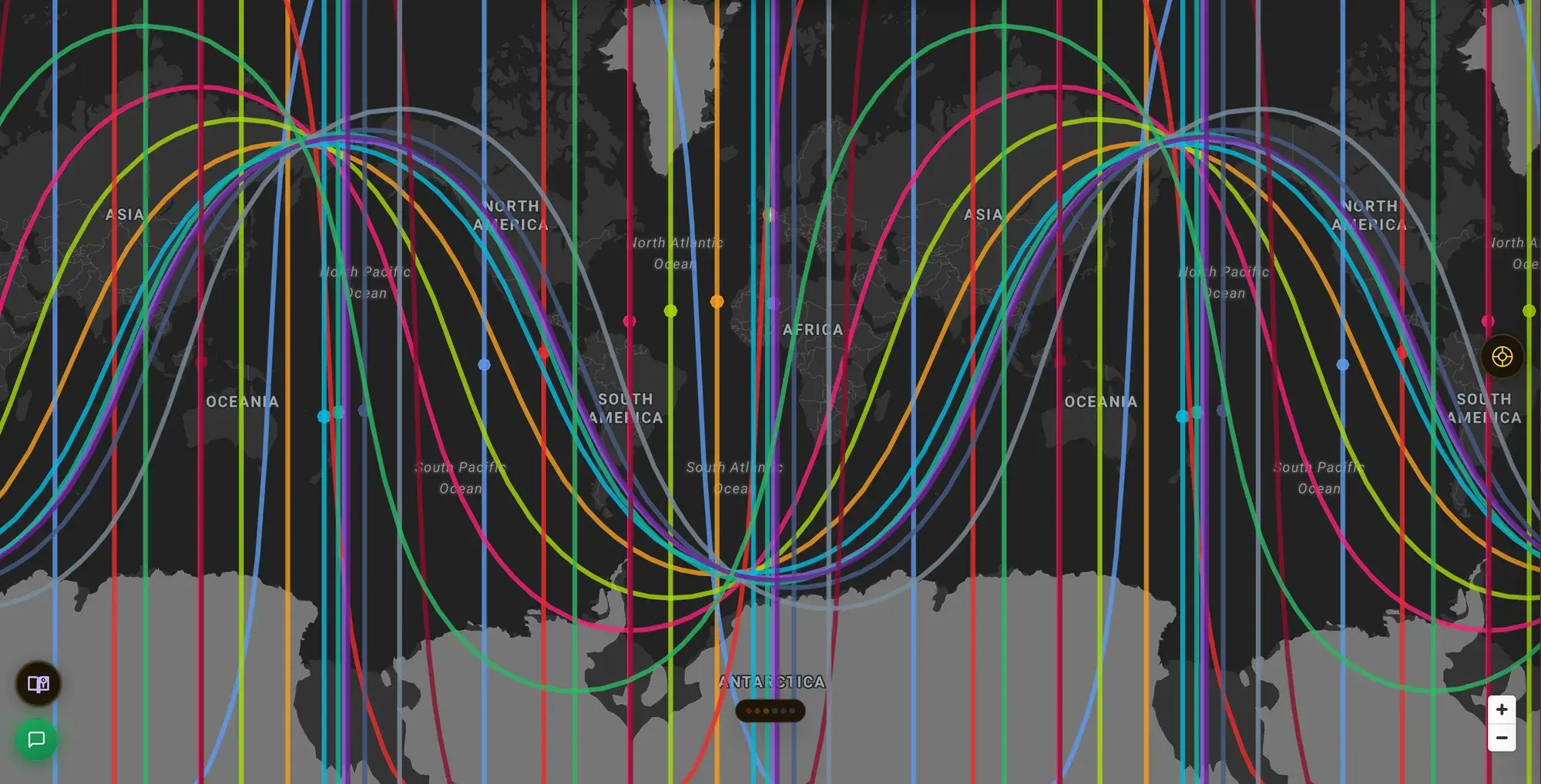
The thing most of these questions are about: one birth chart, drawn as lines across the whole Earth in ELA Map.
Is ELA Map's astrology written by AI?
Not on the map. Every interpretation on the map comes from named, written astrological doctrine. This is a defined body of rules and meanings, authored deliberately and applied consistently. Ask the same question twice and you get the same answer, because the answer is derived, not improvised on the spot. You can always see exactly which tradition produced the sentence in front of you.
This is the opposite of pointing a language model at your chart and printing whatever it free-associates. We made that choice deliberately. Generative AI can sound profound without being accurate. Named doctrine can be disagreed with, but it can always show its work.
Two places go one step further. The short readings on your Today page and your Location Reports are compiled from our interpretation library, refined by AI. Every fact in them comes from your chart's calculated positions, lines and crossings, and a Today reading that names a line, planet, gate or house that isn't in your chart is thrown out.
→ The full explanation: The Data and Engine Behind ELA Map
What is astrocartography?
Astrocartography is a branch of relocation astrology. It draws lines on a world map showing where each planet was rising, setting, overhead, or underfoot at the exact moment you were born. These four angles, and the global lines they trace, show how any place on Earth reshapes the expression of your birth chart. A city that sits on your Venus AC line puts a different face forward than a city on your Saturn MC line. The chart is the same, but the place changes the emphasis.
ELA Map projects those lines from research-grade NASA/JPL ephemeris data, so each line lands where the geometry actually says it belongs.
→ The full beginner's guide: Astrocartography: The Complete Beginner's Guide · every planet and angle: Astrocartography Lines Meaning
What is relocation astrology?
Relocation astrology studies how moving to a different place on Earth changes which parts of your birth chart come forward and which recede. It doesn't alter your chart: the planets stay where they were when you were born. But a new city tilts the angles differently, and that shifts what the chart emphasizes about you there. Relocation astrology covers a range of techniques: basic line reading, relocated chart casting, cyclocartography (where moving planets cross your natal angles over time), and the deeper crossing-point analysis ELA Map computes across the whole globe.
Do I need my exact birth time?
A known birth time sharpens the angle-based lines a lot. The rising, setting, overhead, and underfoot lines are all time-sensitive, and an error of a few minutes can move a line by a city or more. That said, you can start exploring without a perfect time. Many planetary positions are useful even with an approximate one.
ELA Map includes a rising-time estimator for people whose birth time is unknown, so you are not blocked. For the most precise map, especially if you are weighing a real move, the exact time is worth tracking down from a birth certificate or hospital record.
Is ELA Map free?
The core experience is free to explore: your personal map, My Places, the education library, and the tools to explore your own chart. You do not need a subscription to see your astrocartography lines, read your daily sky, or study the guides.
Advanced features for practitioners and power users are available at the paid tier. This includes deep cyclocartography and transit work, world synastry and composite, a group heatmap across up to five charts, transit playback (press play and watch the day's transit lines sweep the map), and Presentation Mode.
How accurate is the data, and where does it come from?
ELA Map computes planetary positions from NASA/JPL's DE440 ephemeris, the same development ephemeris JPL distributes for spacecraft and mission work. We use it directly, not through a compressed third-party derivative. Positions agree with NASA's own live JPL Horizons service to within about a tenth of an arc-second, and the engine re-verifies that automatically every hour.
A tenth of an arc-second is roughly the width of a coin seen from forty miles away. We hold ourselves to that standard, continuously, against NASA's own answer.
Arc-second precision applies to planetary positions. Some derived quantities, like house cusps, carry the normal slightly wider tolerances of any astrology software. We'd rather tell you that than round it up.
→ Full technical detail: The Data and Engine Behind ELA Map
Do I need to know Human Design to use the HD features?
No. ELA Map labels the gate, channel, and center on every Human Design line, and the interpretations explain what each activation means in that place. Knowing your chart helps, but the built-in guides start from zero. The map is designed to be clear whether you have studied Human Design for years or just received your bodygraph this week.
If you are new to locational Human Design, the guide below explains the mechanics before you open the map:
→ Human Design Astrocartography
Can I read a place for my whole family?
Yes. That is one of the things ELA Map was specifically built for. You can overlay up to five charts on a single map, color-coded by person, and compare them against the same location at a glance. You can also cast a true composite for the relationship between two people. This is often the most honest reading when what you are really relocating is the us, not two separate individuals who happen to share an address.
The place where two people's geographies meet is itself information you cannot get by reading each chart separately in a different tool.
How is ELA Map different from other astrocartography sites?
Three things:
- The data is NASA's source ephemeris, not a compressed derivative. ELA Map checks its output against NASA's live service every hour, automatically. Very little astrology software ever re-checks its own accuracy after release. Ours does, and keeps the receipt.
- The map's interpretations are transparent named doctrine, not generated text. The same chart always produces the same reading. You can see which tradition it comes from. Nothing is improvised to sound relevant. (Today readings and Location Reports are compiled from our interpretation library, refined by AI.)
- The engine was built for whole-globe, multi-chart work from the start. That is why it can handle full-family overlays, region-wide heatmap scoring, Human Design cartography, and a group heatmap that scores up to five charts across the whole globe at once. A one-chart-at-a-time tool was never built to do any of that well.
When does ELA Map launch, and how do I get access?
ELA Map's v1 beta is live. Getting access starts right here. Sign up below and you are brought straight in.
The core map, My Places, and this education library are free. No purchase is required to start exploring your chart.