Ask the sky when
Jackson · November 9, 2026 · 7 min read

Photo: Jonny Gios / Unsplash
The question of "ok, but when?" is of course a natural one, from the very beginning. Where and when go right together.
So it's a natural flow to have notifications and information, and the ability to search not just across the globe, or across one's chart, or across the themes of life, but to be able to search across time as well.
Where, then when
The map tells you where a planet runs strong. Transit search tells you when. ELA Map asks that question in three places: on the map for a place, on the map for your own chart, and in the Chart Lab for a point in your chart.
Find a moment, on the map
Pick a place, a planet and an angle: rising, setting, at the top of the sky or at the bottom. Pick how far ahead to look, from a week to a year. Find a moment answers two ways.
Across days tells you which days that planet's line runs close to the place. Within a day finds the minute it crosses.
Choose a result and the map moves to that moment, with the lines drawn as they were. From there you can open that one moment as its own chart in the Chart Lab.
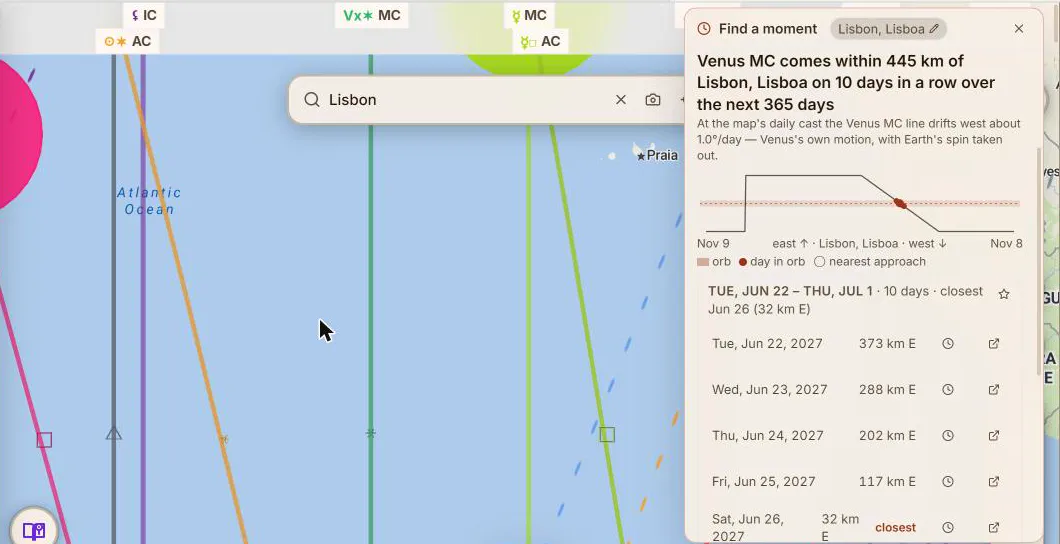
Find a moment at Lisbon: the days Venus's MC line runs close, with the closest marked.
Your own lines, at one place
On a place you have open, the chart panel asks a second question: when is my line angular here? Pick one of your planets and one angle, and it lists the windows when that line sits on the place: when it comes in, when it is exact, when it leaves. A retrograde planet can pass more than once, and each pass is marked.
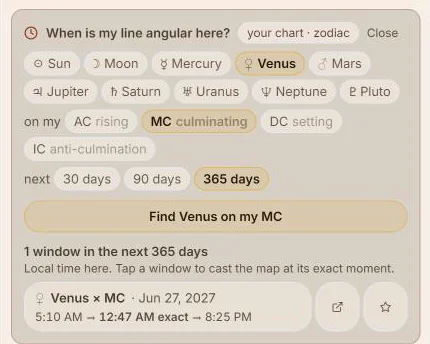
Venus on the demo chart's MC at Lisbon: one window in the next year.
The Timing tab, in the Chart Lab
The Chart Lab asks about your chart itself, with no place needed. Pick a moving planet, a relation and a target:
- aspects: conjunct, sextile, square, trine or opposite a point in your chart
- enters: when a planet enters a sign
- stations: when a planet stands still and turns, from Mercury out to Pluto
When does Saturn conjunct my Sun in the next 90 days? is one question. When does Mars enter Leo? is another.
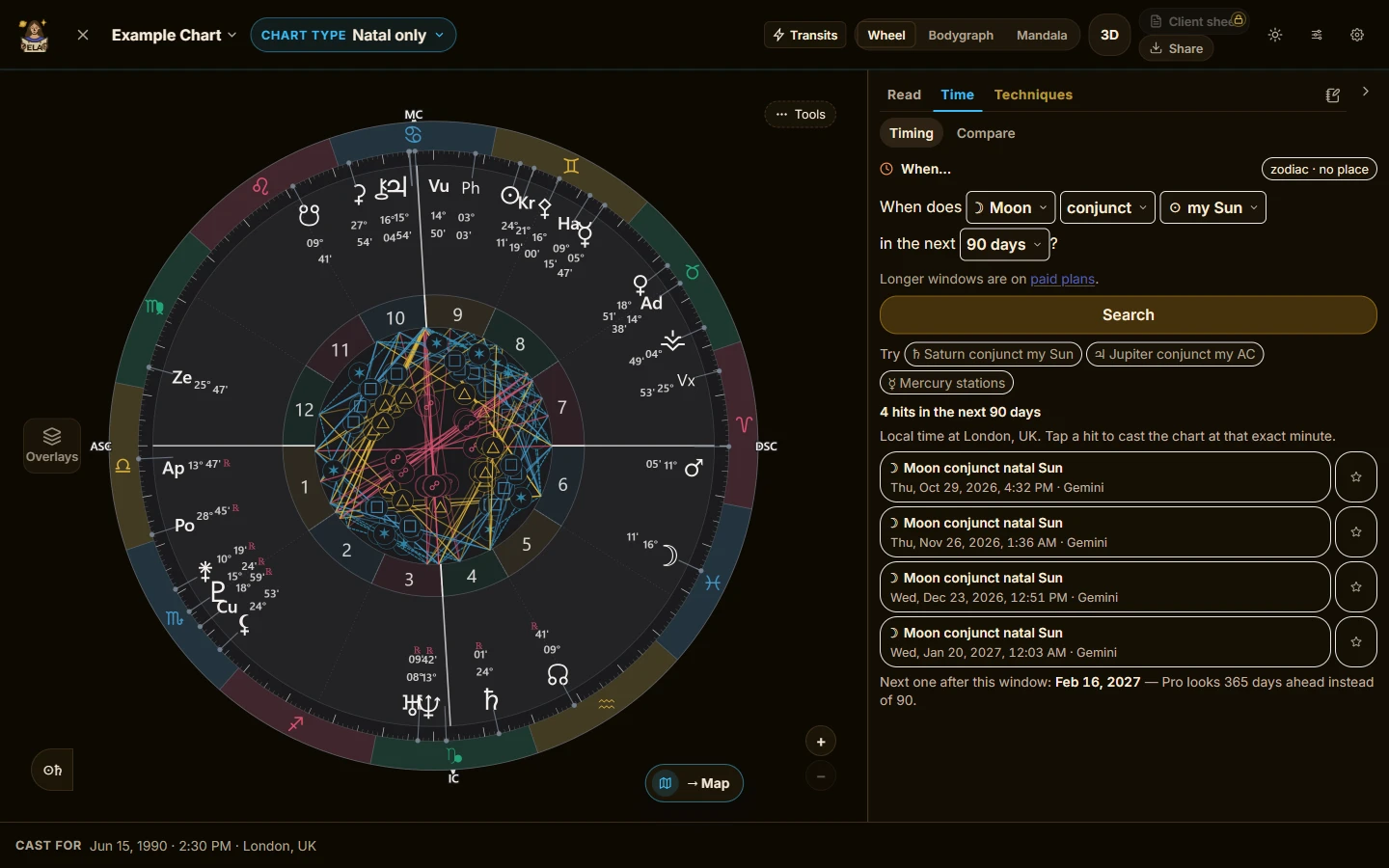
The Timing tab asked about the Moon and the Sun: four dates in the next 90 days, each to the minute.
When the window holds nothing, the tab says so, and names the next date after it.
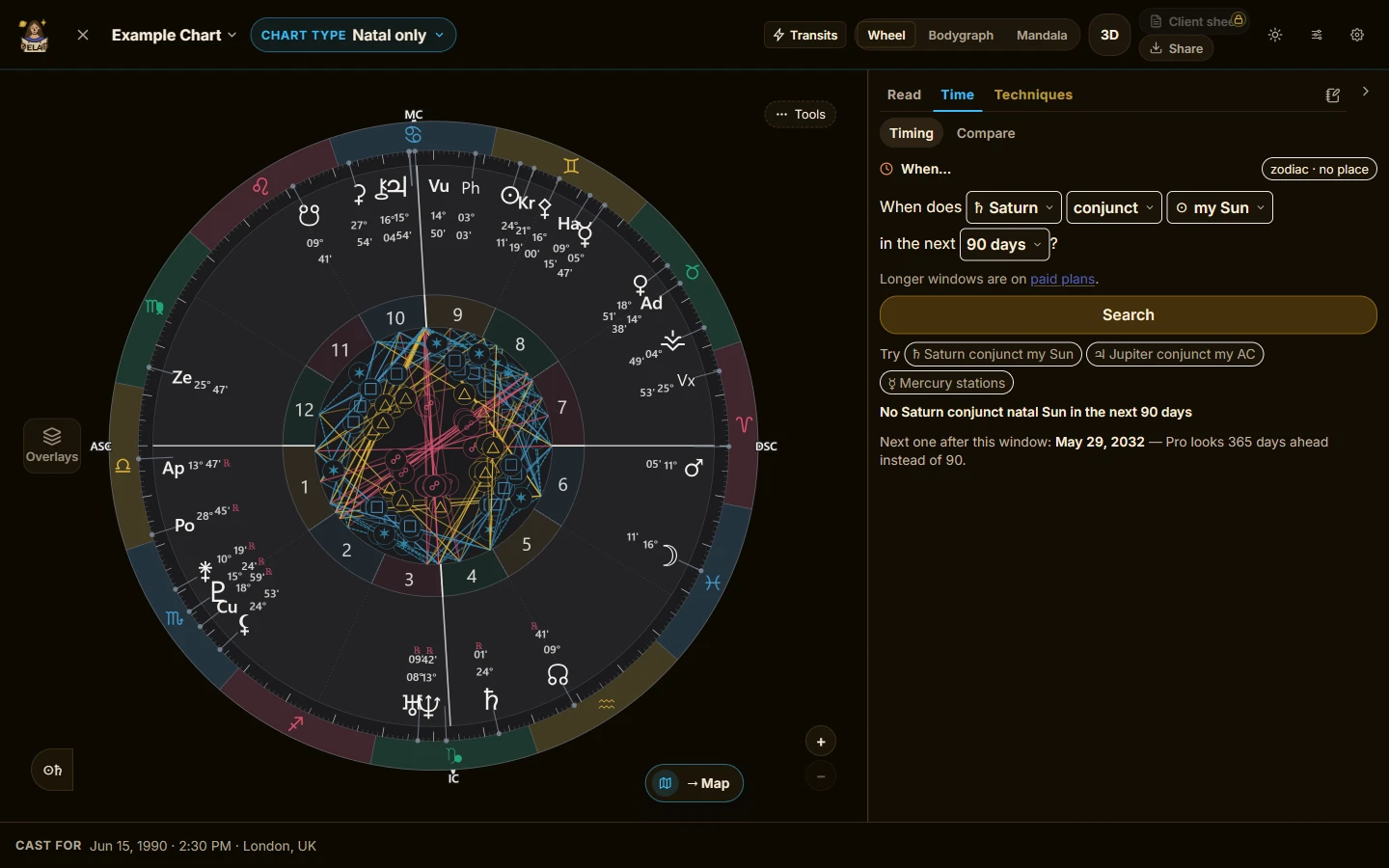
Saturn and the Sun: none in the next 90 days, so the tab names the next one.
From a moment to a chart
Choose a result in the Timing tab and the Lab opens that moment as a chart: the sky at that minute, cast for a place, around your natal wheel or on its own. The time reads in that place's own time zone. The map stays where it was until you take the chart there.
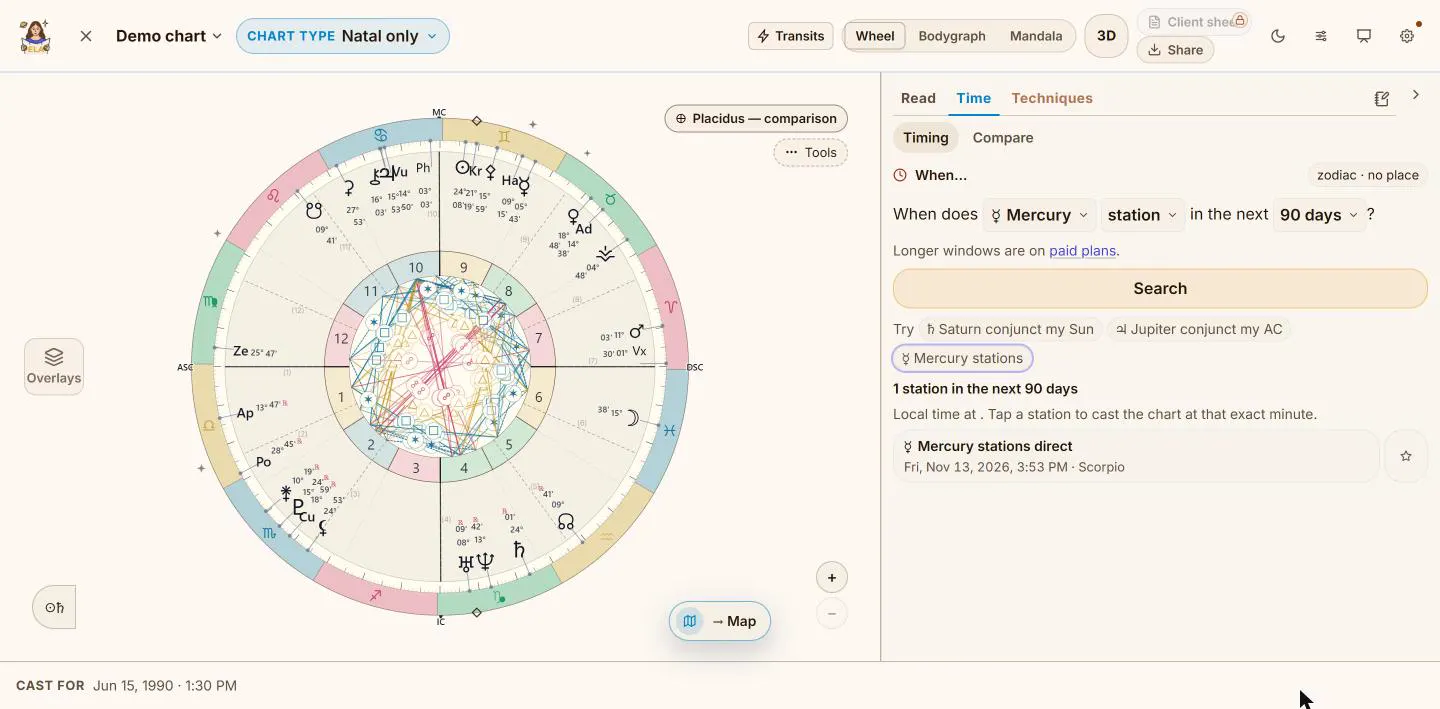
Ask when Mercury stations: one in the next 90 days.
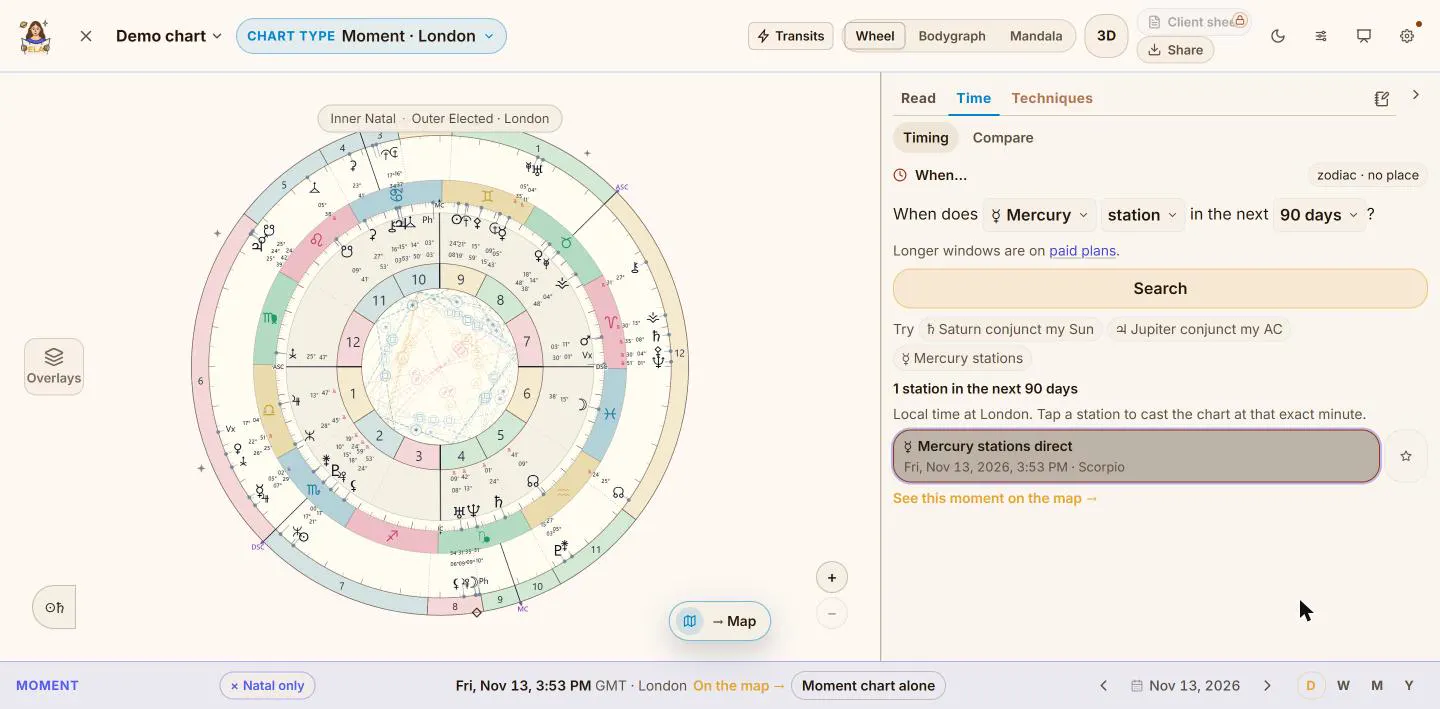
Tap it and the Lab opens that minute as a chart. "See this moment on the map" takes it there.
Keep the moments you want
Star a result to keep it. Ask for a reminder and you get a notice when the moment arrives.
Who gets what
Free accounts see each search, locked, with what it would answer. Premium searches up to 90 days ahead, saves moments and sets reminders. Pro looks a full year ahead and adds Chiron and the North Node, with Black Moon Lilith joining them in the Chart Lab. See the plans.
An informed human is an empowered human. And whether a transit is easy or challenging, being informed of it allows a greater level of empowerment.