Astrocartography vs Human Design: What Each One Actually Reads
Astrocartography vs Human Design cartography: what each technique reads, where they differ, and why reading both on one map is a different practice than reading either alone.
Photo: Kristina Tochilko / Unsplash
Most of what gets written about astrocartography treats the map as a departure board. The right place is out there, one more move away, and every line is a reason to leave or a reason to go.
One popular astrocartography guide sorts the planetary lines into red ones that are "the most difficult and challenging" and the Venus and Jupiter lines as the "easiest" and "happiest," then frames its case studies as "a move from a location that doesn't favor us to one that does."
The real magic is that connecting with the earth as a whole, is a process of connecting with self. Each postition, each line, an invitation to go deeper into the experience of who you are.
We find that Human Design cartography and a fresh interface and approach to the power of locational Astrology and Human Design is an iummense opportunity to break the fatalistic bounds and see into your power of place.
Lets explore the concepts and differences between Human Design cartography and Astrocartography.
Two layers, one place
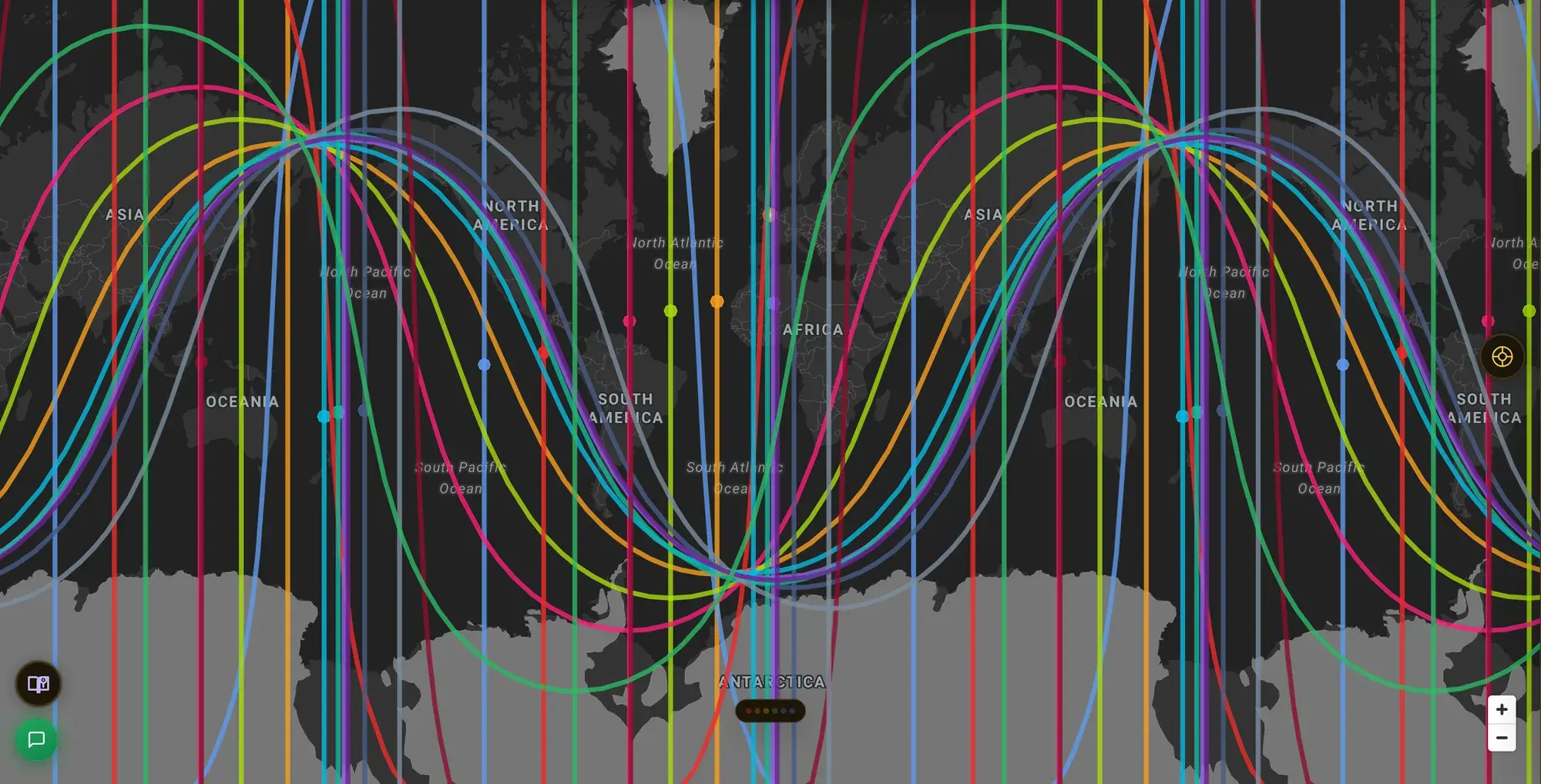
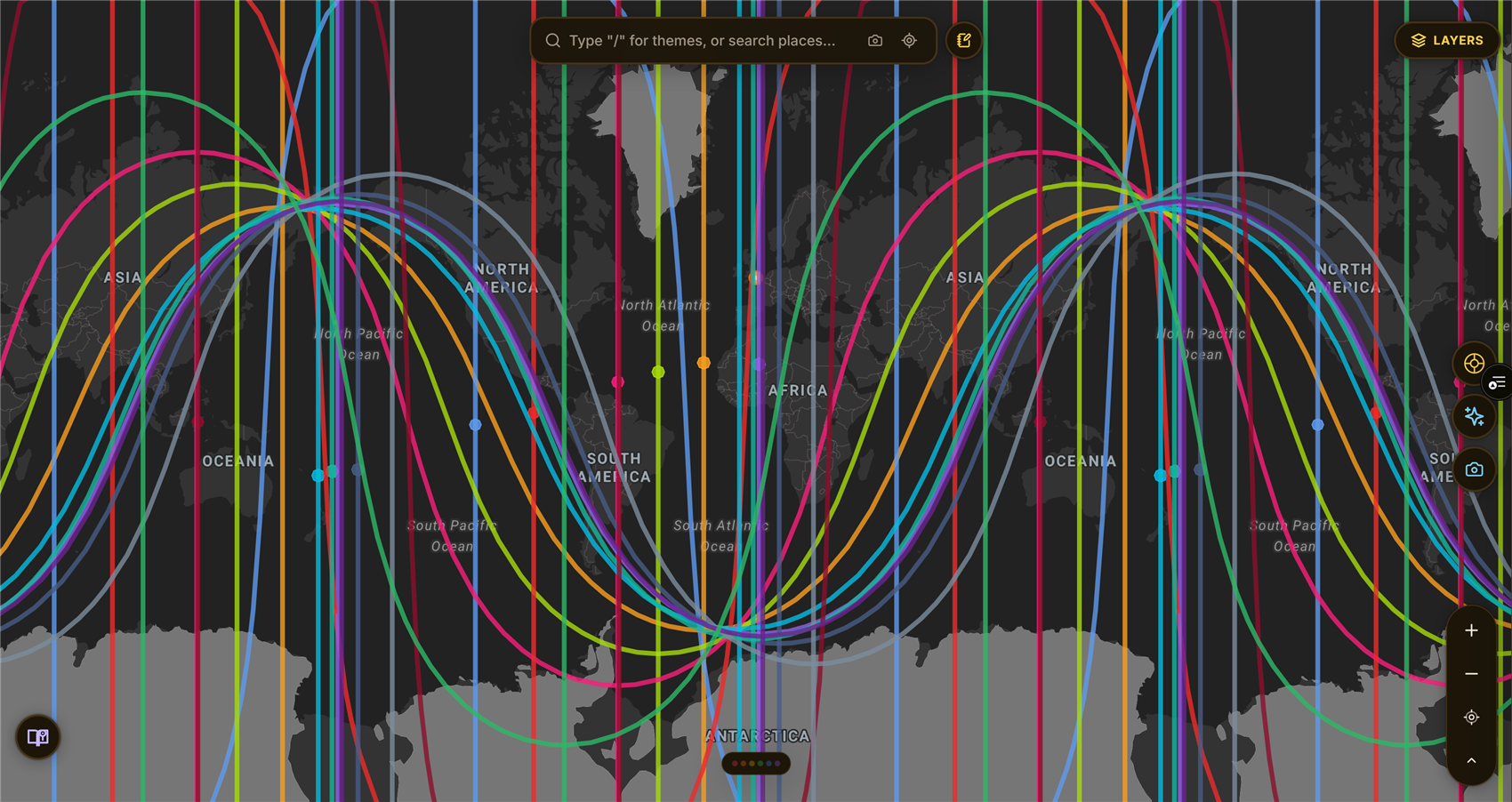
Astrocartography and Human Design cartography read the same place through different layers. Astrocartography maps where planets from your birth chart were angular, showing what a place amplifies.
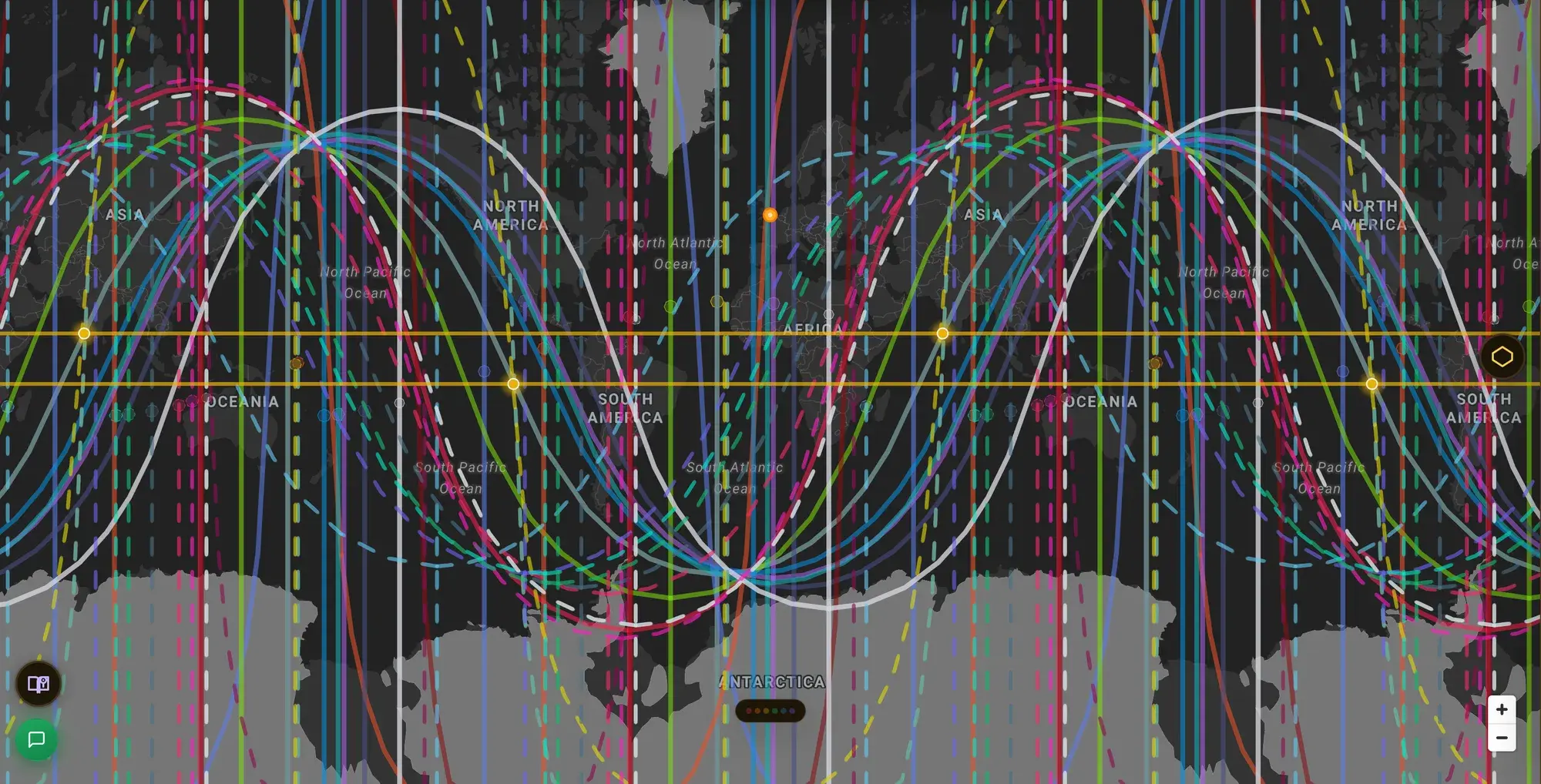
Human Design cartography maps the Design chart (cast 88 solar arc degrees before birth) alongside the natal, Personality, lines as well as brings in gates (micro seasons of the zodiac) and channel (connections between those).
This enables some powerful additional layers to be explored such as the differences in quality between the design lines and the personality lines as they are un-concious and concious by nature. Or how a gates specific quality can carry additional depth for that feature based on your chart.
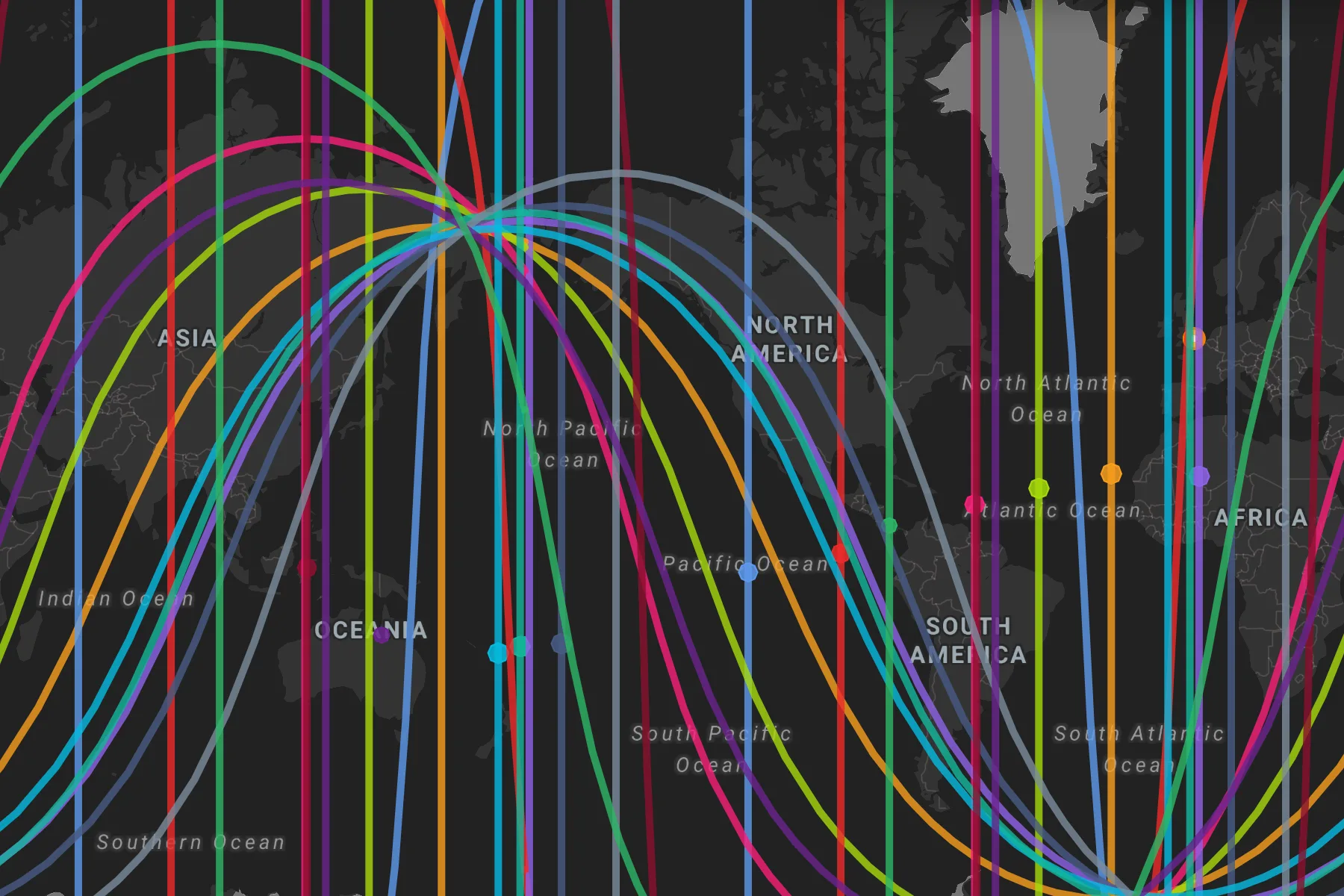
The astrocartography layer. Each planet in the chart, drawn where it was rising, setting, overhead, or underfoot.
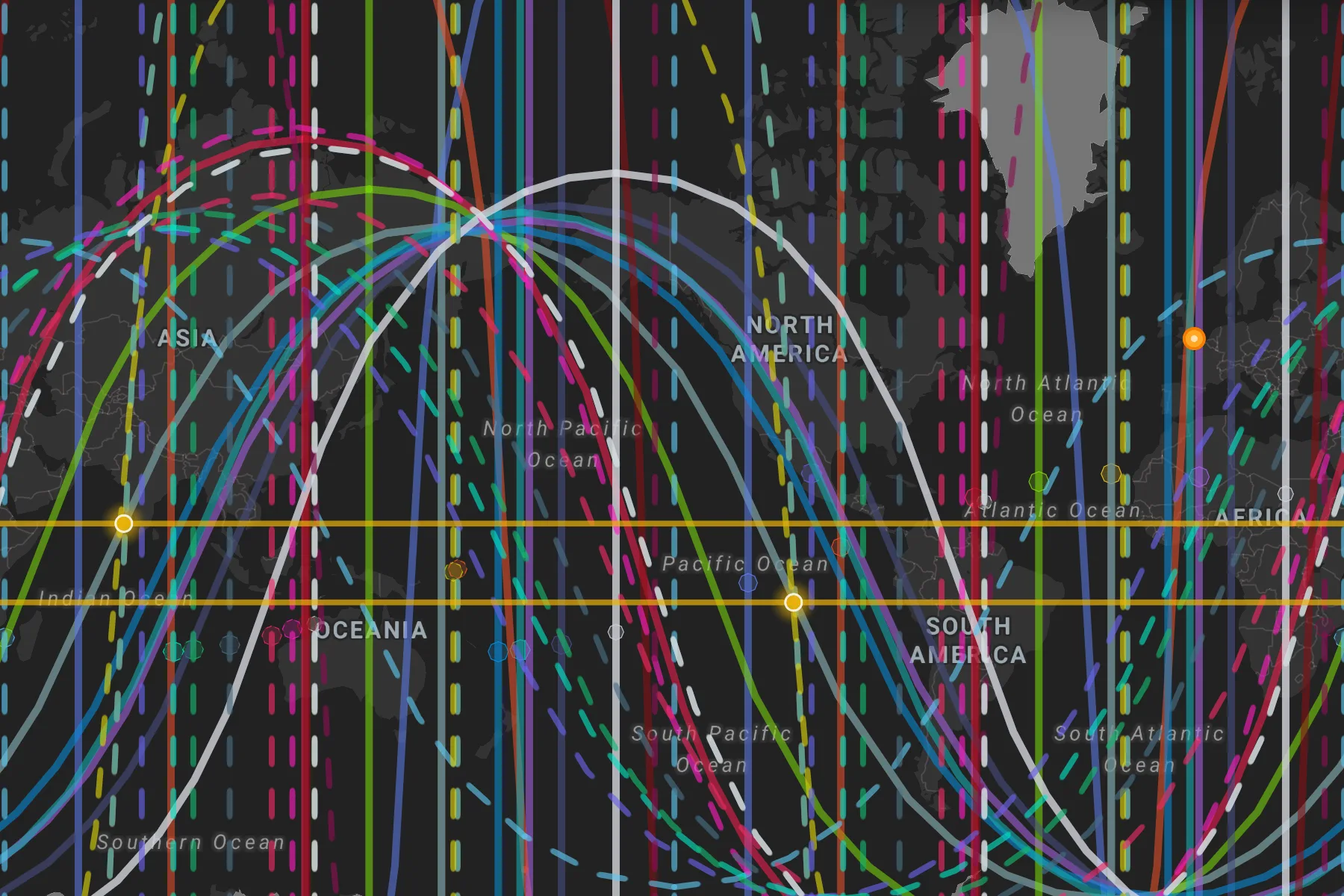
The same chart, the same moment, the same globe, read in Human Design's vocabulary instead.
The primary distinction: what relocates
A primary distinction between these two is the use of house systems in astrology and relocated charts, where in Human Design cartography the body graph doesn't relocate - a open center doesn't magically become defined on relocation - but the qualities of your chart in that area express that part of your design.
The bodygraph does not relocate.
Your Type, Strategy, Authority, and Profile come from your birth data and do not change when you move. What can change with place is volume: which of your defined gates run hot here, which open centers get leaned on, and where the conditioning is quiet enough that you can hear your own Authority instead of the room.
The mechanics, gate by gate and angle by angle, are in Human Design astrocartography.
A line is terrain, not a consequence.
An actual reading from the same body of work mentioned earlier studies a famous couple whose shared Saturn IC line ran about 120 miles from where they were living. Saturn on the IC is usually filed under hardship. The guide reads it instead as the wall that kept a very public family's home life private.
Saturn is boundaries. A boundary is a hardship if you wanted the door open, and a gift if you needed it shut. Never are their absolutes or easy answers. We think that is part of tyhe power of this study and part of the ticket to embodying the power of place.
A line describes what a place tends to ask of you and what it tends to amplify in you. Whether that lands as pressure or as structure depends on what you are doing with your life this season.
For how each planet reads on each of the four angles, see the meaning of an astrocartography line.
The other half is the traveler
Geography maps the terrain. Astrology, one of the oldest maps of the traveler we have, and Human Design, a much younger one, both try to say that people are not interchangeable, and that the differences between us have a shape.
Astrocartography maps the traveler through planetary meaning: where Venus was angular for you, where Saturn was, and what that tends to do. Human Design maps the traveler in a different vocabulary: gates, channels, defined centers, open centers, and the conditioning that moves through the open ones.
Both are cast from the same astronomy. A natal chart is the sky seen from one point on Earth at one moment. Human Design adds a second calculation and through it's interpretation practices another enabled way to approach the experiences you have where ever you find yourself. Human Design can bring another layer of specificity to a location.
The useful part is where they disagree
If both layers always agreed, the second one would be decoration. They don't, and reading the disagreement is the actual skill.
Four things can happen at a given place.
| Astrocartography | Human Design | What you are looking at |
|---|---|---|
| Warm | Quiet | The easiest read on the map. A place that offers something and asks little noise of you to take it. |
| Warm | Loud | A lot on offer, and it leans hard on your openness while offering it. |
| Demanding | Quiet | Often underrated. A place that asks something of you while leaving you clear enough to answer. |
| Demanding | Loud | Not a verdict, but be honest about your season and how to best utilize transformative energies. |
The second row is the one a single layer can't show you. A city can run warm on your astrocartography and loud in your open centers at the same time. That isn't a contradiction. It is a place that will offer you a great deal and ask you to be clear about which of it is yours.
Tools for reading a place both ways
Exploring both astro mode and Human Design for a specific place is wonderfuly helpful, as is using the ineractive chart/bodygraph (located int he right side panel) when interacting with the full scale map. Using the interactive bodygraph or astro chart is a fantastic way to explore the shapes and patterns of a chart while seeing how they reflect on the map and vice versa.
A few ways to work with one place in ELA Map:
- Switch modes on the same spot. Pick a place, read it in Astro mode, then switch to Human Design mode without moving the map. Note where the two readings agree and where they pull apart.
- Separate Personality and Design lines. In the Layers panel, turn Personality Lines and Design Lines on and off on their own. Seeing which lines near a place are conscious and which are unconscious is often the first thing that makes a place make sense.
- Open the Relocated Chart in Astro mode. The place panel can recast your astrology chart for that spot, with its new houses and angles. Your bodygraph never changes this way, which is the primary distinction above, made visible.
- Use the heatmap for the wide view. It scores the whole globe at once, with options such as Angular and Crossings, so you can see where a theme concentrates before you zoom into lines. More in the heatmap guide.
- Look for crossings. Where two of your lines cross, a whole band of latitude picks up both. See what a paran is for how ELA Map draws these as crossing lines.
Why almost nothing lets you do this
People pick a side because their tools make them.
Astrocartography software casts a chart and adds location as a feature. Human Design software casts a bodygraph and treats place as irrelevant, because in classical Human Design it mostly was. So you get a map in one tab, a bodygraph in another, and the reconciling happens in your head.
What this is for, and what it isn't
A map does not predict. It cannot tell you what your experience of a place will be. That is your own relationship with the place.
What a map does at its best is inform. It points out the currents and the weather so you can work with them. It does not promise the weather.
So this is not a case for chasing the horizon, convinced the right place is always one move further on. The point of reading a place well is to work with what is in front of you, wherever you are. The map does not exist to get you to leave.
Where to go next
- Astrocartography: the complete beginner's guide if the planetary side is new to you.
- Human Design astrocartography: the complete guide for the gate and channel layer in depth.
- How to read your map for a step by step walk through your own lines.
- The meaning of an astrocartography line for planet by planet and angle by angle.
- The data and engine behind ELA Map for what the calculations run on.
- Glossary for any term on this page.
See your own map at elamap.com
Place is personal.