What Is a Paran in Astrocartography?
What a paran is, why it works on a line of latitude rather than a single point, and why ELA Map labels these crossing lines on the map instead of using the classical word.
Photo: Abhinav Choudhary / Unsplash
Everything in this article follows from one fact you can watch with your own eyes: the sky turns, and it carries everything in it past the same few places.
Something is coming up in the east. Something else is going down in the west. Something is directly overhead, and something is underneath you on the other side of the world. Those four positions are where astrology has always said a body speaks loudest, and every planet passes through all of them, every day.
A paran is what you call it when two of them arrive at once.
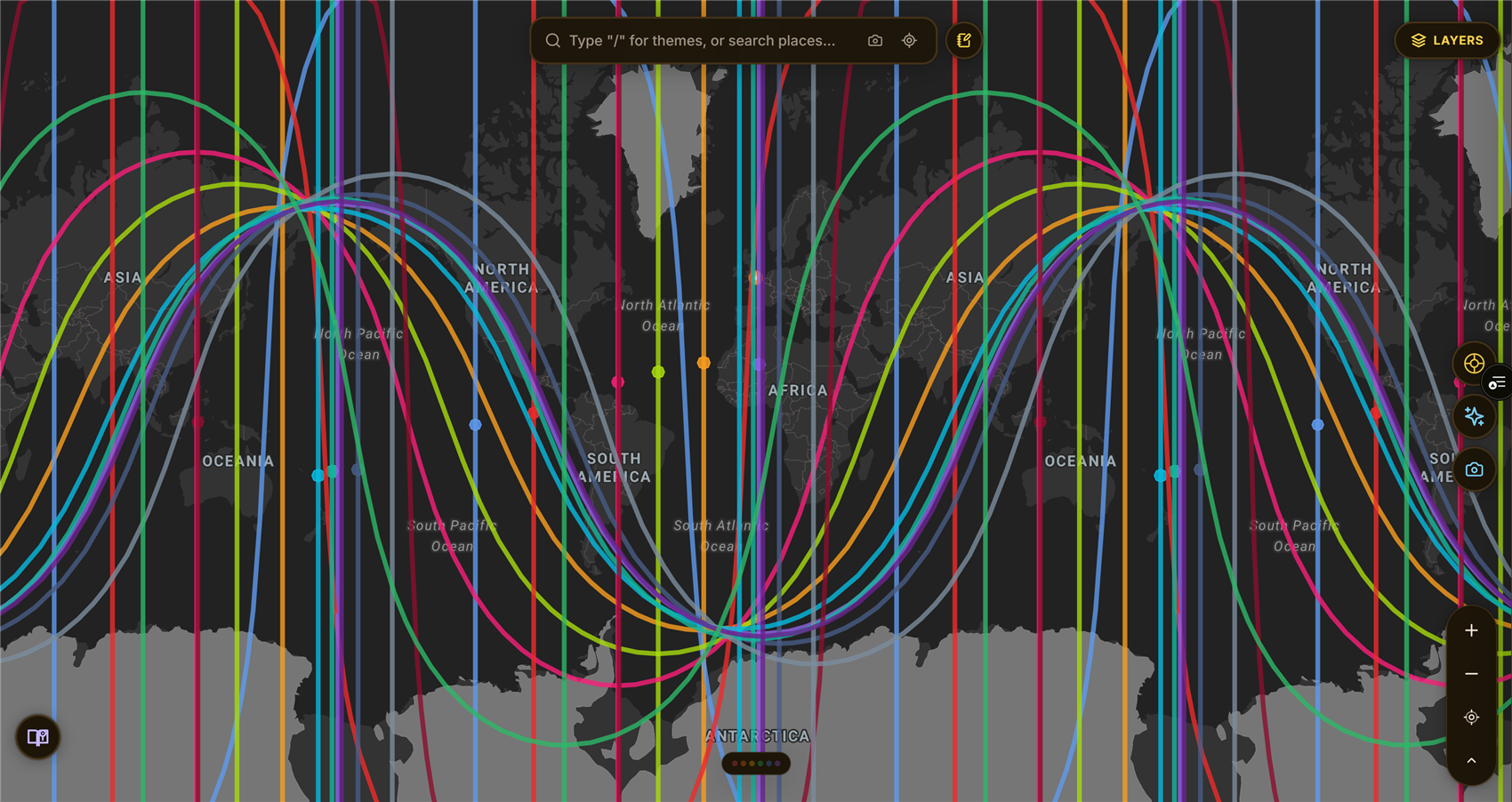
A paran is when two bodies sit on one of the four horizon and meridian points at the same moment: rising, setting, culminating, or on the nadir. Because that pairing depends on latitude, its influence runs along a whole line of latitude rather than sitting at one spot. ELA Map draws these and labels them crossing lines.
The classical definition, plainly
Bernadette Brady, whose work on this is the standard modern reference, lays out four points where a paran can happen: the rising side of the horizon circle, the setting side, the upper part of the meridian where a body culminates, and the part opposite that, below the horizon. If a planet or star is on any of those four points at the same time as another planet or star is on the same point, or on any of the other three, then those two are in paran.
That is the whole definition. Two bodies, four possible positions, one moment.
The word itself is shortened from paranatellonta, a Greek term for stars rising alongside one another, and it comes to us mostly through the fixed-star tradition, where the question of which star rose with which planet mattered enormously.
Why it lives on a latitude
Here is the part that makes parans genuinely different from a planetary line, and it is the part most short explanations skip.
Whether two bodies are angular together depends on where you are standing. Brady is explicit about it: for a particular location the same stars will be in paran with each other, but as the latitude changes, the circle of the horizon changes its orientation to the sky. A star that rises at the same moment as Venus at one latitude may, at another latitude on the same day, have already risen, or still be below the horizon when Venus comes up.
So a paran is not a place. It is a latitude.
The astrocartography tradition arrived at the same conclusion from the other direction. Jim Lewis and Arielle Guttman, writing the foundational literature of this field, make a point of distinguishing planet lines from latitude crossings, and describe it this way: where any two lines on a map cross, the point of intersection establishes a significant latitude, and anywhere along that latitude the energies of the two planets will seem to be associated.
Anywhere along that latitude. Not at the crossing point.
That means a crossing sitting in the middle of the Atlantic is not wasted. If it falls at your latitude, it is in play where you are, thousands of miles away.
What we call them, and why
Now the vocabulary, because you searched for one word and the app says another.
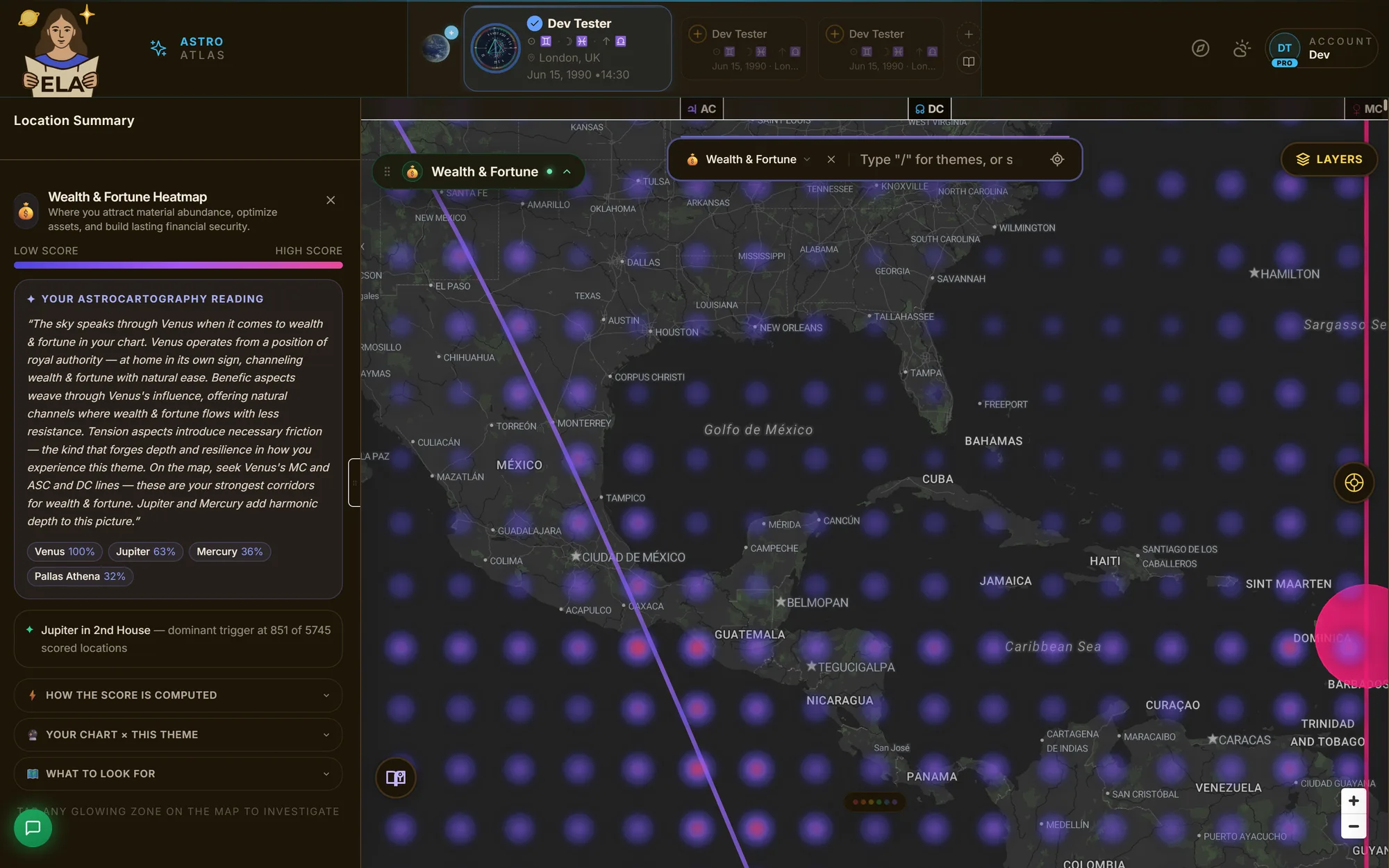
ELA Map calls these crossing lines, or just crossings. On the map you see two of your lines intersect, and the label reads from exactly that: Jupiter DC × Pluto AC. Both bodies, both angles, joined with a multiplication sign.
Real labels from the app. Both bodies named, both angles named, joined with ×. No Greek required.
The reason is not that "paran" is wrong. It is precise and it is the correct classical term, which is why it is in the glossary and why this article exists at all. The reason is that a person opening their map for the first time should not have to learn a piece of specialist vocabulary before they can read what is in front of them. "Crossing" is what the thing looks like and what it does. Nobody needs it translated.
There is a broader principle underneath that. A field protects itself with jargon, and locational astrology has plenty. We would rather spend the reader's attention on the idea than on the terminology.
So: paran when we are talking about the tradition, crossing when we are talking about your map. Same phenomenon.
How ELA Map draws one
Because the influence belongs to a latitude, drawing only a dot at the intersection would be a quiet lie. So we draw the latitude.
Each crossing renders as its own line running along that latitude, with a soft corridor around it in the same way a planetary line carries one, plus a marker and label at the intersection itself. When you see a horizontal band on your map, that is a crossing telling you how far its influence reaches, in real distance on the ground.
If you want the mechanics of how those corridors stay honest as you zoom, that is covered in how to read your astrocartography map.
How much weight to give them
Less than you might want to, and the tradition agrees.
The astromapping literature is direct about this: paran influences are not as strong as the primary planetary lines, but they do have a role in interpretation. That ordering matters, because crossings are seductive. There are a lot of them, they feel like secret knowledge, and it is easy to go hunting for an exciting pairing in a place where nothing else in your chart is doing anything at all.
The honest order is the same as everywhere else on this site. Read what is near you first. Read the angle before the planet. Then, once that picture is clear, look at which crossings share your latitude and let them refine the reading rather than replace it.
Where parans genuinely come into their own is the fixed-star work, which is where Brady's research sits, and in mundane astrology, where paran relationships between outer planets and particular stars are used to characterise events. That is deeper water than most people need on a first pass.
Where to go next
- How to read your astrocartography map, step by step for the reading order this fits into.
- The meaning of an astrocartography line for the primary lines, which come first.
- Is astrocartography real? for what any of this can and cannot honestly claim.
- Glossary for paran, orb, angle, and the rest of the vocabulary in one place.
Your own crossings are already drawn. Look along your latitude.
Place is personal.