Astrocartography Without Traveling: How to Use Your Map Where You Live
You don't need to move or travel to use astrocartography. How to read the lines over where you live, track your local sky day by day, and connect with a distant line from home through its food, music, books and images.
Photo: sorour mahboubifard / Unsplash
Not long after launch, a longtime member wrote to me with a question I had been half expecting. They liked the updates, but couldn't travel much. How should someone in that position actually use this?
It's a good question, and an important one, because most writing about astrocartography quietly assumes you are about to pack a bag. The whole genre is written as a departure board: find your best line, book a flight, move.
The honest answer I gave is the one this page expands on. You don't need to travel to make deep use of this toolkit.
Astrocartography works without travel. Most of its daily use happens where you already are: reading which lines run near your home, watching the moving sky cross your location day by day, and noticing the people and news that arrive from your line places. You can also connect with a distant line from home by associating with that place: its food, music, books, images and more.
The map already includes where you are
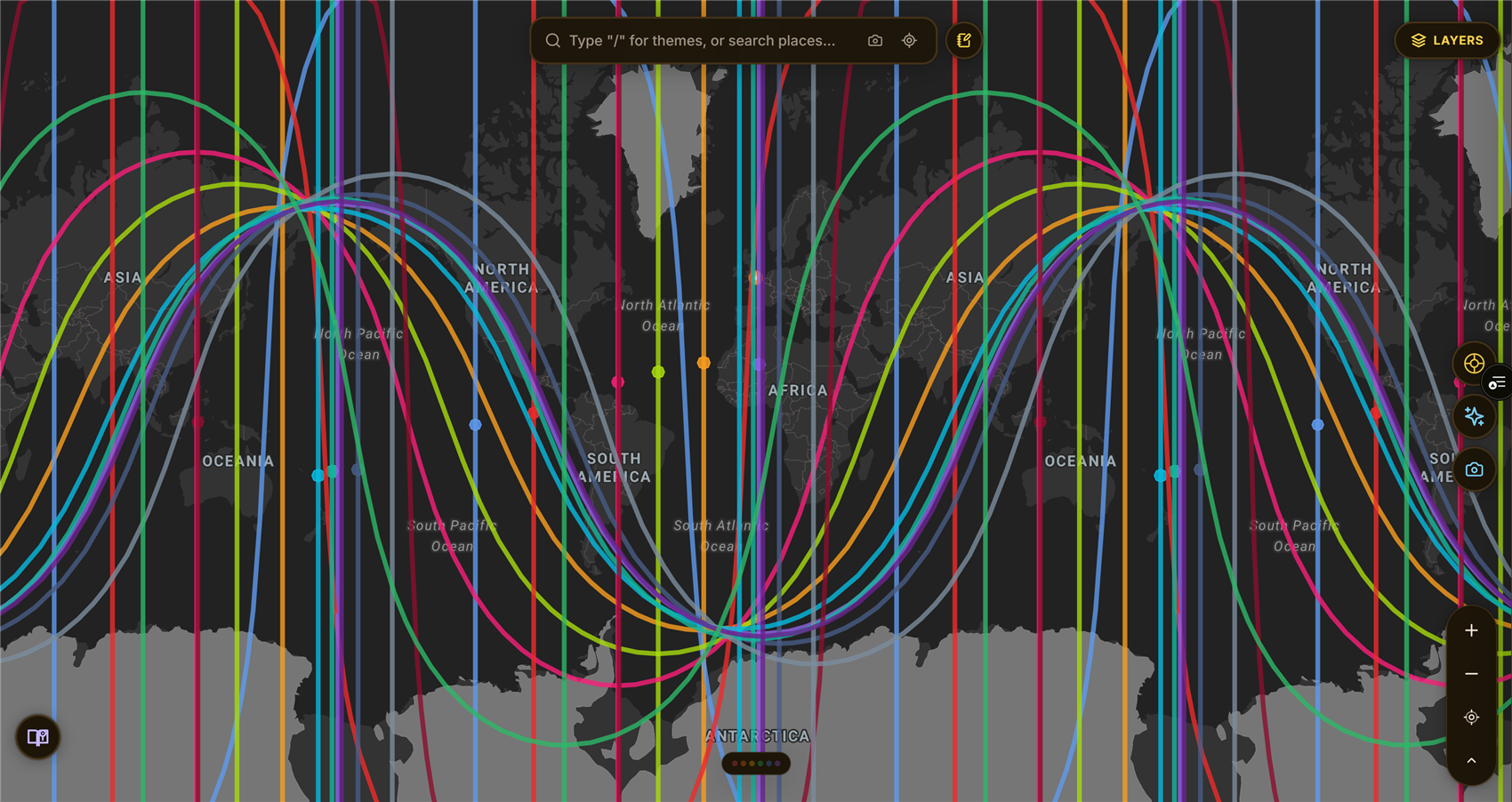
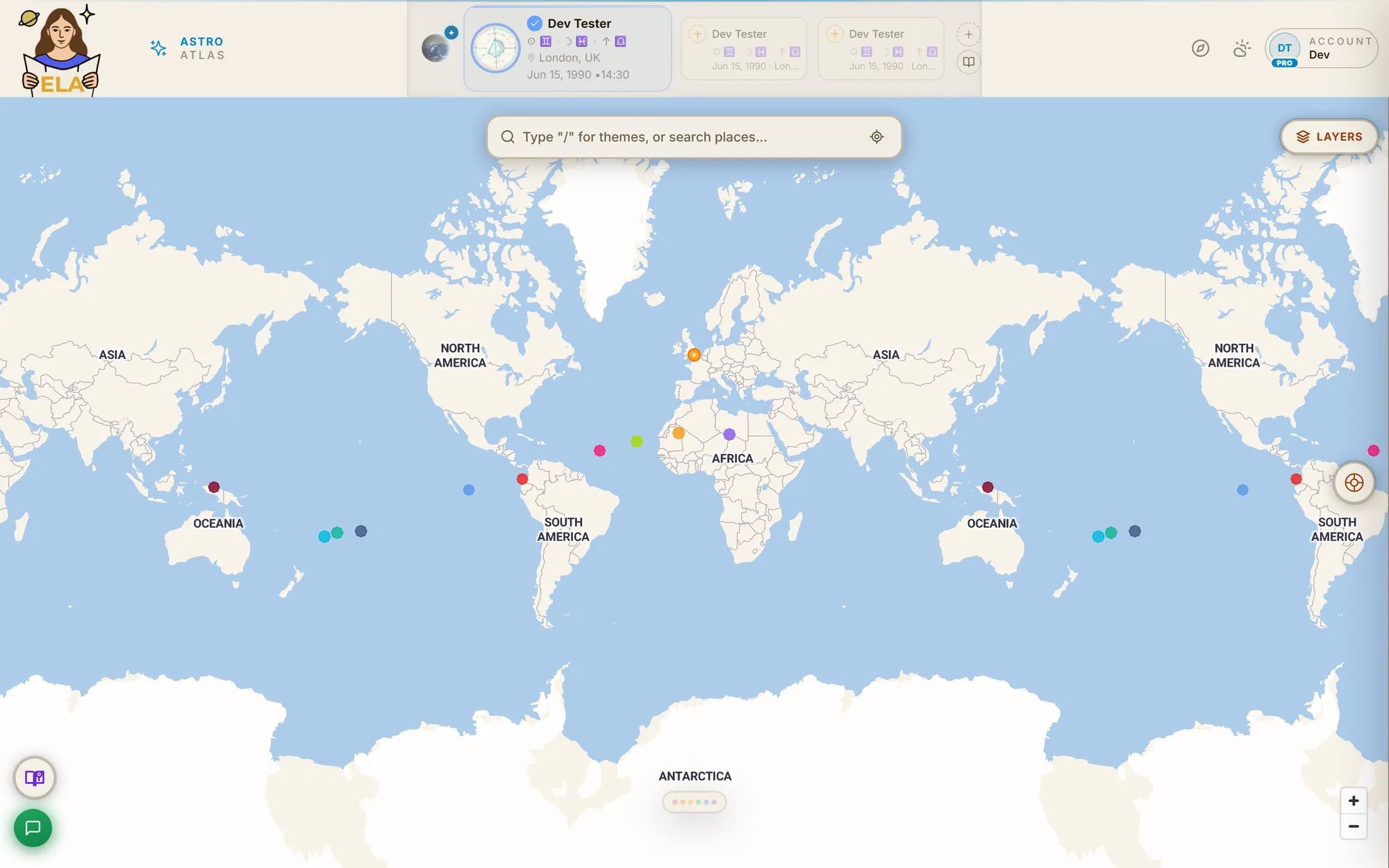
An astrocartography map draws the planets of your birth chart across the whole earth, showing where each one sat on the horizon or overhead at the moment you were born. Those lines don't stop at the places you might visit. They run through your town too, or they pass at some distance and leave it quieter.
That makes the place you live the most studied location on your map, whether you meant to study it or not. You already have years of data on it. You know how your work has gone there, how your relationships have gone, what the place brings out in you and what it seems to mute.
So the first practice is simple: read your own location as carefully as you would read a place you were thinking of moving to. Search your address on the map, open the place, and read the lines in orb. Then check the reading against the years you have already lived there. Where it matches, you have learned to trust the instrument a little. Where it doesn't, you have learned something more useful than any forecast.
If nothing strong runs near you, that is not a verdict. A place without a loud natal line is often a good place for an ordinary life, which is most of life.
Turn on the advanced lines
The four angle lines are the backbone of the map, but they are not the only lines it can draw. In ELA Map the Layers panel has an Advanced group: aspect lines, midpoint lines, declination lines and Hermetic Lot lines.
Turning those on greatly expands the number of influences you can see over a single area. A town that looked empty on the basic map often turns out to sit on a midpoint line between two planets, or a declination line, or the line of a lot that describes a specific part of life. For someone who isn't going anywhere, this is one of the best ways to notice, use and explore local influence. You are not widening the map to find somewhere else. You are adding detail to the place you are standing on.
Astrocartography lines explained covers what each line family means.
Your local sky, every day
The birth-chart lines are fixed. The sky is not.
Every day the planets move, and their lines move across the map with them. Some days a moving line passes close to where you live. When it does, that planet's themes tend to show up locally, in the ordinary texture of the day: who calls, what goes smoothly, what snags, what you feel like doing. This is the part of astrocartography that turns the map from a portrait into weather, and it is available to anyone with a location.
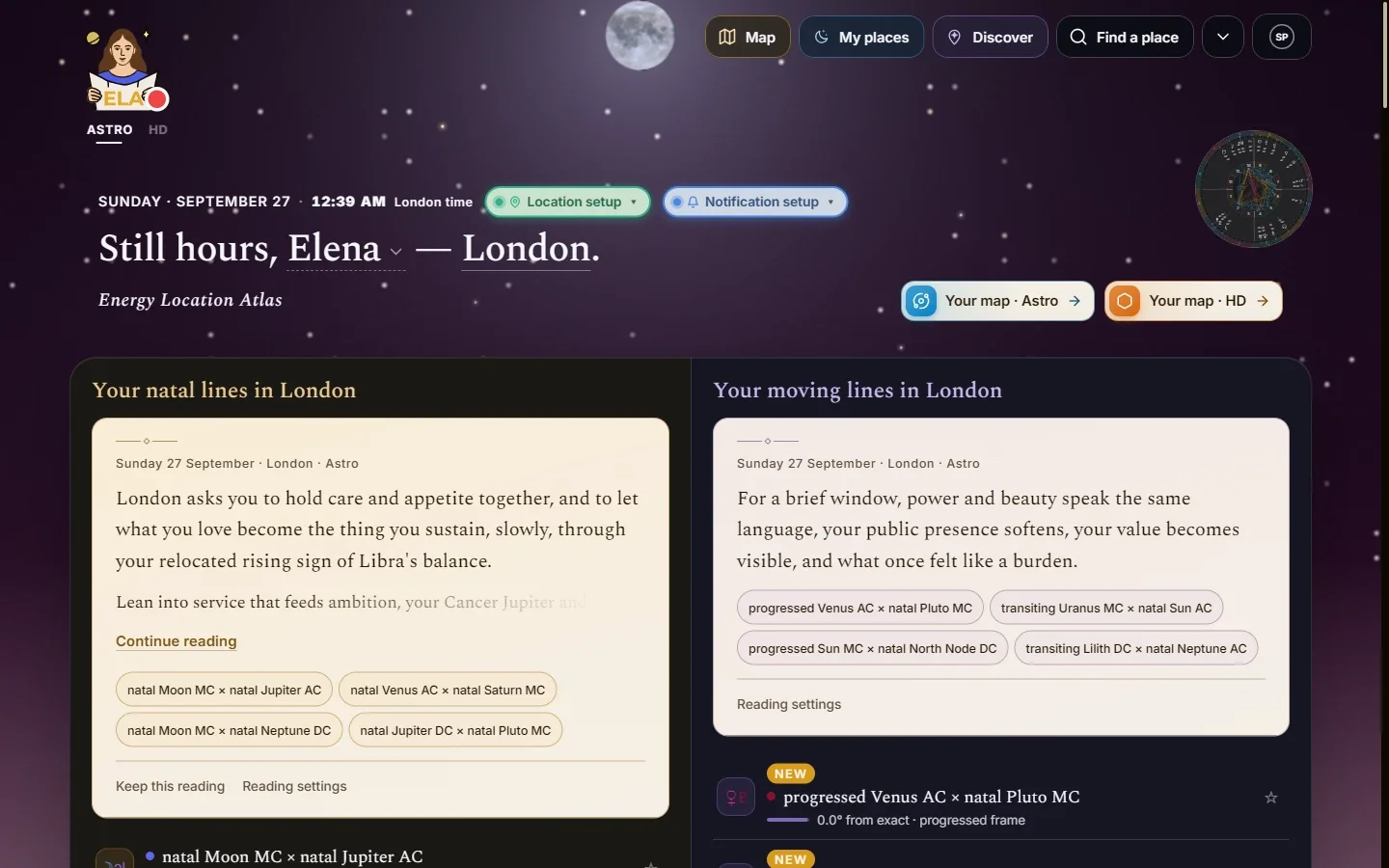
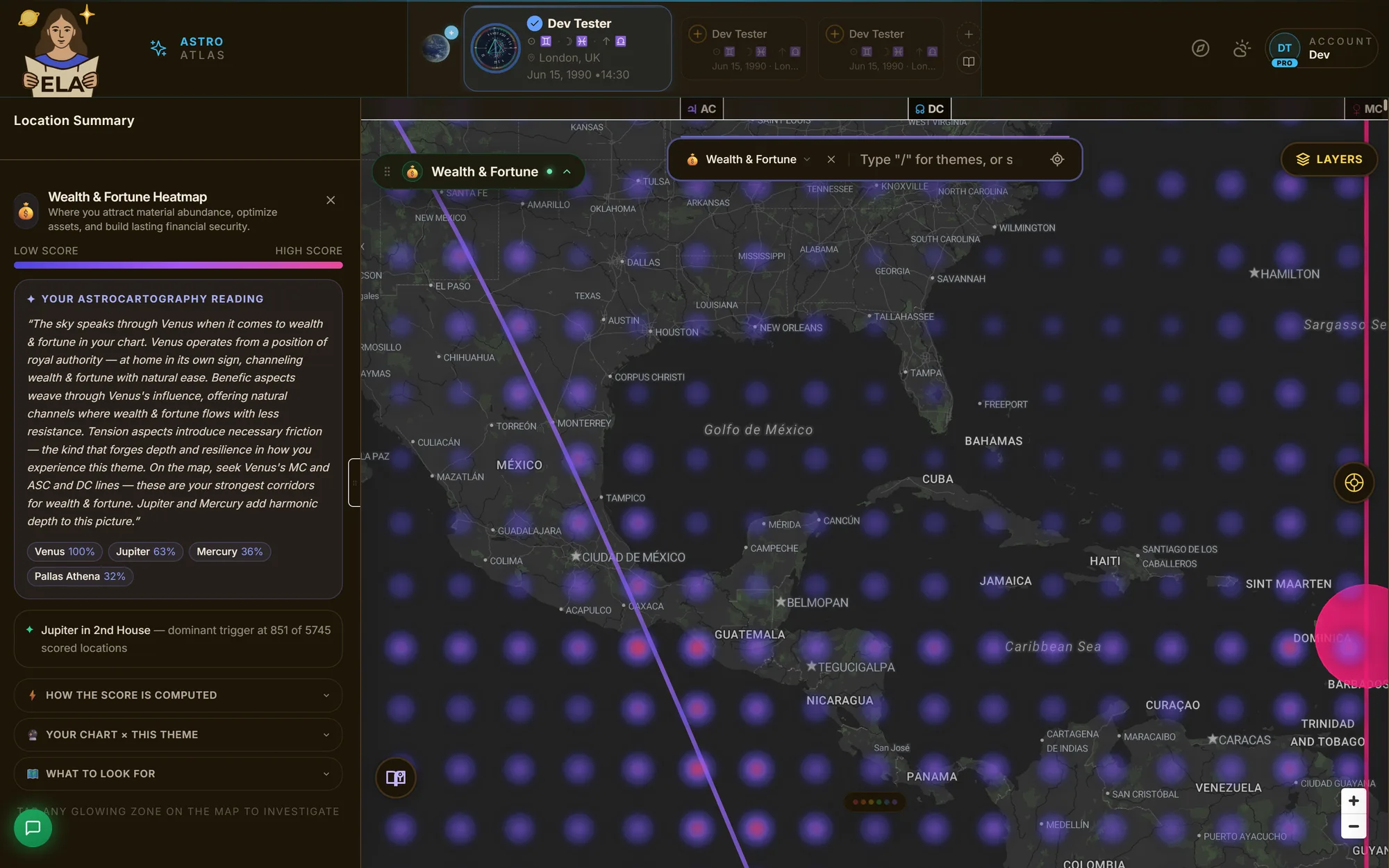
Today, cast for where you stand: your natal lines in town on the left, your moving lines on the right.
To use it:
- Set your current location correctly. Everything local depends on it. On the Today page you can confirm or change the place the read is cast for.
- Read the day where you are. Today is cast for your location and your chart together. Its "Your moving lines" read names the moving lines near you right now, your personal local transit lines. Think of them as the astro weather specific to where you stand.
- Keep it up for a few weeks. Read in the morning, notice the day, and check back in the evening. You are calibrating, learning what a Venus line passing your town is actually like for you, as opposed to what a book says it should be like.
I have found this surprisingly accurate, and one of the more intriguing things to track. The influences show up small and local. Not headline events, mostly. The tone of a conversation, an unexpected invitation, a day that runs on rails or a day that won't start.
The deeper mechanics of those moving lines, including the difference between everyone's sky and your own, get their own page: transit lines and cyclocartography.
My places: the places you're connected to
My places is a list of every place you care about, read against today's sky. Your home, your birthplace, the city a parent lives in, the town where your partner grew up. Each one gets its own live card.
This is where astrocartography without travel gets interesting. You don't need to be in a place for it to be part of your life. Your line places can reach you without a trip. A friend from that city, a relationship, a job offer, a book set there, an intrigue you can't quite explain. The map reads a place as a part of your chart made louder, and that part can knock on your door from anywhere.
A practice worth trying: when someone or something from a distant place arrives in your life, look that place up. Which of your lines runs near it? Very often the connection describes the line better than a paragraph could.
Connecting with a line from home
This is the part I get asked about most, and it's the part people are most shy about trying.
The idea is simple. Each line on your map marks where one part of your chart gets louder. You can't always go to that place, but you can associate with it. You can bring the place into your life, and by doing so, spend time with that part of your chart.
Say I want to connect with the Sun MC qualities of my chart: visibility, vocation, standing for something in public. I find where that line runs, pick a place on it, and start keeping company with that place from home. Its food, its music, its writers, its images. Sitting quietly and imagining myself standing there.
Nothing about this moves me to another city. What it does is give my attention somewhere to go. The line describes a part of me that gets louder in that place, and spending time with the place, even at a distance, is a way of spending time with that part of myself. It's a felt practice more than an intellectual one. You're tapping into the quality, not the coordinates.
Ways to bring a place to you
There are so many ways to associate with a place. A few to start with:
- Food. Cook its dishes. Find the restaurant in your town run by people from there. Learn what it grows, and what its markets smell like. Taste is one of the fastest ways into a place.
- Clothes and textiles. Wear something made there, or in its style. Its fabrics, its colors, its way of dressing for its weather.
- Images. Photographs, paintings by its artists, films shot there, documentaries. Walk its streets on a street-level map.
- Music. Its traditional music and what it plays now. Many cities stream their local radio, so you can listen to the place in real time.
- Literature. Novels set there, its poets, its history, writers who lived there. Reading a place from the inside is close to visiting it.
- Language. A few words and phrases. Even a greeting changes how a place sits in you.
- Scent and plants. Its spices, teas and flowers. A plant native to that region on your windowsill.
- Objects and crafts. Something handmade there, or a craft it's known for that you try yourself.
- People. Its community where you live: a cultural center, a festival, a friend who grew up there.
- News. Follow its local news for a while. You start to know the place as it is, not only as a postcard.
You don't need all of these. Pick the ones that feel natural to you, and let it be enjoyable.
A simple way to practice:
- Pick one line and one place. Choose the line for the quality you want more of, then the most specific place on it you can find: a town, a coastline, a mountain range.
- Bring a few pieces of it home. A meal, an album, a book, an image on your wall.
- Spend regular, short time with it. Ten minutes is plenty. Notice what comes up in you, and whether anything from that line's themes starts showing up in your days.
- Watch for a reply. Places have a way of answering. A message, a person, an opportunity from that direction.
Some honest limits. This is reflective work, not a claim that eating a dish or playing an album relocates you. It won't do what living somewhere does. But for anyone who can't travel, or doesn't want to, it turns the map from a list of places you'll never go into a set of doors you can open from where you sit.
Staying is a choice the map can inform
The genre around astrocartography leans hard on leaving. Sort the lines into good and bad, and there is always one more place to go.
The map is at least as useful for staying well. It can tell you what your home tends to amplify in you, so you stop fighting it and start using it. It can tell you when the sky is passing through, so a hard week makes sense and a good one gets used. And it can connect you with the rest of the earth without a single boarding pass.
Where to go next
- How to read your astrocartography map, step by step, starting with the places you already know.
- Transit lines and cyclocartography for how the moving lines are cast and what they feel like.
- Astrocartography lines explained for every line family, including the advanced ones.
- Is astrocartography real? for what this can and cannot honestly claim.
Your map is free to look at. Start with the town you're in.
Place is personal.