Cyclocartography and Transit Lines: How Moving Astrocartography Works
Cyclocartography explained plainly: what transit and progressed lines are, why they matter, how ELA Map casts the World and Personal skies, and how fast the lines actually move.
Photo: Michael Hull / Unsplash
Your astrocartography map shows where each planet was on the horizon or overhead at the moment you were born. That moment passed. The planets kept moving, and so do the places where they sit on the angles. Cyclocartography is the part of astrocartography that follows them.
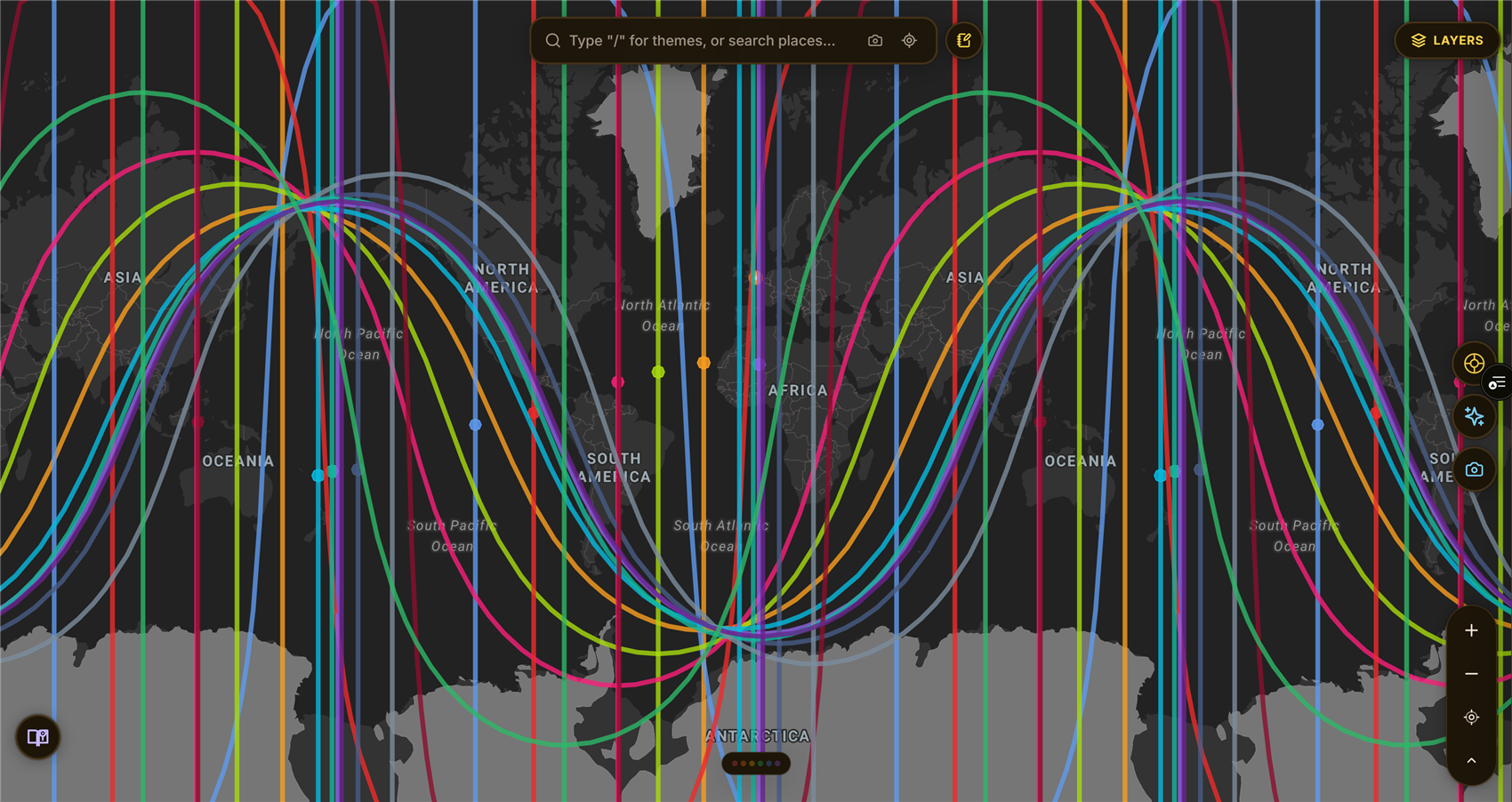
Cyclocartography draws your transits and progressions on your astrocartography map, using the same method as your birth lines but for a date other than your birth. Your natal lines stay fixed; these lines move. They show which planets are angular over which places at a given time, so the map answers when as well as where.
What cyclocartography is
A natal astrocartography map draws four kinds of line for each planet: where it was rising (AC), setting (DC), overhead (MC) and underfoot (IC) at your birth. If you are new to this, what astrocartography is covers the basics.
Cyclocartography uses exactly the same geometry for a different moment. Pick a date and it draws where the planets are on the angles then. Those are transit lines, or moving lines.
The technique comes from Jim Lewis, who developed and popularized astrocartography in the 1970s. In 1982 he published a 55-page booklet on this second technique, under the name Cyclo*Carto*Graphy. It answered a question his maps naturally raised: do the lines on the natal map change over time? One account of that booklet defines it simply as the mapping of one's transits and progressions onto the astrocartography map. Lewis described each moving planet by how fast it travels across the map, how long its influence lasts, and what its effects are like, and he gave clients the moving lines on a transparent sheet laid over their birth map.
That overlay is still the right way to picture it. The birth map underneath describes where parts of you are emphasized, permanently. The moving lines on top describe what is passing through, and when.
Why it matters
A natal map treats a place as fixed. For you, it partly is: the lines through a city at your birth stay there. But your experience of that city also changes with time, and a static map has no way to show it.
Moving lines add that dimension. Lewis wrote that these lines can point to times when potentials of the life are most apt to manifest. In practice, that makes three things possible:
- Your own town has weather. Moving lines pass over the place you live, whether or not you ever travel. This is the heart of using astrocartography without traveling.
- A place can be good now, or good later. The same city reads differently in a year when a line is passing through it.
- Timing becomes part of the decision. A trip or a move can be checked against the dates, not only the destination.
Two skies: World and Personal
ELA Map draws moving lines in two frames. You switch between them on the transit card.
| World | Personal | |
|---|---|---|
| What it is | Everyone's sky | Your own sky, built from your chart |
| Planets | All of them, at their real positions today | Progressed Sun, Moon, Mercury, Venus, Mars and lunar nodes, with today's Jupiter, Saturn, Uranus, Neptune and Pluto |
| When each day is cast | 00:00 Greenwich time | The time of day you were born |
| Same for every chart? | Yes | No |
| Good for | The collective picture, a shared moment or event | Your own timing |
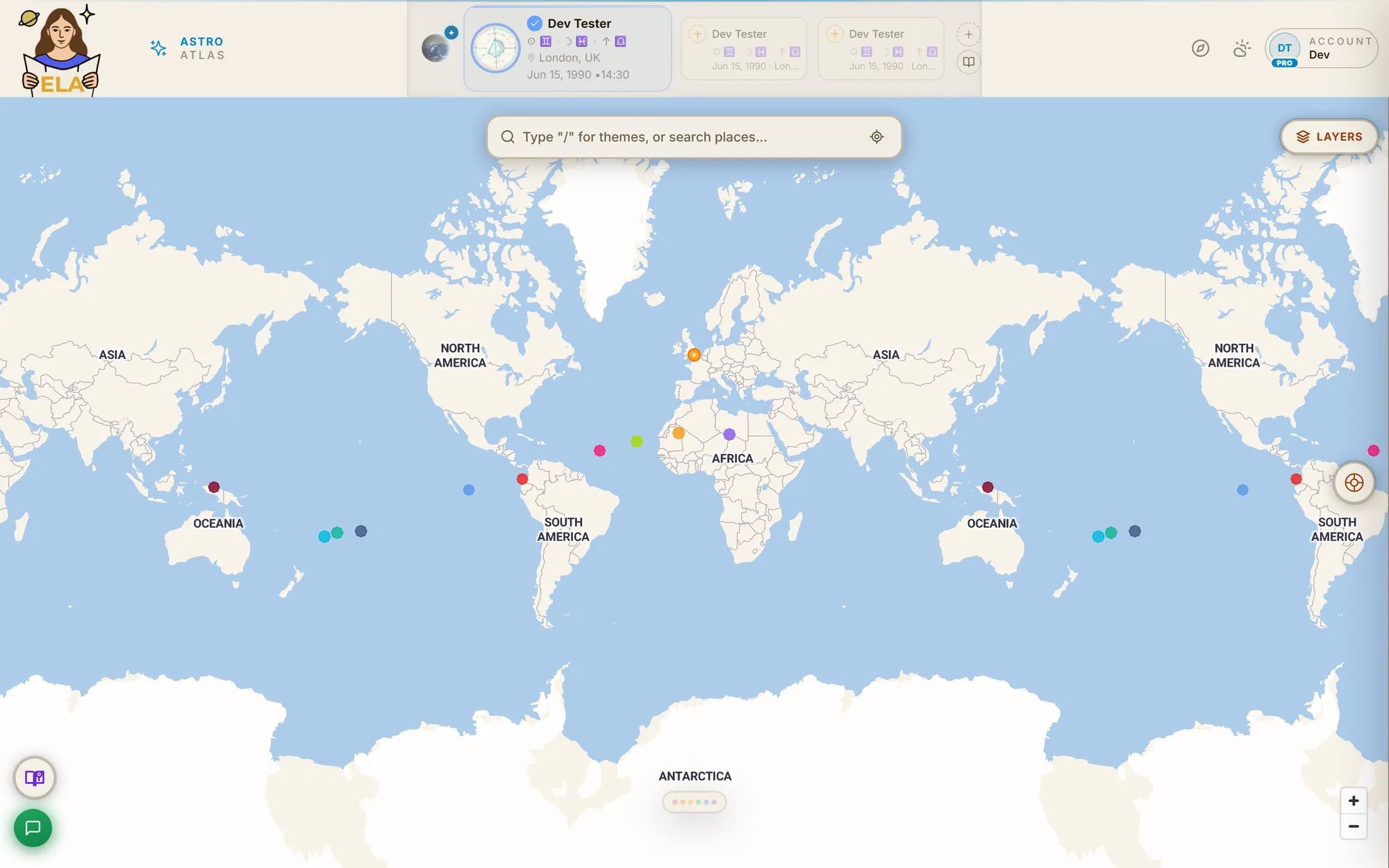
World is not tied to anyone's chart. It is cast at a neutral reference, midnight at Greenwich, so everyone who opens it sees the same lines. It shows where the actual planets are angular across the Earth.
Personal is cyclocartography as Lewis set it up. It is built from your birth data and cast each day at the time of day you were born.
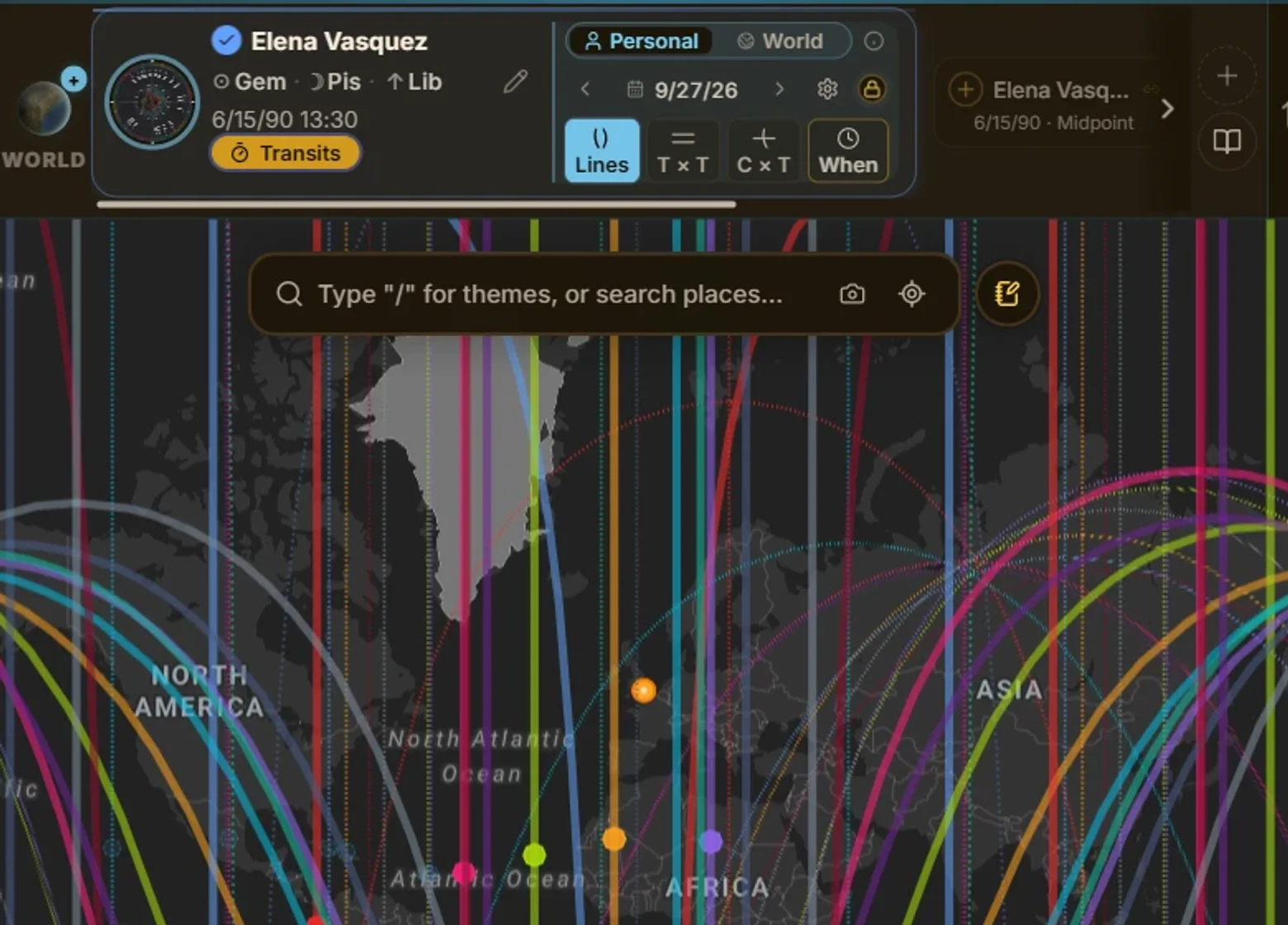
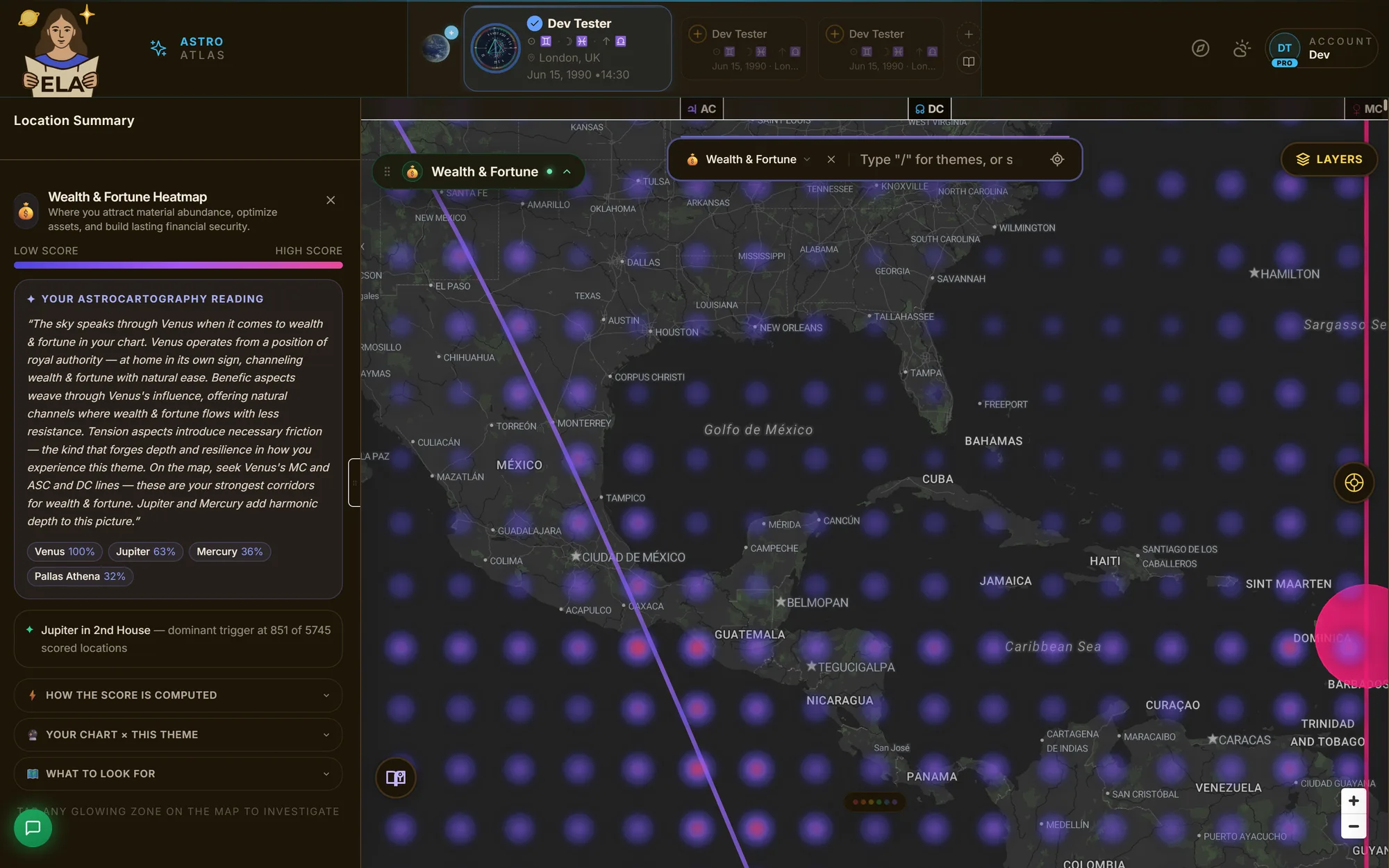
The Personal sky for today: moving lines dotted, birth lines solid. The switch at the top of the card changes to World.
Why the inner planets are progressed
In the Personal sky, the Sun, Moon, Mercury, Venus and Mars are not at their positions in today's sky. They are at their progressed positions.
Secondary progression is a standard technique in astrology. It advances your birth chart by one day for each year of your life. At age thirty-six, your progressed Sun is where the Sun actually was thirty-six days after you were born. Progressed planets move slowly: the progressed Sun about a degree a year, the progressed Moon about twelve to thirteen degrees a year.
The outer planets, Jupiter through Pluto, stay at their real, transiting positions.
This split is the original one. The classic cyclocartography map shows the progressed Sun, Moon, Mercury, Venus and Mars, with Jupiter through Pluto by transit, and software that draws it today uses the same set. ELA Map also progresses the lunar nodes, which is our addition, not part of the classic set.
The usual reasoning goes like this. Progressions are read as personal development: how the parts of you those planets describe unfold over years. Transits of the outer planets are read as the larger conditions of the times, shared with everyone alive. The Personal sky puts both on one map.
How the lines move
Moving lines move on two scales, and it helps to keep them apart.
Within one day, every line sweeps west. As the Earth turns, the whole sky turns overhead, so every line slides west at about fifteen degrees of longitude per hour. In twenty-four hours each line passes over every longitude once. That is why a single moment, such as the exact minute of a new moon, has lines over particular towns and not others.
From one day to the next, the slow lines creep west. ELA Map casts each sky at the same time every day. Between one day's cast and the next, the Earth turns a little more than one full rotation, about one degree more, because it has also moved along its orbit around the Sun. So at the same clock time, the sky sits about a degree further round, and every line shifts about a degree west, adjusted by whatever the planet itself has moved.
For the progressed planets and the outer planets, which barely move from one day to the next, the result is simple: their lines shift about one degree west per day. At that rate a line takes about a year to go all the way around the Earth. It passes over any one place about once a year, and because it moves slowly, it stays near that place for days.
The World sky's faster planets behave differently. The transiting Moon moves about thirteen degrees a day on its own, so its lines jump a long way from one day's cast to the next. The transiting Sun, Mercury, Venus and Mars move on their own at roughly the same pace as that daily one-degree shift, so their lines move much less from day to day and can drift slowly in either direction. In the Personal sky these planets are all progressed, so their lines follow the slow one-degree-a-day pattern.
Three ways to look at the moving sky
Today. One cast for the day: World at midnight Greenwich, Personal at your birth time. It is free on every plan, in both Astro and Human Design mode. On the free plan, the Sun through Saturn show in full and the outer planets show faintly.
Any day, any minute. Premium opens the date and time controls, so you can cast either sky for any day, or for an exact minute such as a new moon, an eclipse, a signing or a flight landing.
Playback. Pro adds a play button to the transit card, with two views:
- 24-hour rotation plays one full day of the sky turning, a frame every five minutes, so you can watch the lines sweep west.
- Drift plays one cast per day over a week, a month, or a span you choose up to 62 days, so you can watch a slow line approach a place and pass over it.
Pro also adds moving lines for extended bodies, beyond the ten planets, the lunar nodes and Lilith.
In Human Design mode
The same World and Personal switch works in Human Design mode. Each moving line leads with the Human Design gate its planet is in. Reading gates on the map is ELA Map's own extension of Human Design: a line shows where a gate is emphasized on the ground, not a change to your chart. The Human Design astrocartography guide covers how transits condition a design.
Following your moving lines
I have personally found tracking these surprisingly accurate, and an intriguing thing to track. The accuracy shows up in daily experience, and it shows up locally: in the ordinary events, people and texture of the place you are actually in, more than in anything dramatic.
A few practical points:
- Start where you live. Check today's sky over your own town for a few weeks and compare it with how the days actually went. That calibration is worth more than any interpretation.
- Slow lines describe periods. A progressed or outer-planet line passing your location stays for days, so read it as a stretch of time, not a single day.
- World and Personal answer different questions. Personal is for your own timing. World is for the collective picture and for choosing a specific moment.
- Check before you move. One account of this work notes that people who move during an important transit are often drawn to exactly where that transiting planet is on an angle. If you are relocating during a major transit, look at where that planet's line falls before you choose.
- Look ahead before a trip. With the date controls, you can see which lines will be near a destination on the days you plan to be there.
- Eclipses belong here too. Eclipse paths are drawn on the map for free. An eclipse is a moving event with a real footprint on the ground, and it pairs naturally with the transit lines.
What it is not
Cyclocartography does not forecast events. A line over your town does not mean something will happen there, and a line far away does not mean nothing will. It describes emphasis: which planet is angular over which place, at which time.
It does not replace the natal map. The moving lines mean the most read against the fixed lines underneath, which is why Lewis drew them as an overlay.
And it is transparent. The positions come from NASA/JPL ephemeris data, the lines use the same angular geometry as every astrocartography line, and the method for each sky is the one described on this page. Transparent, named doctrine, not generative AI.
Where to go next
- Astrocartography lines explained for the four angles and every line family.
- Astrocartography without traveling for following the moving lines where you live.
- How to read your astrocartography map for a reading order that starts with places you already know.
- How accurate is astrocartography? for why birth-time accuracy matters, especially for moving lines.
Today's sky is free to look at on every plan. Start with the lines over your own town.
Place is personal.