Start Here: Your First Ten Minutes with ELA Map
A friendly, no-jargon introduction to ELA Map — what the lines are, the three moves that unlock the whole app, and where to go when you want to understand more.
Welcome. This is the one page to read if you're brand new — to ELA Map, and to the practice behind it. Ten minutes here and the rest of the app will make sense on its own.
What you're looking at
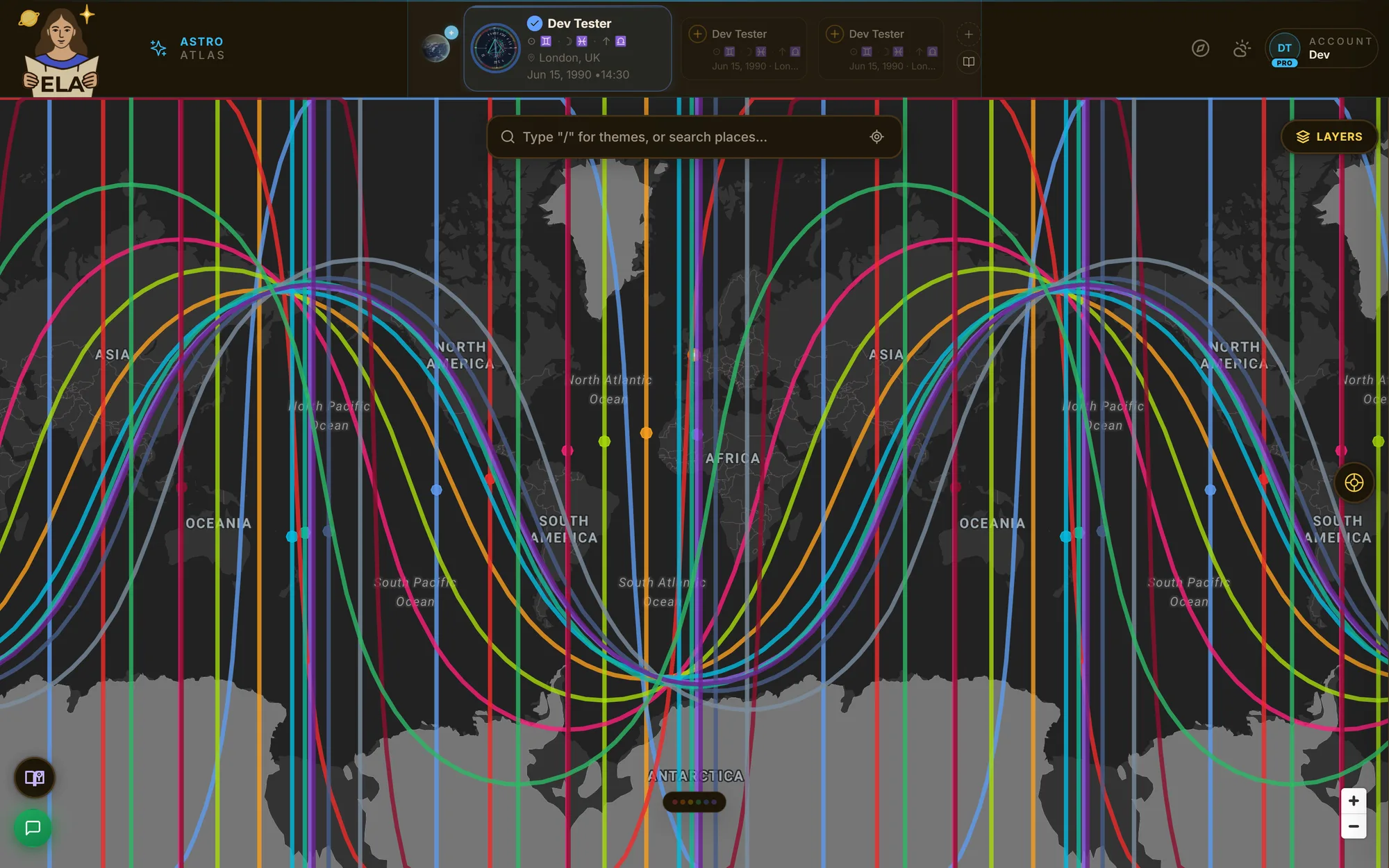
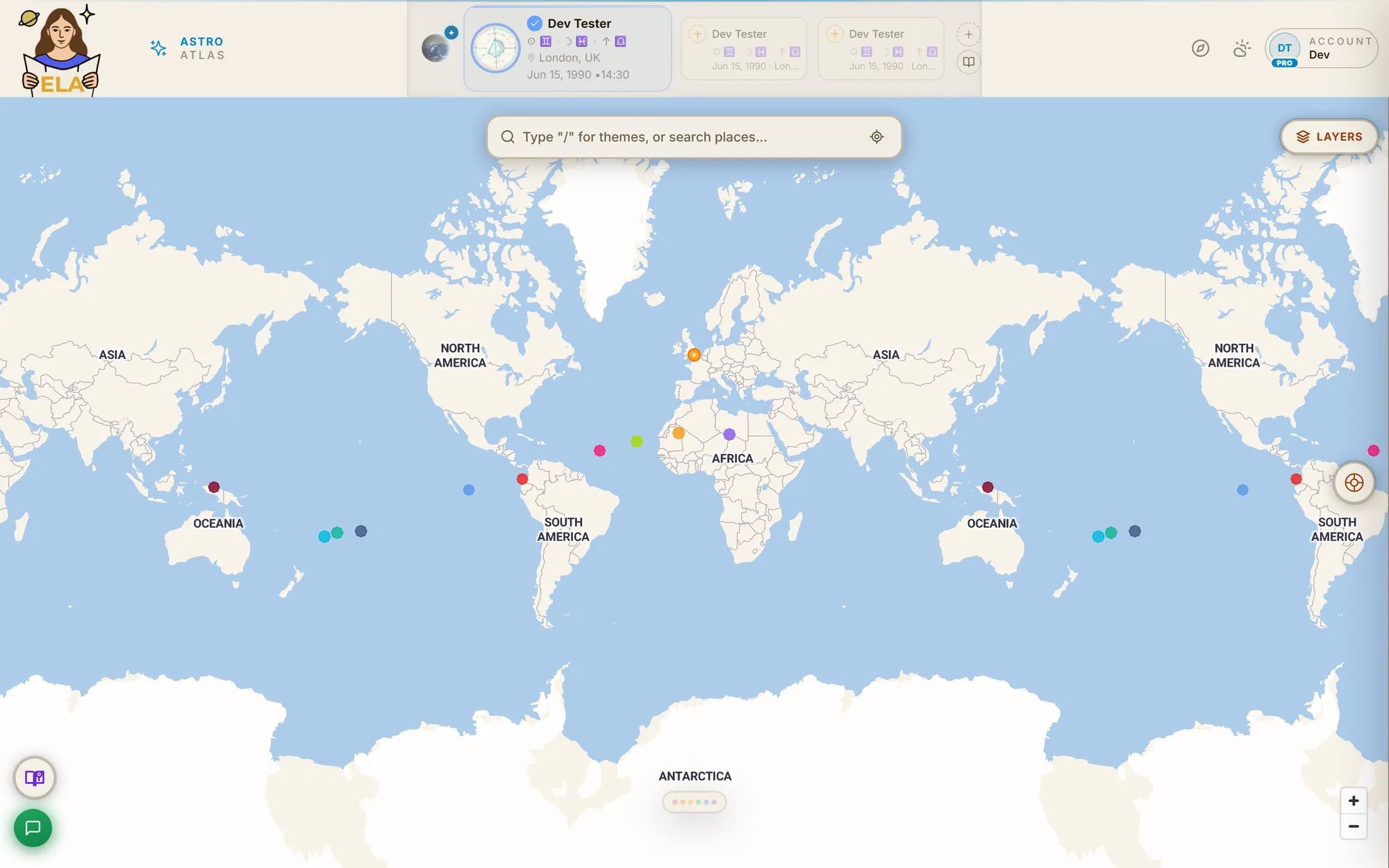
The moment you were born, every planet occupied one exact position in the sky. ELA Map takes that snapshot — your birth chart — and drapes it over the Earth. Each planet becomes a set of colored lines across the globe: the places where it would have been rising on the horizon, setting, directly overhead, or directly underfoot at your moment of birth.
The old name for this practice is astrocartography. The friendly translation: your chart, as geography. A place isn't just a place anymore — it's a place with your Venus running through it, or a thousand miles from anything of yours at all.
One framing to carry with you: the map describes terrain, not verdicts. There are no "good" and "bad" lines — a Saturn line can be exactly the structure a life needs. And nothing here is a prediction or advice. ELA Map is for personal exploration, self-reflection, and entertainment — a mirror, not an oracle.
The three moves
Everything in the app opens from three gestures.
1. Double-click a place you know
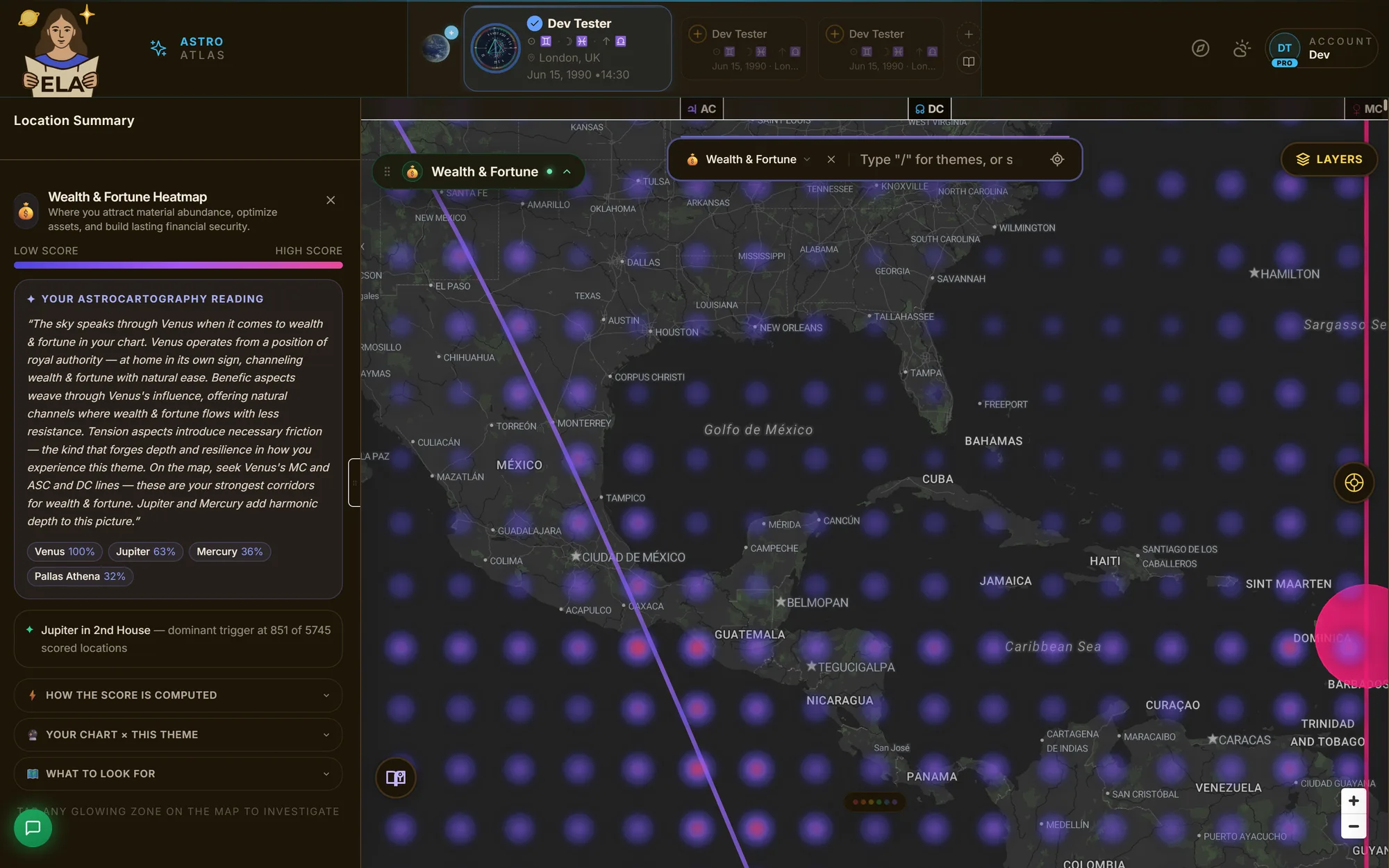
Don't start with somewhere exotic. Start with somewhere you've lived — your hometown, the city you loved, the one that never quite fit. Double-click it (press-and-hold on mobile) and the Location Summary opens: every line near that place, and a personalized reading of what each one means in your chart.
This is the fastest way to learn the language, because you already know the answer. When the map says a place carries your Moon's themes of home and belonging, you can check it against the years you actually spent there. Ground the vocabulary in lived experience first; then point it somewhere new.
2. Turn on the heatmap
Lines are precise; the heatmap is the big picture. Pick a theme — career, relationships, vitality — and the whole world re-colors, brighter where your chart offers more support for that theme. It blends every line, crossing, and angle into one glance. Find it in the layers panel, top right. (The full math is public: see how the heatmap works.)
3. Ask "why?"
Everything on the map can explain itself. Hover a line and a tooltip names it. Tap a name and the reading opens. Every interpretation in ELA Map comes from named, transparent astrological doctrine — assembled from a written corpus, not improvised by an AI. When you want the source, it's always one tap deeper.
Five words you'll meet
- Line — where one planet sat on one of the four angles at your birth, traced across the Earth.
- The four angles — AC rising (how you lead), DC setting (what arrives through others), MC overhead (your public, visible life), IC underfoot (your private, rooted life).
- Crossing — where two of your lines intersect: two planetary themes sharing one location.
- Heatmap — all of it blended into one theme-colored view of the world.
- Human Design Mode — a second lens on the same map using the Human Design system's gates and channels. Find it in your account menu when you're curious; it introduces itself.
Everything else lives in the glossary.
Where to go deeper
When a ten-minute orientation stops being enough:
- Astrocartography: The Complete Beginner's Guide — the full story of the practice, its history, and how to read a map well.
- The meaning of an astrocartography line — every planet, every angle, line by line.
- Human Design Astrocartography — the second system, from zero.
- The data and engine behind ELA Map — why the lines land where they land, computed from research-grade NASA/JPL data.
And if you ever want the guided walkthrough of the interface itself, open your account menu on the map and choose Replay tour.
Start with a place you know. The map gets personal fast.